Legal Battle Between Anthropic, Trump Admin Could Have Major First Amendment Implications, Experts Say
Written by James Lynch
Share this story
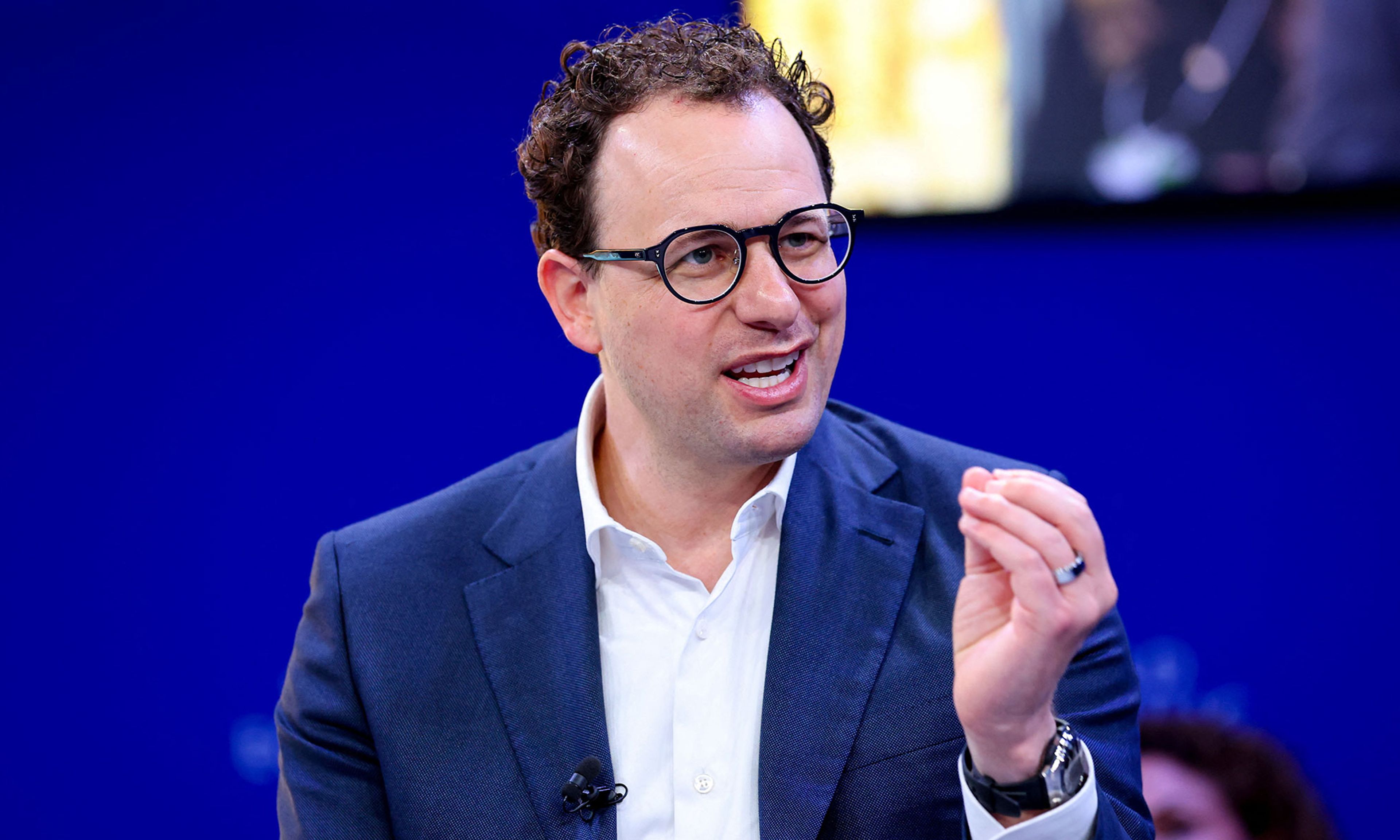
Anthropic CEO and co-founder Dario Amodei speaks during the World Economic Forum in Davos, Switzerland, January 20, 2026.
Artificial intelligence company Anthropic is suing the Trump administration for blacklisting it from Pentagon contracts — a legal dispute that could have significant First Amendment implications, experts say.
Anthropic filed a lawsuit Monday against the Department of Defense and other federal agencies in California after the Pentagon officially labeled the frontier lab a "supply-chain risk" — a designation that blacklists Anthropic from doing business with Pentagon vendors and contractors. Anthropic said the "unlawful" action is already destroying the company to the tune of hundreds of millions of dollars.
"Anthropic’s contracts with the federal government are already being canceled. Current and future contracts with private parties are also in doubt, jeopardizing hundreds of millions of dollars in the near-term," the complaint reads.
"On top of those immediate economic harms, Anthropic’s reputation and core First Amendment freedoms are under attack. Absent judicial relief, those harms will only compound in the weeks and months ahead."
Anthropic is asking a judge to reverse the blacklist and temporarily pause it as the case moves forward. Secretary of Defense Pete Hegseth announced the blacklist of Anthropic in February after the company refused to allow the Pentagon to use Claude for domestic surveillance or fully autonomous weapons without human oversight. The Pentagon demanded Anthropic allow it to use Claude for all lawful purposes, but Anthropic maintained its lines in the sand, preventing the two sides from working out a deal.
Anthropic's case will test the federal government's ability to pressure companies into doing what it wants through the threat of harsh retaliation that goes well beyond the scope of the specific dispute.
"While the courts have been hesitant in the past to question the government’s claims of national security concerns, the circumstances of this case certainly highlight the real risk to the First Amendment rights of Americans if the underlying considerations of such claims are not thoroughly scrutinized," said Jennifer Huddleston, a senior fellow in technology policy at the Cato Institute, a libertarian think-tank.
"The designation and attempts to blacklist the company from other aspects of the government go far beyond the scope of what would be considered least restrictive means even if there are security concerns about the further use of the product," Huddleston said.
The federal government has singled out Anthropic and took action against it that went well beyond its direct relationship with the Pentagon. Hegseth's move followed tense negotiations and a variety of threats from the Pentagon if Anthropic did not bow to the government's pressure. The fight touches on the difficulty of balancing the government's stated national security concerns and the First Amendment, a dilemma with newfound complexity because of artificial intelligence and Anthropic's positions on its deployment.
"Anthropic’s free speech argument is actually ingrained in the larger argument premised on safety and reliability," said Tre Lovell, a prominent attorney specializing in media and the First Amendment. "The dispute between the Defense department and Anthropic centers around usage of its AI in the specific areas of lethal autonomous warfare and massive surveillance of Americans. However, Anthropic relies on the premise that such usage is unsafe, untested and unreliable as opposed to any political ideology towards its use. This would extend beyond arguments of free speech and directly address the actual safety and reliability for such usage, which is a different argument."
“Further, the ability of Anthropic to do business with whomever it wishes is also an expression of the First Amendment [that the] Trump Administration is challenging in its effort to debar Anthropic from working with other areas and entities associated with the government," Lovell added.
In his announcement, Hegseth said "no contractor, supplier, or partner that does business with the United States military may conduct any commercial activity with Anthropic," but the official designation appears to be more narrow in scope. Anthropic clarified that the "vast majority" of its customers are unaffected by the Pentagon's actions, which apply only to the use of Claude as a direct part of Pentagon contracts.
Hegseth's designation of Anthropic is the first time an American company has been hit with the blacklist, a mechanism typically applied to firms linked to foreign adversaries such as Russia and China. Last week, Anthropic confirmed it was officially given the "supply-chain risk" label and said it would take the government to court.
"When the government deploys extraordinary coercive power — particularly when justified on emergency or national security grounds — to punish a company for refusing to bow to the government’s demands, the line between legitimate procurement decisions and unconstitutional retaliation grows dangerously thin," said John Coleman, an attorney at the Foundation for Individual Rights and Expression, a nonpartisan group specializing in First Amendment cases.
Hegseth's move followed a declaration from President Trump that all U.S. agencies will no longer be using Claude. Trump slammed the "Leftwing nutjobs" at Anthropic and said the company was trying to strong-arm the military into abiding by its terms instead of the Constitution. Anthropic CEO Dario Amodei has emphasized his support for the U.S. military equipping Anthropic's technology in order to weaken adversaries and defend the homeland.
"As we stated last Friday, we do not believe, and have never believed, that it is the role of Anthropic or any private company to be involved in operational decision-making—that is the role of the military. Our only concerns have been our exceptions on fully autonomous weapons and mass domestic surveillance, which relate to high-level usage areas, and not operational decision-making," Anthropic reiterated in its most recent statement.
Anthropic's fight with the Department of Defense reverberated widely across the tech industry and marks a new chapter of ongoing debates about AI safeguards. It also reflects Anthropic's unique position as a leading AI innovator and a company that considers AI safety central to its mission.
More broadly, the dispute brought newfound prominence to Claude and caused a surge in app downloads and traffic for the company. The Trump administration's behavior was widely criticized for treating a premier U.S. company like an enemy and attempting to destroy it. Proponents of the move believe tech companies should not be involved with military decision-making, especially when it comes to restricting American war-fighting capabilities.
The Trump administration has given the Pentagon six months to transition away from Claude and to use a different AI model for its classified systems. Claude is considered an industry-leading model and it was the first to be deployed in the military's classified networks. It was used widely throughout national security agencies and the federal government as a whole.
For the time being, the Pentagon appears to be using Claude for its military objectives. The U.S. military used Claude during Operation Epic Fury, the series of U.S.-Israeli strikes that killed Iranian Ayatollah Ali Khamenei and numerous other top officials in the Islamic regime. Regime insiders have elected Khamenei's son to take over the remnants of the regime as the war continues and the world braces for a global energy crisis.
Already, the Department of Defense has agreed to a deal with Open AI, the maker of ChatGPT, to use its model in classified systems. Open AI CEO Sam Altman has experienced backlash from employees over the deal, especially because its ambiguous messaging on whether Open AI would allow the Pentagon to use ChatGPT for all lawful purposes. Altman has attempted to reassure dissatisfied employees about the terms of the agreement and admitted the timing of the deal appeared overly opportunistic.

About the Author
James Lynch is a news writer for National Review. He previously was a reporter for the Daily Caller. He is a graduate of the University of Notre Dame and based in the Washington, D.C. area.
Featured Tags
Advertisement
Advertisement
Comments