Share this story
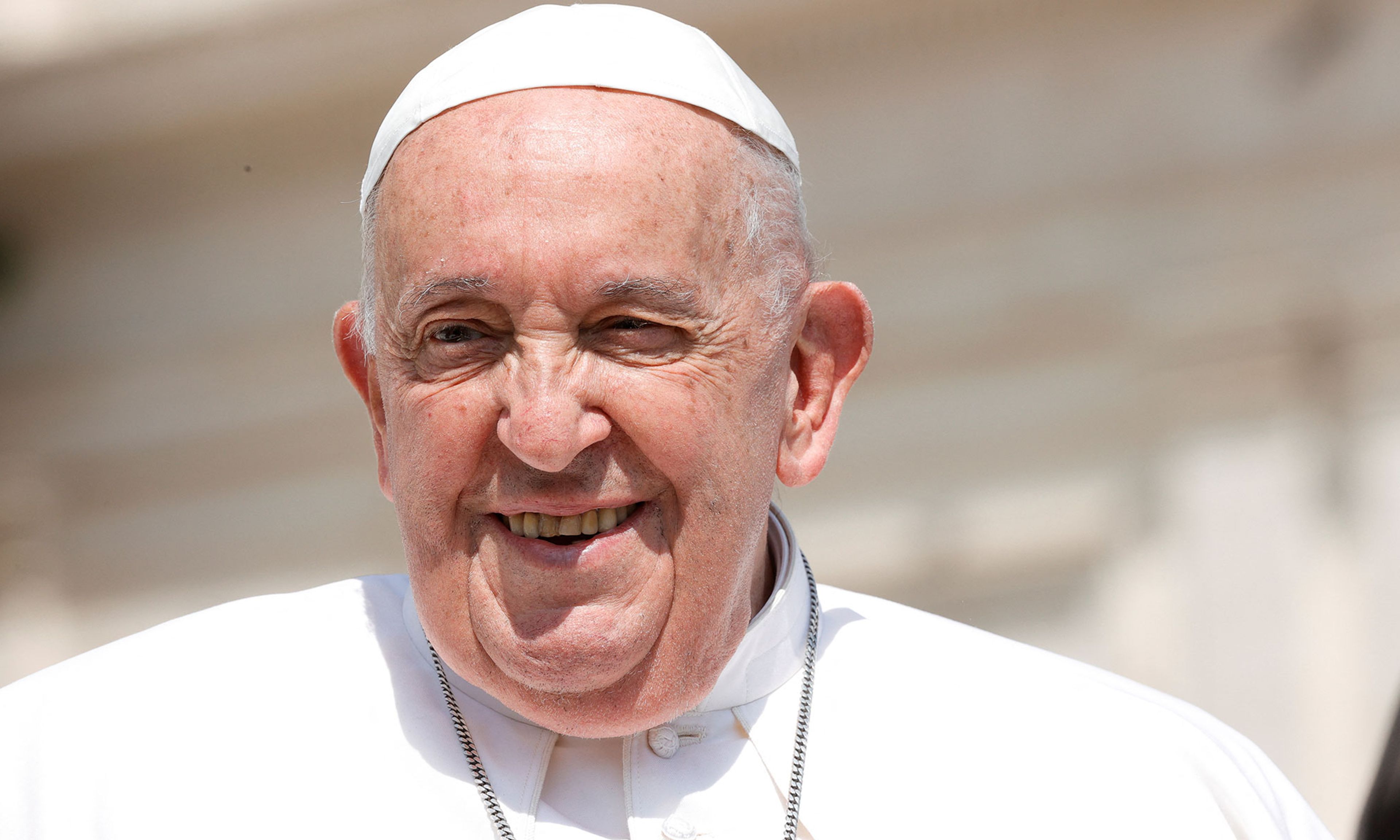
Pope Francis reacts on the day of the weekly general audience in Saint Peter Square at the Vatican, May 15, 2024.
Pope Francis, the head of the Catholic Church and Bishop of Rome, died Monday at 88 after an extended battle with a complex respiratory infection.
The pope, who led the Catholic Church for twelve years, passed away just one day after Easter Sunday when the world's 1.3 billion Catholics celebrated the Resurrection of Jesus Christ. Despite his ongoing health problems, he made several appearances during Holy Week, including a trip to St. Peter's Basilica and a visit with Vice President JD Vance on Sunday.
"Dearest brothers and sisters, with deep sorrow I must announce the death of our Holy Father Francis. At 7:35 this morning, the Bishop of Rome, Francis, returned to the house of the Father. His entire life was dedicated to the service of the Lord and of His Church," Cardinal Kevin Farrell said, announcing the Pope's death as the Vatican's camerlengo. Farrell will temporarily run the Vatican until the Catholic Church elects a new Pope.
"He taught us to live the values of the Gospel with fidelity, courage, and universal love, especially in favor of the poorest and most marginalized. With immense gratitude for his example as a true disciple of the Lord Jesus, we commend the soul of Pope Francis to the infinite merciful love of the One and Triune God."
The Vatican later announced the Pope's cause of death to be a cerebral stroke that caused irreversible heart failure. Bells tolled in the Vatican to mark his passing.
Characteristic of Francis's pontificate, one of his final public appearances came at a prison last week, where he spent time with inmates and prayed for them. Pope Francis briefly appeared on the balcony of St. Peter's Basilica during Easter Sunday to give a blessing, to the delight of the Catholics in attendance. He also boarded the Popemobile to greet crowds in St. Peter's Square for the first time since his hospitalization, which turned out to be his final public appearance.
In his final Easter message, The Pope proclaimed the triumph of Jesus's Resurrection and called for peace around the world, highlighting the wars in Gaza, Ukraine, and parts of Africa, as well as conflicts and instability elsewhere.
"Christ is risen! These words capture the whole meaning of our existence, for we were not made for death but for life. Easter is the celebration of life! God created us for life and wants the human family to rise again! In his eyes, every life is precious! The life of a child in the mother’s womb, as well as the lives of the elderly and the sick, who in more and more countries are looked upon as people to be discarded," the deceased Pope's message reads.
"I would like us to renew our hope that peace is possible! From the Holy Sepulchre, the Church of the Resurrection, where this year Easter is being celebrated by Catholics and Orthodox on the same day, may the light of peace radiate throughout the Holy Land and the entire world."
The late pope's funeral Mass has yet to be announced. In his will, Pope Francis expressed a desire to be buried at the Papal Basilica of St. Mary Maggiore, a reflection of his devotion to Mary, Mother of God.
"I wish my final earthly journey to end precisely in this ancient Marian sanctuary, where I would always stop to pray at the beginning and end of every Apostolic Journey, confidently entrusting my intentions to the Immaculate Mother, and giving thanks for her gentle and maternal care," the Pope said in his spiritual testament, a final message each Pope writes for publication after his death.
His body will be laid into a coffin Monday night, local time. Pope Francis's body is expected to be laid in state at St. Peter's Basilica as soon as Wednesday, giving Catholics the chance to pay their respects.
The Vatican has delayed the highly anticipated canonization of Blessed Carlo Acutis, the soon-to-be first Millennial Saint, because of Pope Francis's death. Acutis died in 2006 of leukemia at age 15 and is best known for using his computer skills to create an online website documenting Eucharistic miracles. His canonization was scheduled for Sunday.
In Rome, Catholics poured into St. Peter's Square to pay tribute to the late pontiff. Many Catholic leaders and world leaders also mourned the pope's death and expressed condolences to all those who loved him.
"Rest in Peace Pope Francis! May God Bless him and all who loved him!" said President Donald Trump.
"I just learned of the passing of Pope Francis. My heart goes out to the millions of Christians all over the world who loved him. I was happy to see him yesterday, though he was obviously very ill. But I’ll always remember him for the below homily he gave in the very early days of COVID. It was really quite beautiful. May God rest his soul," Vance said.
Pope Francis's death comes after a 38-day hospital stay earlier this year that ended in March and saw him on the brink of passing away. Pope Francis had been making brief public appearances again after leaving the hospital, even though he appeared frail and struggled to speak or lift his arms.
"We can never choreograph our own birth or death, can we, that’s always in God’s hands," Cardinal Timothy Dolan, Archbishop of New York, told reporters Monday.
"But if you could choreograph it, you couldn’t have choreographed it any better than what happened. The last time we saw him, Easter Sunday. The last words, 'A blessed Easter,' as he gave us his blessing," Dolan added.
"He renewed for us the mission to bring the Gospel out to the ends of the earth and offer divine mercy to all," said Archbishop Timothy Broglio, president of the U.S. Conference of Catholic Bishops.
"Recently, he expressed anew prayerful hope in his letter of support to the bishops of this country in our attempts to respond to the face of Christ in the migrant, poor, and unborn. In fact, he has always used the strongest and clearest expressions in the defense of the dignity of the human person from conception to natural death."
Pope Francis developed bronchitis and a respiratory infection earlier this year, leading to his hospitalization on February 14 at Rome's Gemelli Hospital. A few days later, the Vatican said he was in critical condition as concerns mounted over the Holy Father's health.
The pope's health took another turn for the worse when he suffered a bronchospasm and experienced vomiting. His lung condition suddenly worsened, requiring mechanical ventilation and fluids to be removed from his lungs. Then, on March 3, Pope Francis had two episodes of acute respiratory insufficiency due to bronchospasm and the accumulation of mucus, the Vatican said. He left the hospital in March after his health slowly improved following those near-death episodes.
When he was hospitalized, the Vatican issued daily updates on the pope's health, a stark contrast from the lack of transparency surrounding the declining health of Pope St. John Paul II two decades ago. Catholics from around the world came together to pray for Pope Francis's recovery and put their trust in God's plan for the direction of the Catholic Church.
Pope Francis struggled with chronic lung problems for most of his life, and began using a wheelchair in 2022 due to knee issues and sciatica. Resignation was never on the table for the late pontiff, despite his repeated health difficulties.
Before his hospitalization, Pope Francis devised a message of hope for this Lent season as Catholics prepared for Easter and continue to celebrate the Jubilee year 2025. He asked Catholics to examine their lives and compare them to the hardship facing refugees and the persecuted worldwide. Throughout his papacy, Pope Francis was a widely recognized international figure among Catholics and the world at large, and made many trips abroad to meet with world leaders.
Pope Francis was considered a reformist leader and occasionally alienated more traditionalist Catholics with his extended outreach to LGBT people and hostility towards the Traditional Latin Mass. The divisions between different factions of the Catholic Church were a constant for Pope Francis's entire tenure.
The late pontiff also faced criticism for a controversial deal he struck with the Chinese Communist Party on the appointment of Catholic bishops in China. The Vatican extended the deal last year despite continued CCP repression towards Catholic clergy and lay Catholics, including pro-democracy businessman and activist Jimmy Lai in Hong Kong.
During his papacy, Pope Francis shepherded the Catholic Church's response to numerous high-profile sexual misconduct scandals involving clergy, especially that of disgraced former Cardinal Theodore McCarrick, who sexually abused adult male seminarians and minors for decades while serving as a prominent church figure. McCarrick died at 94 earlier this month in Missouri.
Pope Francis denounced the death penalty and called for its abolition, revising the Catechism of the Catholic Church to reflect his position. In line with Catholic teachings, the Pope repeatedly lambasted left-wing gender ideology and abortion in harsh terms.
A champion of Church dialogue, Pope Francis oversaw the Synod on Synodality and ratified the gathering's final document last year, a move that was considered unusual. The Synod's final document focused on conversion and lacked major changes that some church reformers were hoping for.
Throughout his pontificate, Pope Francis emphasized assisting the poor, environmental issues and a lax approach to immigration, as shown by his response to Vice President JD Vance, a Catholic convert and proponent of President Trump's mass deportations. Furthermore, Pope Francis pushed for interfaith dialogue and diplomatic solutions to geopolitical issues rather than armed conflict. In recent years, Pope Francis advocated for peace in Ukraine and Gaza, calling Gazan Catholics nightly to express his sympathies.
Pope Francis became pontiff in March 2013 when a papal conclave elected him following the late Pope Benedict XVI's shock resignation. Born Jorge Mario Bergoglio, Pope Francis was the first Pope from the Americas and the first from the Jesuits, a nearly 500-year-old Catholic order known for its global evangelization and educational work. A native of Buenos Aires, Argentina, he was the first pope born outside of Europe since the 8th century.
Pope Francis joined the Jesuits in 1958 after battling pneumonia and almost losing his life. He was ordained a priest in 1969 and became the archbishop of Buenos Aires, Argentina, in 1998. Pope St. John Paul II named Pope Francis a Cardinal in 2001, and he was considered a candidate for the papacy after John Paul II's passing. Upon becoming pope, Francis named himself after St. Francis of Assisi because of his concern for the poor, in what would become a staple of Francis's pontificate.
The College of Cardinals will soon hold a papal conclave to elect Pope Francis's successor. Of the 253 Cardinals, 138 of them will be able to participate in voting for the next successor to St. Peter atop the Catholic Church. Cardinals above the age of 80 are not eligible to vote for the next Pope. No clear frontrunner has emerged.
About the Author
James Lynch is a news writer for National Review. He previously was a reporter for the Daily Caller. He is a graduate of the University of Notre Dame and based in the Washington, D.C. area.
Featured Tags
Advertisement
Advertisement
Comments