Top CIA Official Says 'Economic Security' Deals Could Play Growing Role in Admin’s China Strategy
Written by James Lynch
Share this story
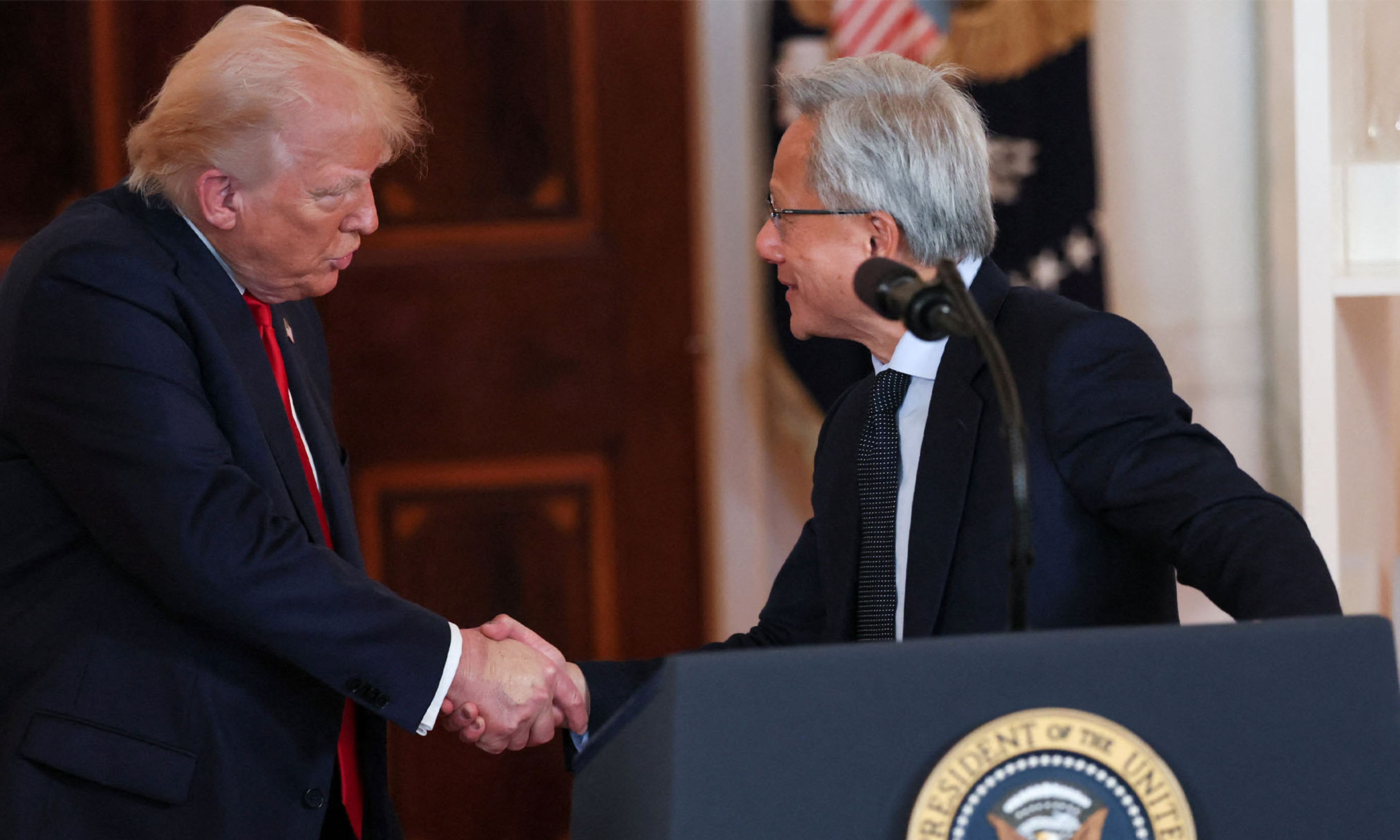
NVIDIA CEO Jensen Huang and President Donald Trump shake hands at an 'Investing in America' event in Washington, D.C., April 30, 2025.
A high-ranking CIA official expects the Trump administration’s China strategy to increasingly feature agreements between the federal government and companies in critical industries.
CIA Deputy Director Michael Ellis said Thursday that the “economic security is national security” understanding of U.S. competition with China, as demonstrated by the Department of Defense’s agreement to purchase a stake in a critical minerals company, will play a larger role in combating China’s control over vital industries.
"I think that there are going to be a whole realm of areas where the mantra that 'economic security is national security' plays a larger and larger role," Ellis said at the Federalist Society’s National Lawyers Convention.
His comments were part of a panel at the Washington, D.C., conference on the Trump administration’s legal priorities.
The Department of Defense became the largest shareholder in MP Minerals in July, purchasing $400 million of the company’s preferred stock. MP Minerals is the only company with an operational rare earth mine in the U.S., despite the importance of rare earth minerals for developing modern military weapons.
Critics likened the Trump administration's direct investment in the company to a state-owned enterprise, the kind of economic solution that socialists routinely propose for promoting certain industries. The Pentagon maintains deep financial ties with the largest U.S. defense contractors, who rely on taxpayers for the lion's share of their annual revenue.
Ellis detailed the terms of the agreement and China’s ability to impose crippling export controls on critical minerals if it chooses to do so. Paired with the export controls is China’s ability to flood the market with lower-priced products to crowd out industry competitors, Ellis warned.
Ellis observed that the Department of Defense is "playing a larger role in the economy" than "has traditionally been the case" in recognition of China’s capabilities and the challenge it poses to U.S. economic interests.
The Trump administration reached a similar deal with leading AI chipmaker Nvidia that allows the company to keep selling chips to China in exchange for the U.S. government getting 15 percent of the revenue.
Nvidia is pushing the Trump administration to allow it to sell advanced AI chips to China, a proposition that U.S. officials squashed ahead of President Trump’s meeting with Chinese leader Xi Jinping last month. The company has also opposed congressional efforts to prioritize American companies in AI chip sales, pitting the chip manufacturer against China hawks.
In the panel discussion, Ellis spoke more broadly about the "existential threat" that China poses to the U.S. and the unique nature of China’s entanglement in global supply chains and the Chinese Communist Party’s ability to coerce businesses.
Earlier this year, Ellis issued a similar warning about China in a May interview with Axios in which he emphasized the importance of ensuring that America maintains its competitive technological edge.
The CIA is developing closer relationships with the private sector to take fuller advantage of corporate America’s efficiency and innovative capacity. During the panel, Ellis noted the CIA’s work with a venture capital firm on its national security investments and the secretive agency’s research and development lab.
He also emphasized that private businesses cannot stand on the sidelines, because China’s fight against the U.S. is an all-fronts conflict, with corporate espionage as part of China’s strategy.
China's push to develop new technological frontiers has been aided by U.S. taxpayer dollars. The Biden administration spent $2.5 billion on collaborative technological research with Chinese Communist Party–linked entities, a move that could have provided China with key national defense capabilities.

About the Author
James Lynch is a news writer for National Review. He previously was a reporter for the Daily Caller. He is a graduate of the University of Notre Dame and based in the Washington, D.C. area.
Featured Tags
Advertisement
Advertisement

Comments