Trump Allies Promised to Make Anti-Redistricting Indiana Republicans Pay. Will They Be Able To?
Written by Audrey Fahlberg
Share this story
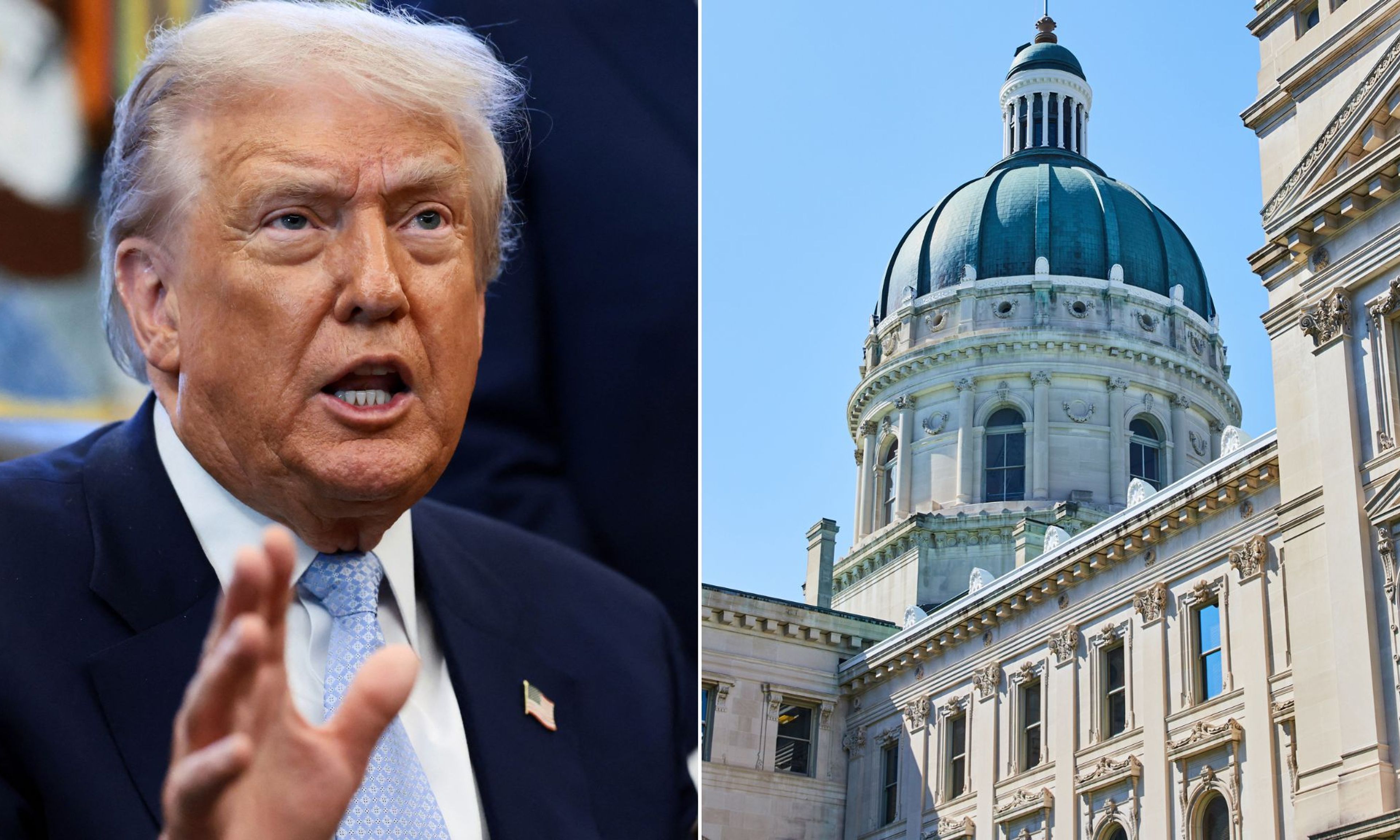
Left: President Donald Trump speaks in the Oval Office at the White House in Washington, D.C., November 17, 2025. Right: View of the Indiana Statehouse in Indianapolis.
Indiana state senators were warned by MAGA forces last year that opposing a Trump-backed mid-decade gerrymander for unified GOP control would come at a steep political cost. Now the time has come for Trump-aligned forces to prove they still have the influence to make good on their threats.
On May 5, the Indiana Republican state legislators who opposed the Trump-backed effort to eliminate Democratic congressional representation in the state late last year will find out whether that fateful vote will cost them their jobs.
Republican groups are joining forces in opposition to oust as many anti-redistricting state legislators as possible through attack ads, primary challengers, and grassroots get-out-the-vote efforts. The groups and politicians pledging to spend heavily to oust anti-redistricting Republicans who joined Democrats in voting down the map include Turning Point Action, the Club for Growth, and spending groups affiliated with the state’s junior U.S. Senator Jim Banks and Governor Mike Braun.
For Trump world, the retribution campaign offers yet another opportunity to remind members of Congress and Republican elected officials nationwide that defying the president still comes at a steep cost.
“The president drew a line, and people crossed it. He’s going to enforce that line,” said Alex Pfeiffer, a former senior Trump White House official and Republican operative.
Judgment day for Hoosier Republicans approaches at a critical moment in Trump’s second term, as the U.S. military commitment in Iran drags on and Americans continue to sour on Trump’s economic performance.
Republicans on the receiving end of this MAGA spending effort are incredulous that Trump allies would engage in an intra-party retribution campaign during a midterm cycle that’s shaping up to be a barn burner for Democrats.
“It is completely irrational if the goal is to maintain a congressional majority, because these funds are a direct distraction from that goal,” says State Senator Spencer Deery, a married father of three who voted against the Trump-backed 9-0 map last year. “Not only is it the millions that they're diverting from that goal, it's also the money that I and my colleagues are raising to compete with that that also then drains funds that are available for a congressional majority.”
MAGA-aligned Republicans counter that the purpose of a political party is to move together to accomplish goals — an ideal that requires party leadership enforcement when dissenters emerge. Spending against anti-redistricting Republicans in this case is “money well spent,” added Pfeiffer, the former Trump official. “If you vote against the president to help Democrats retain power, you should get punished.”
Braun’s decision to ally with the White House in this dispute and the retribution campaign that has followed might have a deleterious effect on his ability to govern, some Republicans warn, depending on next month’s primary results. “It's definitely not healthy for future relationships, and it's going to be interesting to see the aftermath of that,” says Deery, who was targeted in a swatting attempt last year for his vocal opposition to the Trump-backed map.
MAGA’s Indiana-focused retribution campaign comes as both parties’ mid-decade redistricting battles continue to play out nationwide. Trump-backed redistricting efforts have been successful in Texas, North Carolina, and possibly Florida, and Democrats successfully retaliated in California, where voters backed a ballot initiative to redraw the state’s congressional lines through 2030. Virginia voters head to the polls on April 21 to determine whether the state legislature can temporarily wrest redistricting power from the commonwealth’s independent redistricting commission to shift the state’s six-to-five map favoring Democrats to a new map that favors Democrats by a ten-to-one margin.
“Now the votes of Indiana Republicans will matter far less than the votes of Virginia Democrats,” Vice President JD Vance wrote on social media in January. “We told you it would happen, and you did nothing.”
In a move that effectively balanced Indiana Republicans’ rejection of a 9-0 map benefitting their own party, Democrats in Maryland’s state legislature declined to take up a new map that would eliminate Republicans' only congressional seat, largely over Democratic state Senate President Bob Ferguson’s concerns that the aggressive gerrymander would backfire in court.
For some Republicans, this entire episode is yet another case study in how Trumpian politics differ from the GOP’s traditional methods, from his expansive use of executive power to his lack of reverence for countermajoritarian institutions like the filibuster.
Trump’s norm-busting approach offends many of his Republican critics at the state level on principle — but many of them also believe it’s politically self-defeating. As the anti-redistricting GOP camp tells it, mid-decade redistricting misunderstands affordability-focused voter sentiment on the ground, corrodes institutions, caves to out-of-state interests, and deteriorates the federalist principles around which conservatives traditionally rally.
Not that there’s any sympathy for those arguments in Trump world. “Listen, they have to answer to their own constituents, and the people overwhelmingly support President Trump and his efforts,” Republican National Committee Chairman Joe Gruters told NR in a recent interview. “This is a case of Republican officials thinking that they know better than the president and others, and they were asleep at the wheel.”
“We're not engaged” in the spending effort, Gruters added. “But they're going to have to answer to their own voters, and my guess is the voters are overwhelmingly going to side with the president, and I would say that they're in big trouble.”

About the Author
Audrey Fahlberg was a politics reporter for National Review.
Featured Tags
Advertisement
Advertisement


Comments