Trump Claims Link Between Tylenol Use During Pregnancy and Autism. Here's What the Evidence Says
Written by James Lynch
Share this story
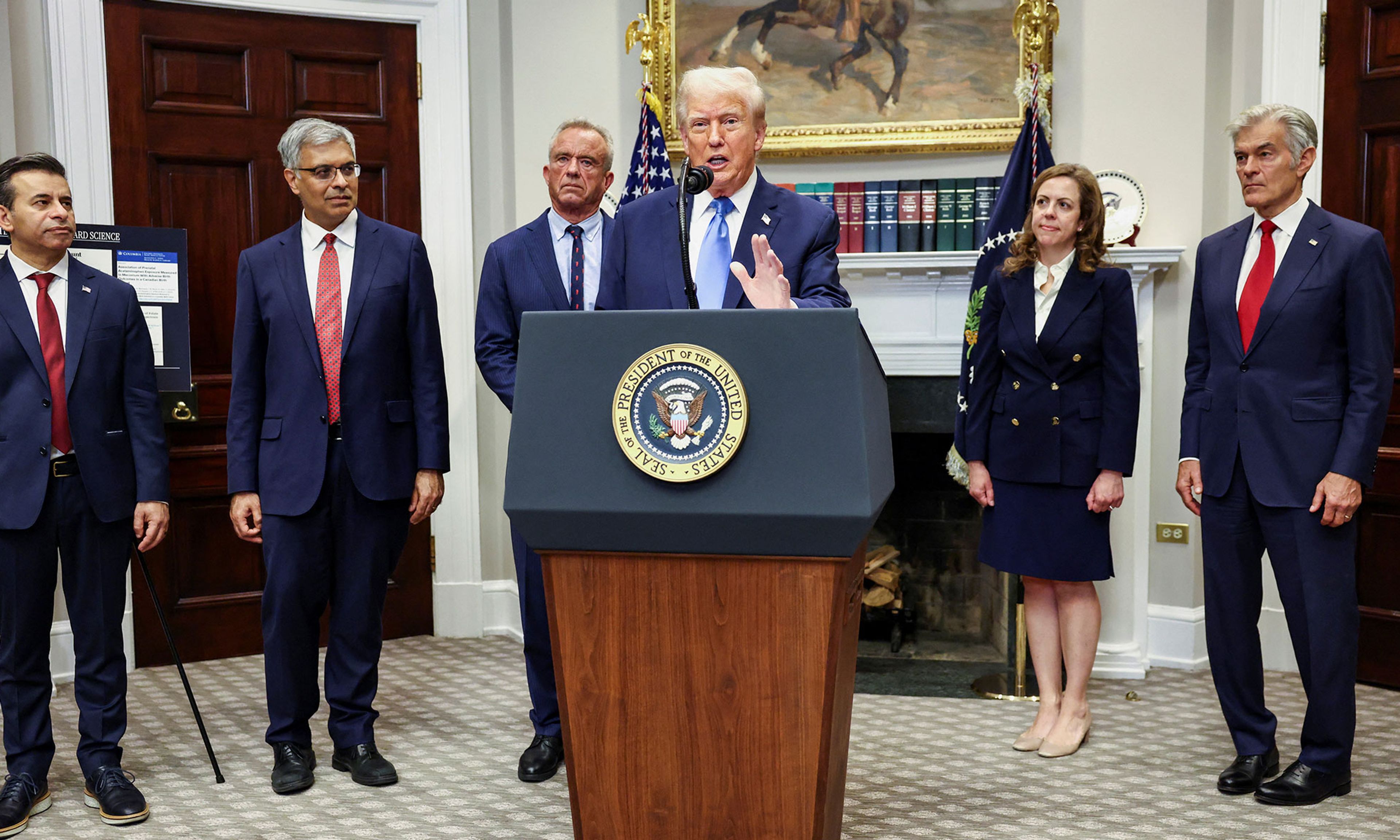
President Donald Trump makes an announcement at the White House in Washington, D.C., joined by (from left) FDA Commissioner Dr. Marty Makary, NIH Director Jay Bhattacharya, Secretary of Health and Human Services Robert F. Kennedy Jr., and Administrator of the Centers for Medicare and Medicaid Services Mehmet Oz (at right), September 22, 2025.
President Donald Trump announced Monday a link between Tylenol usage during pregnancy and autism, a claim that the medication's maker fiercely disputes.
The Trump administration is releasing new guidance advising pregnant women against acetaminophen unless they have a fever. Tylenol is the brand name for acetaminophen, an over-the-counter medication commonly used for pain relief and common sicknesses like cold and fever.
Trump made the announcement alongside Health and Human Services Secretary Robert F. Kennedy Jr., Food and Drug Administration Commissioner Dr. Marty Makary, National Institutes of Health Director Dr. Jay Bhattacharya, and Centers for Medicare and Medicaid Services Administrator Dr. Oz.
Kennedy framed the move as part of an "all-agency effort" to identify the reasons for the increasing prevalence of autism. He considers autism a "cataclysmic" epidemic and emphasized the Trump administration's continued efforts to investigate the causes of it. Without naming specific studies, Kennedy referenced a "potential association" between acetaminophen and autism.
Makary did list three specific studies linking acetaminophen intake during pregnancy to autism. Two of them were from 2019, the Boston Birth Cohort study of 996 mother-infant pairs and the Nurses Cohort II study of nearly 9,000 children, found a connection between acetaminophen use and impaired neurodevelopment.
The third study Makary referenced was publicized in August by researchers at the Icahn School of Medicine at Mount Sinai. Their research found that prenatal exposure to acetaminophen may increase the risk of a child having neurodevelopmental disorders, including autism.
"Our findings show that higher-quality studies are more likely to show a link between prenatal acetaminophen exposure and increased risks of autism and ADHD," said Dr. Diddier Prada, an assistant professor at Mount Sinai.
The paper does not show acetaminophen directly causes neurological disorders. But it does strengthen the evidence of a connection and it calls for the cautious use of acetaminophen during pregnancy.
The results of those papers differ from the most comprehensive study on acetaminophen use and neurological disorders. A paper published in JAMA last year found that the evidence of increased autism or other intellectual disabilities from acetaminophen usage disappears once researchers controlled for confounding variables by examining sibling pairs. The researchers examined nearly 2.5 million children born in Sweden between 1995 and 2019, with follow up through December 2021. Their results results suggest confounding factors — such as the possibility that women suffering from discomfort during pregnancy, prompting increased acetaminophen use — may have health problems that correlate with their child having autism.
Trump's announcement is the first time the U.S. government has linked Tylenol to autism in any capacity. Kenvue, the maker of Tylenol, strongly disputed the Trump administration's findings and said it was the safest pregnancy reliever for pregnant women.
"We believe independent, sound science clearly shows that taking acetaminophen does not cause autism. We strongly disagree with any suggestion otherwise and are deeply concerned with the health risk this poses for expecting mothers," a company spokesperson said in a statement. "Acetaminophen is the safest pain reliever option for pregnant women as needed throughout their entire pregnancy. Without it, women face dangerous choices: suffer through conditions like fever that are potentially harmful to both mom and baby or use riskier alternatives."
Several medical organizations have issued statements this month endorsing the safety of acetaminophen during pregnancy. The Society of Obstetricians and Gynaecologists of Canada, American College of Obstetricians and Gynecologists, Society for Maternal-Fetal Medicine, and Autism Science Foundation have all said there is no clear evidence linking acetaminophen use during pregnancy to autism in children. They each released statements ahead of the Trump administration's expected announcement.
As of Monday, the Food and Drug administration's webpage on acetaminophen says it "has not found clear evidence that appropriate use of acetaminophen during pregnancy causes adverse pregnancy, birth, neurobehavioral, or developmental outcomes," but the agency does recommend pregnant women consult with doctors before using any medicine.
The FDA is going to issue a physician's notice and a safety label change for acetaminophen use during pregnancy. Makary also said the FDA will be sending a letter to all doctors about its decision.
Kennedy said HHS will be launching a public awareness campaign to inform families and encouraged clinicians to use their best judgement in advising pregnant women considering acetaminophen use for pain and fever.
The announcement came after Trump previewed it Sunday during the memorial service for the late conservative activist Charlie Kirk. The president touted it as "an answer to autism" and said Monday was going to be one of the most important press conferences of his career.
In addition, the Trump administration is promoting leucovorin as a potential treatment for autism patients. Leucovorin is used to mitigate the side effects of certain chemotherapy drugs and it can treat anemia.
Kennedy has long sounded the alarm about the rise of autism over the past several decades. One out of every 31 children aged 8 have autism, according to the latest Centers for Disease Control data. It marks a sharp increase from 2000, when one out of every 150 children were diagnosed with autism.
Autism is a neurological condition that impacts social awareness and communications skills beginning in childhood. Autistic people have also been shown to struggle with learning and develop fixations on certain objects or activities. Due to its range of symptoms, autism is placed on a spectrum from mild to debilitating cases that make basic functions difficult.
Kennedy routinely promotes the discredited claim linking childhood vaccination to autism. He suggested at the press conference that the Trump administration will keep researching vaccines and a possible connection to autism. Bhattacharya said Monday that the Trump administration is spending an extra $50 million on autism research with a focus on genetic and environmental factors.
Researchers have attributed the rise in autism to a variety of causes including a greater ability to diagnose children and parents having children later in life. Investigating the rise of autism is one of Kennedy's top priorities at HHS and it is part of his broader Make America Healthy Again agenda. Trump has allowed Kennedy to run "wild" at HHS and push his MAHA priorities at the state and national level.

About the Author
James Lynch is a news writer for National Review. He previously was a reporter for the Daily Caller. He is a graduate of the University of Notre Dame and based in the Washington, D.C. area.
Featured Tags
Advertisement
Advertisement



Comments