Hegseth Blacklists Anthropic after Trump Orders Federal Agencies to Stop Using Its Technology
Written by James Lynch
Share this story
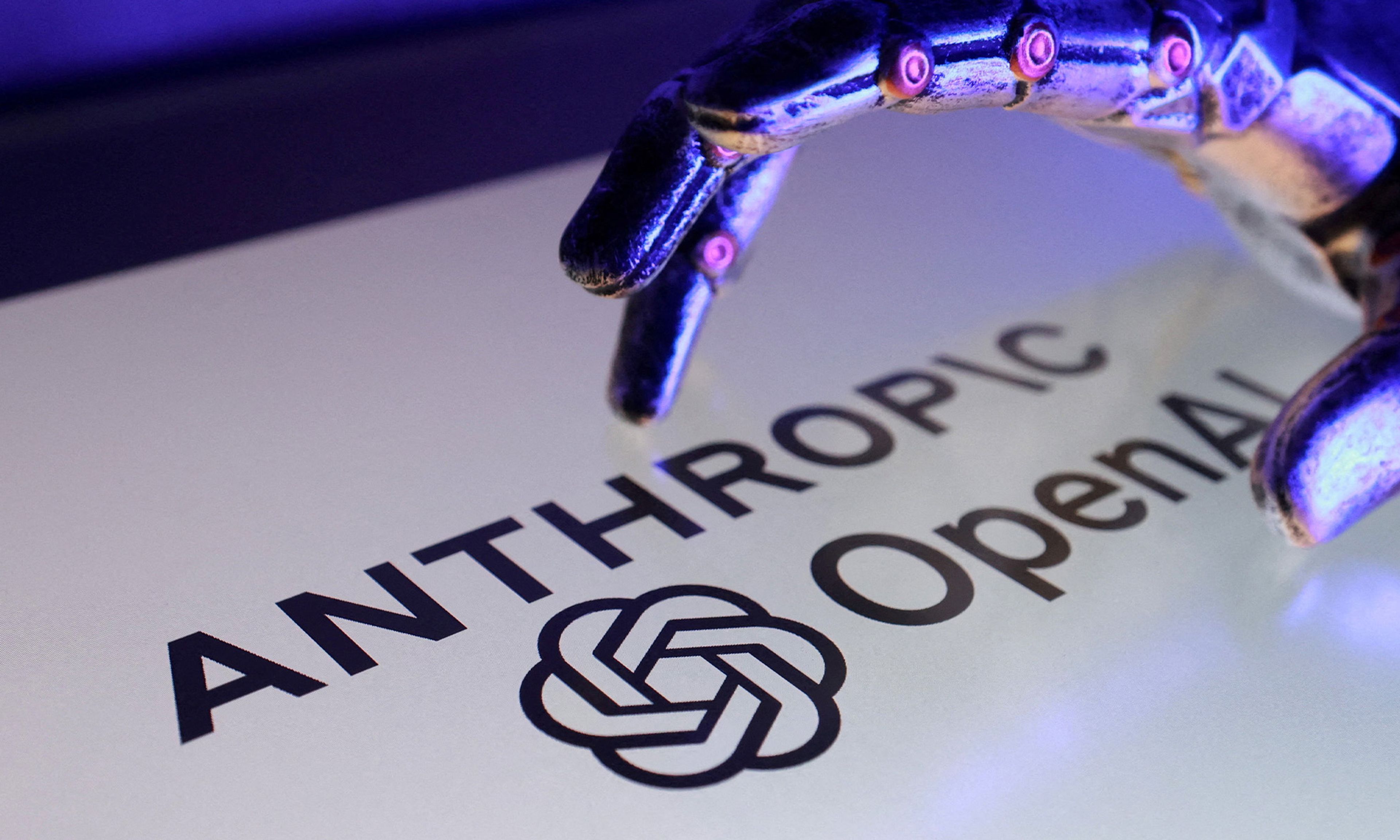
Open AI and Anthropic logos are seen in this illustration created on September 12, 2025.
Secretary of Defense Pete Hegseth and President Trump are escalating the U.S. government's feud with Anthropic over the company's refusal to allow the Pentagon to use its AI technology for domestic surveillance and fully autonomous weapons.
Trump is ordering federal agencies to immediately stop using Anthropic's technology, with the exception of the Department of Defense, which will have a six-month phase-out period to integrate another model into its most sensitive systems.
"The Leftwing nut jobs at Anthropic have made a DISASTROUS MISTAKE trying to STRONG-ARM the Department of War, and force them to obey their Terms of Service instead of our Constitution. Their selfishness is putting AMERICAN LIVES at risk, our Troops in danger, and our National Security in JEOPARDY," Trump posted on Truth Social.
"Therefore, I am directing EVERY Federal Agency in the United States Government to IMMEDIATELY CEASE all use of Anthropic’s technology. We don’t need it, we don’t want it, and will not do business with them again!"
Trump's announcement follows a statement from Anthropic CEO Dario Amodei rejecting the Pentagon's demands for Anthropic to allow its industry-leading AI model Claude to be equipped for domestic surveillance and fully autonomous weaponry. Amodei's decision to draw a firm line in the sand reverberated widely across the industry, especially because of the Trump administration's threats to either blacklist Anthropic or coerce it into adapting Claude to fit the Pentagon's needs.
"Regardless, these threats do not change our position: we cannot in good conscience accede to their request," Amodei said.
"It is the Department’s prerogative to select contractors most aligned with their vision. But given the substantial value that Anthropic’s technology provides to our armed forces, we hope they reconsider. Our strong preference is to continue to serve the Department and our warfighters—with our two requested safeguards in place."
Shortly thereafter, Hegseth announced he will be designating Anthropic a "supply-chain risk," a move that effectively blacklists Anthropic by preventing any company doing business with the U.S. military from partnering with Anthropic. The blacklist is usually reserved for firms linked to foreign adversaries that pose a national-security risk to U.S. interests. Placing the "supply-chain risk" designation onto Anthropic is unprecedented and will likely generate enormous losses for a company at the forefront of AI innovation.
"Anthropic’s stance is fundamentally incompatible with American principles. Their relationship with the United States Armed Forces and the Federal Government has therefore been permanently altered. In conjunction with the President's directive for the Federal Government to cease all use of Anthropic's technology, I am directing the Department of War to designate Anthropic a Supply-Chain Risk to National Security," Hegseth said.
"Effective immediately, no contractor, supplier, or partner that does business with the United States military may conduct any commercial activity with Anthropic."
Hegseth's move was something the administration threatened to do during its negotiations with Anthropic. Alternatively, the administration had threatened to invoke the Defense Production Act to force Anthropic to adapt Claude to fit the Pentagon's demands. Moreover, Hegseth reiterated the Pentagon's position that it should have the unrestrained ability to use Claude for all lawful means. He argued Amodei was prioritizing virtue-signaling over American military capabilities and putting troops in harms way by doing so.
Hegseth made sure to note his decision was final and said Anthropic will not provide its services to the Department of Defense for more than the next six months. It is not yet known if Anthropic will pursue legal challenges to Hegseth and Trump's latest moves.
Trump threatened civil and criminal penalties against Anthropic if the company does not comply with the terms of the six month phase-out. Amodei said in his statement that Anthropic would cooperate with the U.S. government on a transition plan if need be.
The Pentagon has a new contract to use Grok, the model created by Elon Musk's xAI, in classified settings, but it is unclear if Grok will be able to fully replace Claude. Anthropic's model was the first one to be used in the military's classified systems and it is deployed across national-security agencies. Through its partnership with Palantir, Claude contributed to the U.S. government's successful operation to capture socialist Venezuelan dictator Nicolas Maduro in January.
A top Pentagon official responded to Amodei's statement yesterday by accusing him of having a god complex and dismissing the possibility the Trump administration would engage in domestic surveillance.
"Anthropic is lying. The @DeptofWar doesn’t do mass surveillance as that is already illegal. What we are talking about is allowing our warfighters to use AI without having to call @DarioAmodei for permission to shoot down an enemy drone swarms that would kill Americans," Under Secretary of War for Research and Engineering Emil Michael said in one of several social media posts attacking Anthropic and Amodei.
Anthropic is simultaneously an industry leader during an economy-wide AI boom, and a company that advocates for AI guardrails. Amodei himself has repeatedly warned of the potential downsides of widespread AI adoption without proper remedies. His latest decision garnered praise from proponents of AI safeguards, some of whom have called for congressional investigations into the Pentagon's behavior.
"Fully autonomous weapons systems and Orwellian AI-enabled domestic mass surveillance are affronts to our dignity and liberty. We highly commend Anthropic, OpenAI and leading researchers from across AI companies for standing up for the principle that AI should never be used to kill people without meaningful human control, and that domestic mass surveillance of US citizens is a red line that should never be crossed," said Max Tegmark, founder of the Future of Life Institute, an AI policy organization that advocates for greater regulation.
"We call on all AI companies to follow suit. However, our safety and basic rights must not be at the mercy of a company's internal policy; lawmakers must work to codify these overwhelmingly popular red lines into law."
Anthropic has taken steps to prevent minors from using Claude, a move that proved prescient when some of its competitors faced lawsuits over disturbing patterns of AI chatbot behavior. Additionally, Anthropic has pushed for export controls and severed tied with firms linked to the Chinese Communist Party in order to prevent China from taking advantage of advanced American AI technology.
Open AI, a main competitor to Anthropic known for creating ChatGPT, sought to remedy the standoff between Anthropic and the U.S. government. Open AI CEO Sam Altman told staff Thursday the firm was negotiating with the Department of Defense to integrate Open AI's model into classified systems with similar safeguards to Anthropic's, the Wall Street Journal first reported.
Top senators working on defense policy and appropriations also urged the Pentagon to resolve its dispute with Anthropic, Axios first reported. Senate Armed Services Committee chairman Roger Wicker (R., Miss.) and ranking member Jack Reed (D., R.I.), alongside Defense Appropriations chair Mitch McConnell (R., Ky.) and ranking member Chris Coons (D., Del.), sent the two sides a letter asking them to sort out the dispute. It remains to be seen whether congressional lawmakers will step in and seek a legislative remedy to put the situation to bed.

About the Author
James Lynch is a news writer for National Review. He previously was a reporter for the Daily Caller. He is a graduate of the University of Notre Dame and based in the Washington, D.C. area.
Featured Tags
Advertisement
Advertisement


Comments