Trump Signs Executive Order to Challenge State AI Regulations in Major Tech Industry Victory
Written by James Lynch
Share this story
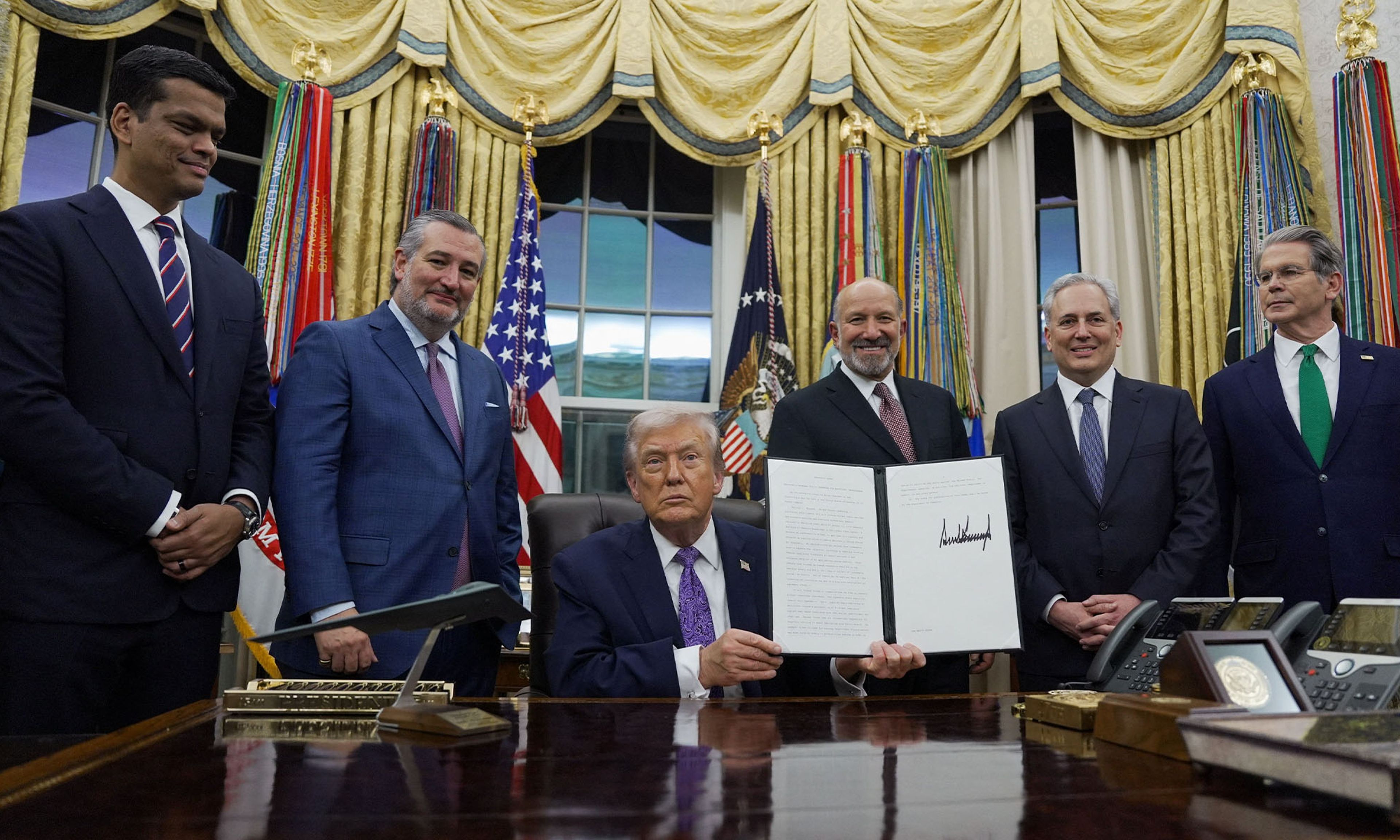
President Donald Trump shows a signed executive order on AI next to Sriram Krishnan, Senate Commerce Committee Chairman Ted Cruz (R., Texas), Commerce Secretary Howard Lutnick, David O. Sacks, and Treasury Secretary Scott Bessent, in the Oval Office at the White House in Washington, D.C., December 11, 2025.
President Trump signed an executive order Thursday challenging state regulations on artificial intelligence, a major win for the tech industry and allies who are opposed to what they consider a complex patchwork of state-level AI laws.
Trump's executive order articulates the need for a "minimally burdensome" federal standard for AI regulation rather than 50 different regulatory regimes created by each state. Until a national AI framework exists, the Trump administration will fight cumbersome state AI regulations through potential litigation and withholding federal funds.
When signing the executive order, Trump emphasized the need for the U.S. to outcompete China when it comes to AI innovation. He was surrounded by administration officials and Senator Ted Cruz (R., Texas), chairman of the Senate Commerce Committee.
"It's really the biggest industry that anybody's seen," Trump said. "We have to be unified. China is unified," he added.
Trump's directive instructs Attorney General Pam Bondi to create an AI litigation task force to challenge burdensome state AI regulations on interstate commerce grounds. He is asking Commerce Secretary Howard Lutnick to identify stringent state-level AI regulations and publish an evaluation of them. Trump is also empowering Lutnick to potentially withhold federal broadband funding from states with stringent AI regulations.
Trump's AI executive order closely resembles a draft order that circulated in November during the unsuccessful, Trump-backed congressional push to pass a law pre-empting state AI regulations with a federal standard. Ahead of Trump's executive order, other draft executive orders circulated within the administration that focused on human flourishing and "woke" AI.
"We've got 50 states running in 50 different directions. It just doesn't make sense. We're creating a confusing patchwork of regulation. What we need is a single federal standard," said Trump's AI and crypto czar David Sacks, a venture capitalist and tech industry ally.
Sacks stated the administration's intention to work with Congress in creating a federal standard, as the executive order lays out. As chairman of the Senate Commerce Committee, Cruz will play an essential role in developing any kind of AI legislation. Cruz is a proponent of the free-market and supports a light regulatory regime for AI.
"President Trump took an important step today to promote American leadership in AI. We don’t want China’s values of surveillance and communist control governing AI. We want American values of free speech, individual liberty, and respect for the individual," Cruz said on social media. He made similar comments at the signing ceremony.
Supporters of a soft regulatory approach to AI praised Trump's executive order for taking steps to promote a national framework and bring clarity to the AI regulatory landscape.
"Ultimately, the EO properly acknowledges that while states have a vital role in addressing certain concrete harms, it is the federal government that is charged with safeguarding national priorities in technologies that operate at global scale. The EO is a meaningful step toward clarity and coherence. Now Congress must finish the job," said Neil Chilson, head of AI policy at the Abundance Institute, a pro-innovation think tank.
Advocates for AI safety roundly criticized Trump's executive order for caving to the tech industry at the behest of Sacks. Republicans and Democrats alike have criticized the possibility of pre-empting state AI regulations with a federal standard.
"This coercive executive order violates the very principles of federalism, punishes responsible innovation, and threatens the freedom of states to govern as they see fit," said Brendan Steinhauser, CEO of the Alliance for Secure AI and a longtime Republican strategist.
"By silencing local authority through fear and manipulation, Sacks and his clique of tech bros are obstructing justice and undercutting America’s ability to maintain AI dominance on the global stage."
About the Author
James Lynch is a news writer for National Review. He previously was a reporter for the Daily Caller. He is a graduate of the University of Notre Dame and based in the Washington, D.C. area.
Featured Tags
Advertisement
Advertisement

Comments