Trump to Meet with Putin in Alaska Next Friday to Discuss Ending War in Ukraine
Written by John R. Puri
Share this story
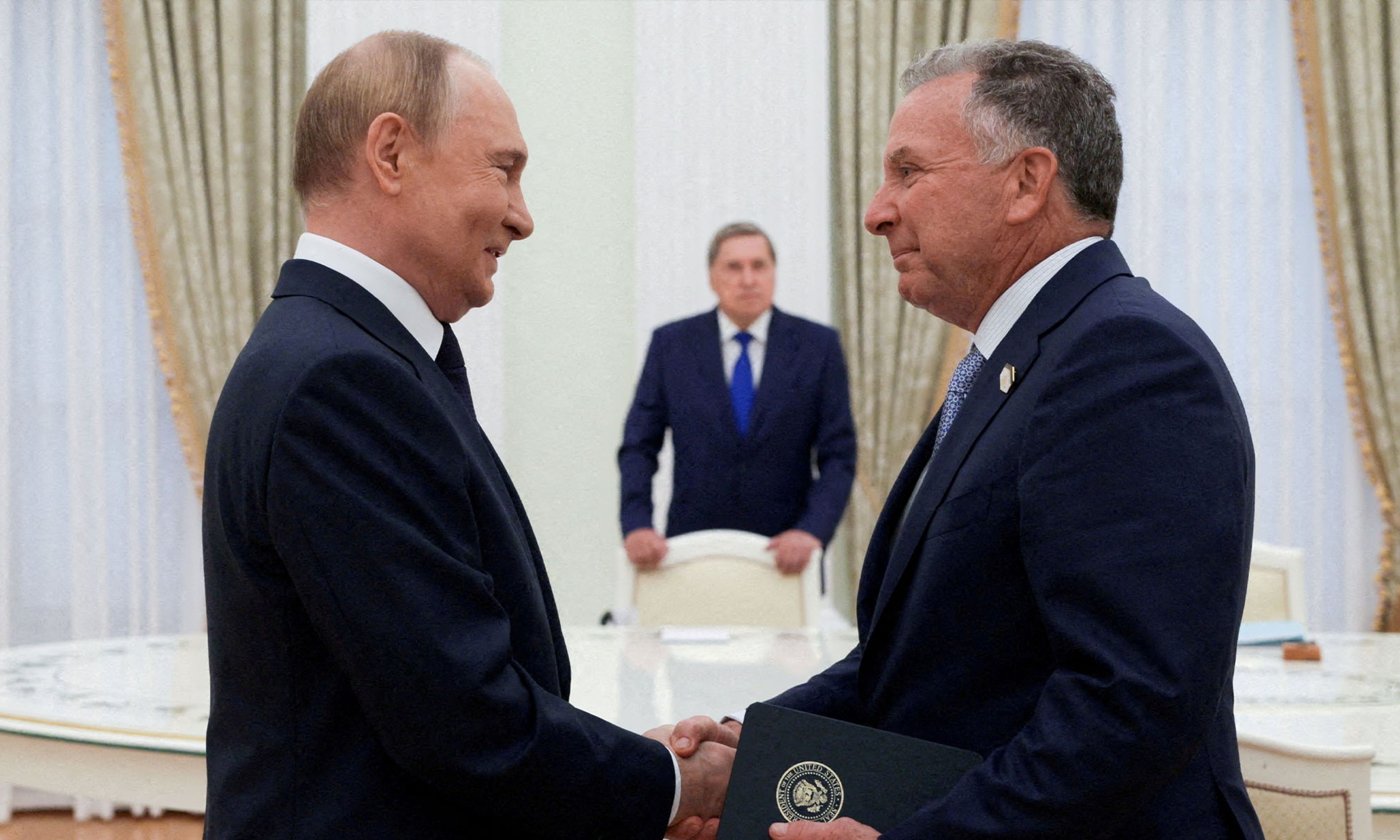
Russian President Vladimir Putin welcomes President Donald Trump's envoy Steve Witkoff during a meeting in Moscow, Russia August 6, 2025.
President Trump announced on Friday that he would meet with Russian President Vladimir Putin on August 15 to discuss ending Russia's war in Ukraine. He did not disclose additional details.
Trump posted on Truth Social, "The highly anticipated meeting between myself, as President of the United States of America, and President Vladimir Putin, of Russia, will take place next Friday, August 15, 2025, in the Great State of Alaska. Further details to follow. Thank you for your attention to this matter!"
The president had previously set a ten-day deadline, arriving today, for Russia to agree to a cease-fire in Ukraine. If it did not do so, Trump had threatened to punish the country with additional sanctions and tariffs. Those threats included secondary tariffs of 100 percent on countries doing business with Russia, such as India.
Steve Witkoff, Trump's special envoy to the Middle East, met with Vladimir Putin in Moscow for three hours on the deadline day. Trump posted that the two men's conversation had been "extremely productive," but later said the meeting did not constitute a breakthrough in negotiations. A Kremlin aide called the talks "useful and constructive."
At the meeting, Putin reportedly presented Witkoff with a sweeping cease-fire proposal that would cement most of Russia's territorial gains in Ukraine. Putin said he would agree to a cease-fire if Ukraine withdrew its forces from all of Ukraine’s eastern Donetsk region. That would leave Russia in control of the Donetsk and Luhansk regions that it has largely captured since invading Ukraine in 2022, as well as the Crimean peninsula, which Russia annexed in 2014.
Although Russian forces occupy Donetsk and Luhansk, Ukraine still controls sizable chunks of territory in the eastern part of the country, including key cities it uses as defensive strongholds.
According to Witkoff's conversations with European officials, Putin's proposal includes two phases. The first phase would freeze battle lines in place and require Ukraine to withdraw troops from Donetsk. A second phase would entail Trump and Putin agreeing on a final peace plan, which would then be taken to Ukrainian President Volodymyr Zelensky for further negotiation.
European officials have expressed serious concerns with Putin's proposal, noting that it would require Ukraine to cede control of the Donbas region to Russia without Russia committing to any actions other than a pause in fighting. They also fear the cease-fire offer is merely a ploy by Putin to avoid sanctions and tariffs by negotiating in bad faith while continuing the war.
Many aspects of the cease-fire proposal are still unclear, prompting a diplomatic scramble by European allies to learn more details.
The White House declined to release further details. Press Secretary Karoline Leavitt said, “Out of respect for our sensitive diplomatic discussions with Russia, Ukraine, and our European allies, the White House won’t comment on alleged details in the news media.”
Zelensky has so far refused to negotiate territorial issues if Russia agreed to a full and unconditional cease-fire. Putin's demand that Ukraine withdraw from Donetsk in exchange for a cease-fire contradicts that commitment. Ukraine has also emphatically stressed the need for Western security guarantees in any peace deal to help defend against future Russian attacks.
Russia's newest proposal does not address Western security guarantees for Ukraine, nor does it address the country's prospects for NATO membership. Instead, it includes an assurance by Putin that his government would pass a law pledging not to attack Ukraine or Europe. European officials are deeply skeptical of this offer.
Public opinion in Ukraine has shifted dramatically toward favoring a negotiated end to the war in the years since Russia invaded. Ukrainians have become increasingly open to conceding some territory as part of a settlement, with a smaller share of the country's population viewing victory as Ukraine regaining all territory seized by Russia since 2014.
Still, significant political obstacles remain to Ukraine ceding territory to Russia in a peace agreement. The Ukrainian constitution bars President Zelensky from authorizing territorial changes unilaterally, and European and Ukrainian officials oppose diplomatically recognizing Russian control over territory it captured by force.
Putin, meanwhile, has aggressively pushed for global recognition of Russia's claims to Ukrainian territory in negotiations with the United States. His cease-fire proposal could now shift pressure onto Ukraine to offer concessions in pursuit of an agreement.
Russia has ramped up its long-range attacks against Ukraine in recent weeks and months, more than doubling the number of missiles and drones it has launched into Ukraine since Trump's inauguration on January 20. It has targeted residential areas and critical infrastructure, including energy facilities and hospitals, causing significant damage and casualties.
Some leaders in Europe, such as Polish Prime Minister Donald Tusk, are cautiously optimistic that Putin's cease-fire proposal could begin the process to halt fighting in Ukraine. "Perhaps a freezing of the conflict — I don’t want to say the end of the war, but a freezing of the conflict — could happen sooner rather than later," he said on Friday. Tusk remarked that Zelensky, too, was "very cautious but optimistic."
About the Author
John R. Puri is the Thomas L. Rhodes Fellow at National Review.
Featured Tags
Advertisement
Advertisement

Comments