Trump Says U.S. Will ‘Run’ Venezuela Until Transition, After Maduro Captured
Written by Jack Crowe & Kamden Mulder
Share this story
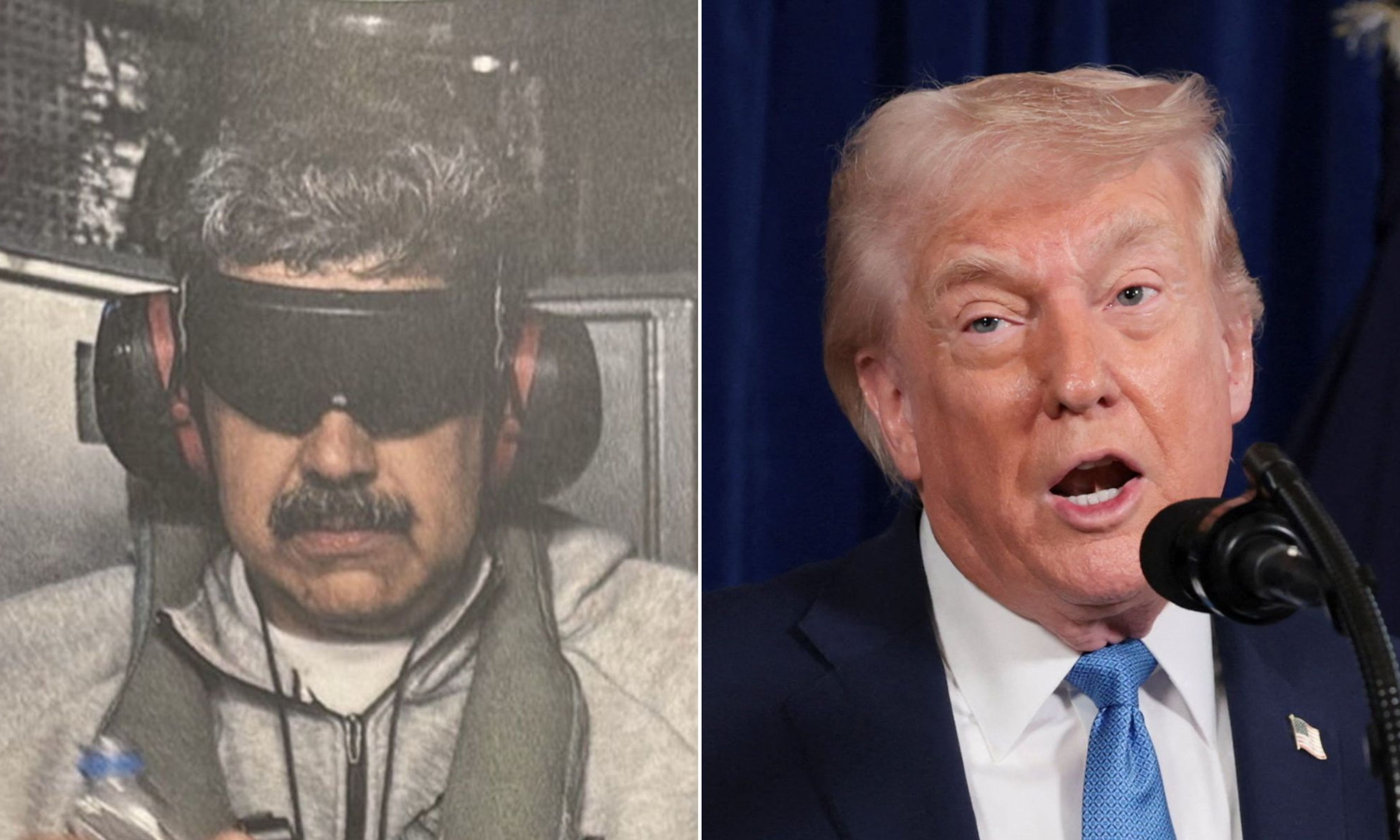
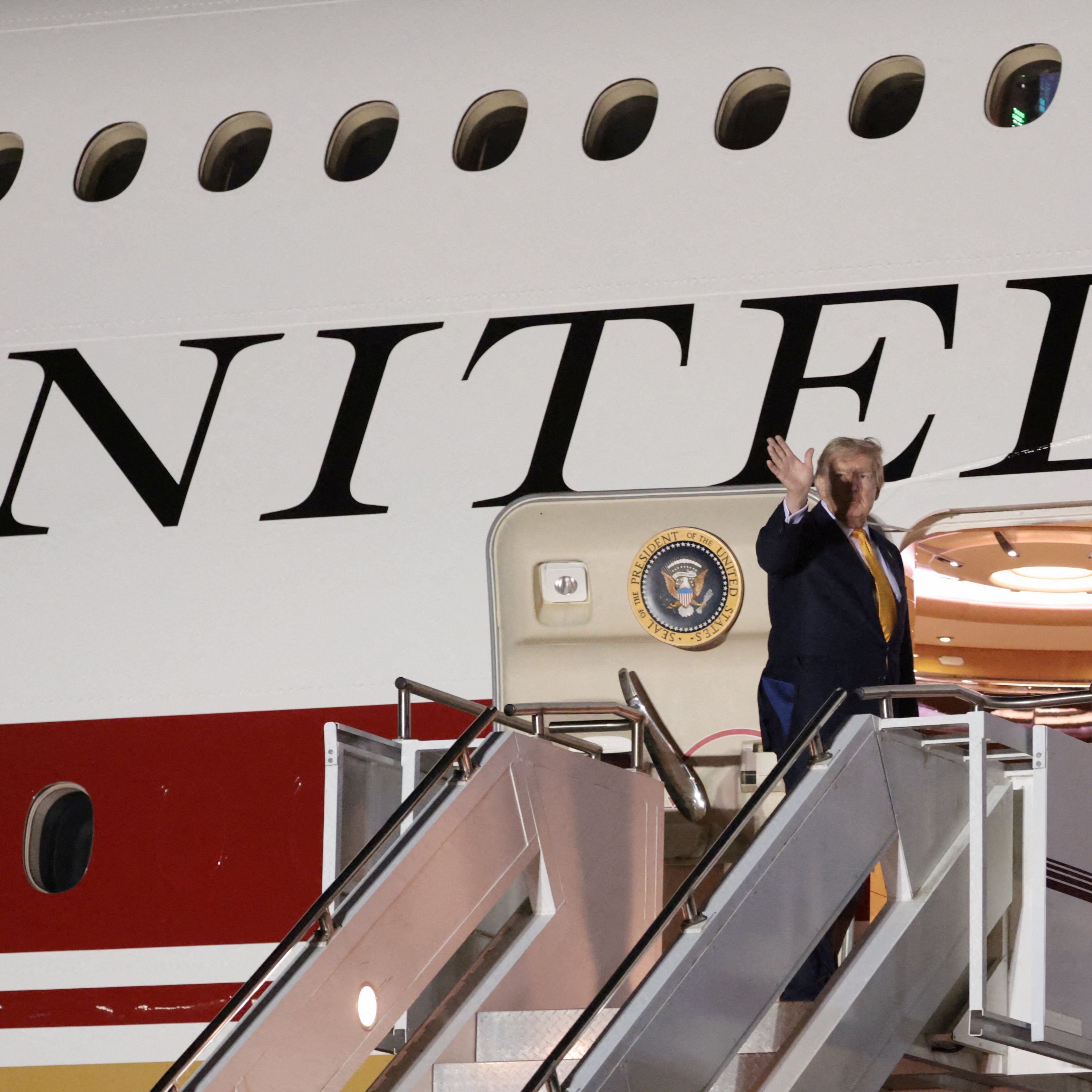
Left: Nicolás Maduro depicted aboard the USS <i>Iwo Jima</i>. Right: President Donald Trump holds a press conference following the reported capture of Maduro, at Trump’s Mar-a-Lago club in Palm Beach, Fla., January 3, 2026.
President Donald Trump said the United States will "run" Venezuela until a peaceful transition of power is executed, following an operation carried out in the Latin American country early Saturday morning that successfully captured President Nicolás Maduro and his wife.
"We're going to run this country until such time as we can do a safe, proper, and judicious transition," Trump said from Mar-a-Lago during a press conference. "We want peace, liberty, and justice for the great people of Venezuela, and that includes many from Venezuela that are now living in the United States and want to go back to their country. It's their homeland."
Asked on Saturday who would be running the country, Trump said that they would be designating people but that, “for a period of time,” it would largely be those standing behind him at the press conference -- apparently meaning Secretary of State Marco Rubio, Defense Secretary Pete Hegseth, and Chairman of the Joint Chiefs of Staff Dan Caine.
The United States is in Venezuela, and will remain in the country until a "proper transition can take place," Trump said.
General Caine said the attack was known as "Operation Absolute Resolve." The president clarified that no American lives or military equipment were lost during the operation, and the embargo on Venezuelan oil also remains in full effect.
After the completion of the attack, a potential second wave was planned and ready to be executed. At this time, however, a second attack is not necessary, according to the president. Trump described the second wave as "much bigger."
The capture of the Venezuelan leader and his wife marks a dramatic conclusion to Trump's months-long pressure campaign to oust the socialist dictator. Shortly after Trump's initial announcement of the operation, Attorney General Pam Bondi announced that Maduro and his wife had been indicted in the Southern District of New York on drug trafficking and firearm charges.
"They will soon face the full wrath of American justice on American soil in American courts," Bondi said of Maduro and his wife.
Venezuelan officials did not immediately release casualty numbers but said that the operation did result in Venezuelan deaths.
Trump administration officials have long argued that Maduro, who seized power in 2013, is an illegitimate ruler and is responsible for trafficking vast quantities of cocaine into the U.S. He was indicted in 2020 in the U.S. on charges that he was the active leader of a drug cartel known as Cartel de los Soles.
Previously, Rubio's only public comment on the operation consisted of a reposted social message, originally published in July of last year, stating that “Maduro is NOT the President of Venezuela and his regime is NOT the legitimate government."
Rubio did, however, speak at the press conference. He confirmed that the White House did not notify Congress before the operation was carried out, calling it a "trigger-based mission."
"It's just simply not the kind of mission you can call people and say 'Hey, we may do this at some point in the next 15 days,' but it's largely a law enforcement function," Rubio said. "At its core, this was an arrest of two indicted fugitives of American justice, and the Department of War supported the Department of Justice in that job. Now, there are broader policy implications here, but it's just not that kind of mission that you can pre-notify because it endangers the mission."
The Pentagon has been amassing warships, troops, and air assets in the Caribbean since August and has attacked many small vessels, which Pentagon officials insist were carrying drugs, killing at least 115 people. The U.S. has also seized two Venezuelan oil tankers in recent weeks, disrupting the Maduro regime's main source of revenue.
When asked about the specifics of American involvement in Venezuela going forward, Trump confirmed that the U.S. is not afraid to put boots on the ground. He would like the whole process to move quickly, but noted "it takes a period of time."
"We have to rebuild their whole infrastructure," the president said. "The infrastructure is rotted. It's actually really dangerous."
Rubio commented on the current state of Cuba as well, calling the country a "disaster." The secretary said Cuba is in "total collapse."
"America is a safer nation this morning. It's a prouder nation this morning, because it didn't allow this horrible person and his country, that was doing very bad things to us," Trump said. "It didn't allow it to happen, and the Western Hemisphere is right now a lot safer place to be."
About the Author
Jack Crowe is the senior news editor of National Review Online.
About the Author
Kamden Mulder is a William F. Buckley Jr. Fellow in Political Journalism. She is a graduate of Hillsdale College.
Featured Tags
Advertisement
Advertisement
Comments