U.S., China Reach Agreement to Slash Tariffs for 90 Days
Written by Brittany Bernstein
Share this story
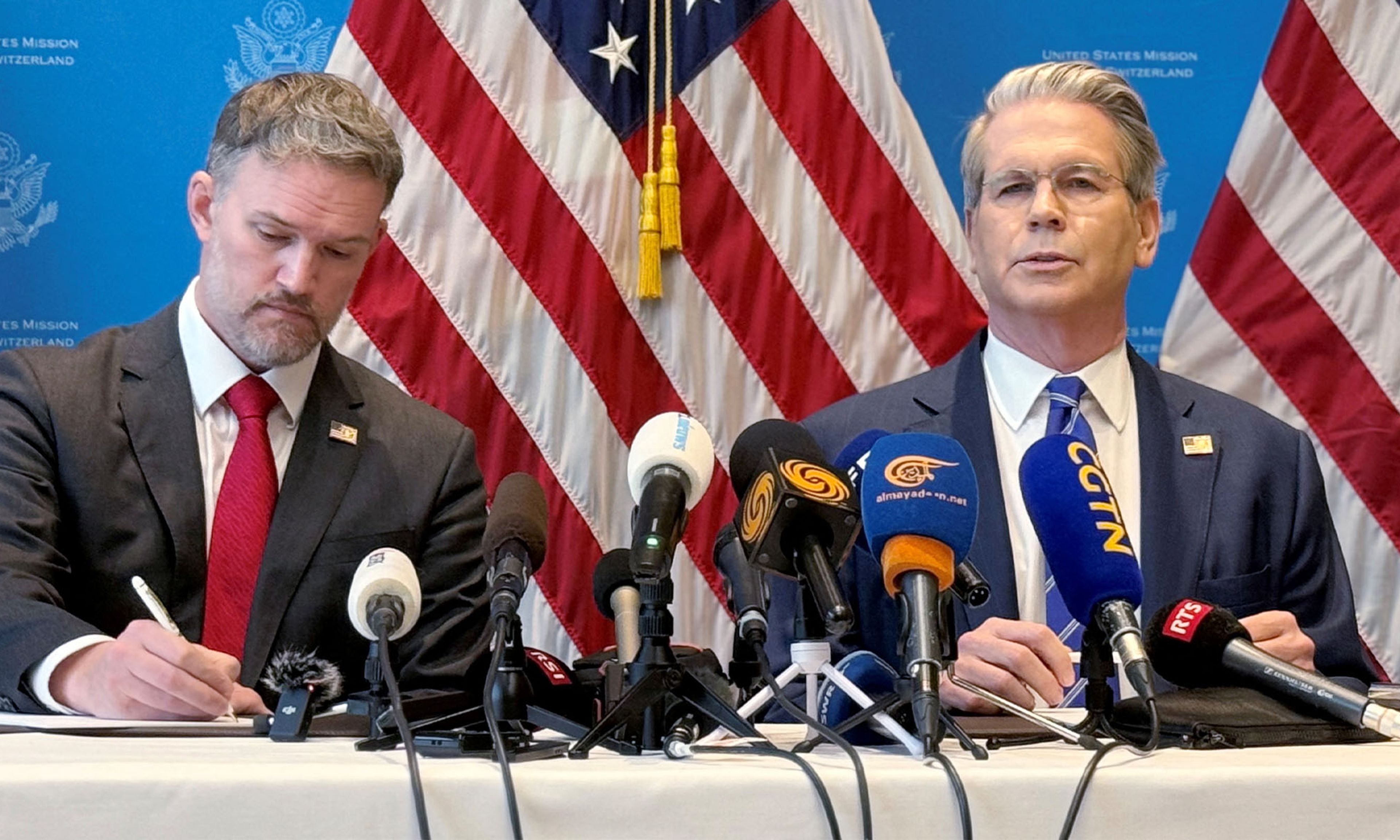
Secretary of the Treasury Scott Bessent and Trade Representative Jamieson Greer attend a news conference after trade talks with China in Geneva, Switzerland, May 12, 2025.
The U.S. and China have agreed to lower their respective reciprocal tariffs for 90 days as they look to end a bruising trade war between the world’s two largest economies.
Treasury Secretary Scott Bessent told reporters that the U.S. and China had each agreed to temporarily reduce tariffs by more than 100 percentage points. The U.S. will reduce the tariff on Chinese imports from 145 percent to 30 percent. In China's case, the country will reduce the tariff on American goods from 125 percent to 10 percent.
The reductions are set to go into effect on Wednesday.
“Both countries represented their national interest very well,” Bessent said after trade talks with Chinese officials in Geneva, Switzerland. "We both have an interest in balanced trade, the U.S. will continue moving towards that."
“The consensus from both delegations this weekend is that neither side wants a decoupling, and what had occurred with these very high tariffs was the equivalent of a trade embargo, and neither side wants that,” Bessent said.
The White House and China's Ministry of Commerce released a joint statement explaining that the 90-day pause was agreed upon in the “spirit of mutual opening, continued communication, cooperation, and mutual respect.” The two countries have agreed to continue negotiations.
The agreement will also see China suspend or cancel some non-tariff retaliatory measures, including export restrictions and the blacklisting of several U.S. companies.
Both sides had teased the unexpected agreement on Sunday.
U.S. Trade Representative Jamieson Greer noted “how quickly we were able to come to agreement, which reflects that perhaps the differences were not so large as far as maybe thought.”
Trade Representative Li Chenggang said, “As regards the timing for the release of the joint statement, as we say back in China, if the dishes are delicious, then timing is not a matter. So I think no matter when this statement is released, it’s going to be … big news, good news for the world.”
Trump had initially placed 20 percent tariffs on China because of the country's failure to mitigate the flow of fentanyl out of its country and across the U.S. southern border.
He then imposed a 34 percent "Liberation Day" tariff on Chinese goods before a back and forth tit-for-tat increase in tariffs by both sides led the president to increase the rate to 145 percent days later. China retaliated with a 125 percent levy on imports from the U.S.
The president explained last month that he was upping the tariff on Chinese goods “Based on the lack of respect that China has shown to the World’s Markets."
When the president announced a 90-day pause last month on retaliatory tariffs for countries that had come to the negotiating table, he not only left China's tariff in place but increased it.
“Conversely, and based on the fact that more than 75 Countries have called Representatives of the United States, including the Departments of Commerce, Treasury, and the USTR, to negotiate a solution to the subjects being discussed relative to Trade, Trade Barriers, Tariffs, Currency Manipulation, and Non Monetary Tariffs, and that these Countries have not, at my strong suggestion, retaliated in any way, shape, or form against the United States, I have authorized a 90 day PAUSE, and a substantially lowered Reciprocal Tariff during this period, of 10%, also effective immediately,” Trump explained at the time.
Trump indicated that last month's pause was because of Wall Street panic.
“I thought that people were jumping a little bit out of line. They were getting yippee, you know, they were getting a little bit yippee. A little bit afraid,” Trump said.
Last week, President Donald Trump and U.K. Prime Minister Keir Starmer also announced a historic trade deal between their two countries that will include billions of dollars of increased market access for American exports, including beef, ethanol and other farm products.
Trump said the details of the deal with Britain will be finalized in the coming weeks, but said the close U.S. ally has agreed to “eliminate numerous non-tariff barriers” under the agreement, which Trump touted as a “great deal for both countries.”
Under the deal, the U.K. will still be subject to Trump’s 10 percent baseline tariff that he has imposed on all countries, but the U.S. agreed to lower its 25 percent tariff on imports of British cars to just 10 percent. Commerce Secretary Howard Lutnick also indicated Rolls Royce engines and plane parts will be imported tariff-free, while Britain is set to buy $10 billion of Boeing airplanes. Meanwhile, tariffs on British steel exports will drop from 25 percent to zero.
“Many other deals, which are in serious stages of negotiation, to follow!” Trump said on social media when announcing the U.K. deal.

About the Author
Brittany Bernstein is the deputy news editor of National Review Online.
Featured Tags
Advertisement
Advertisement
Comments