Washington State Is Giving a Leg Up to Minority-Owned Businesses Through Legally Suspect Programs
Written by Abigail Anthony & Malia Marks
Share this story
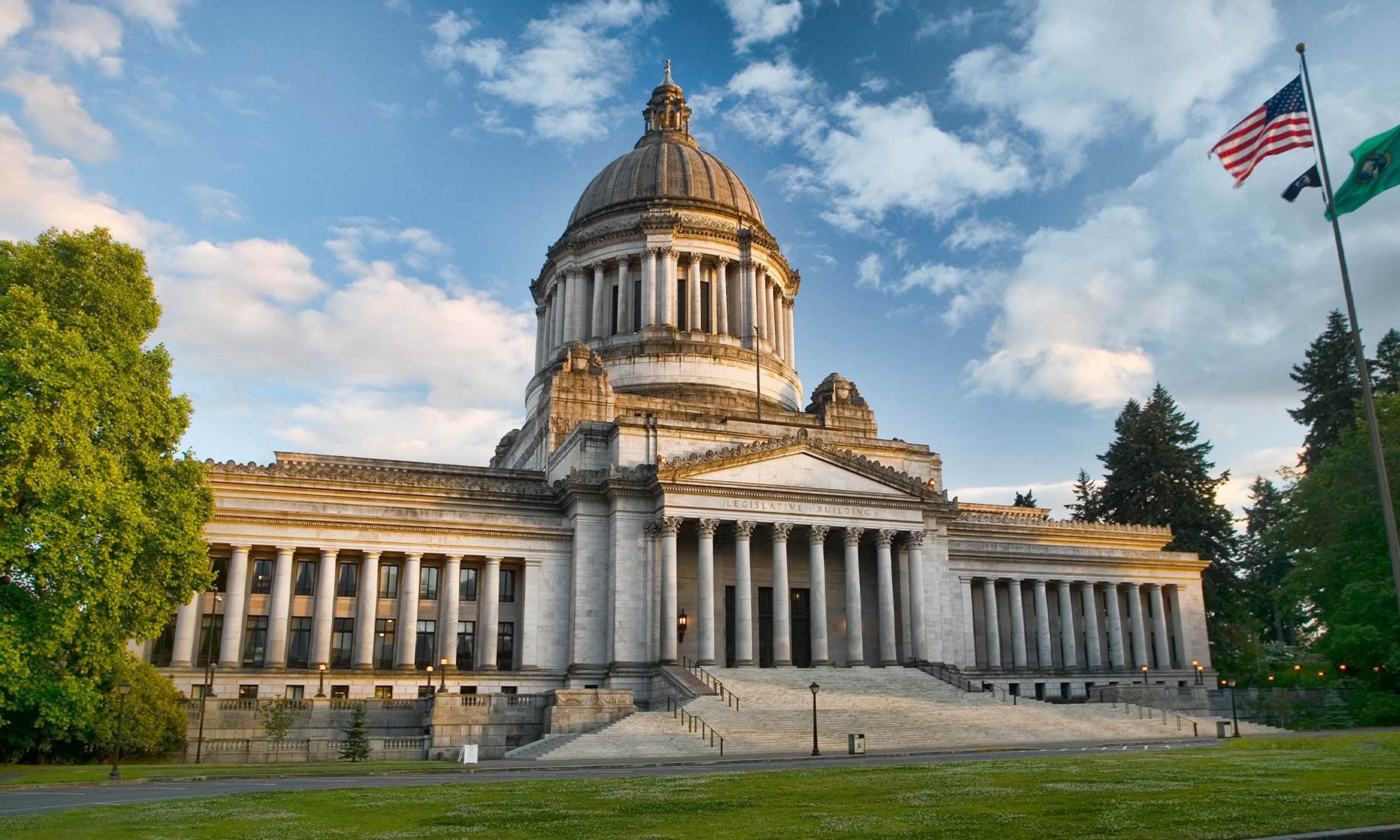
Washington State Capitol building in Olympia
Washington State presumes certain racial groups to be “disadvantaged” for particular business certifications that come with special privileges and benefits. Legal experts say that is likely unconstitutional, and the state’s data suggest it is entirely unnecessary.
Washington State’s Office of Minority and Women’s Business Enterprises (OMWBE) — which describes itself as an “anti-racist organization committed to promoting diversity, equity, and inclusion in public contracting and procurement” — awards special certifications to small businesses that are owned by racial minorities, women, or LGBTQ-identifying individuals below a particular net-worth threshold.
Once a business owner receives a certification from the agency, he or she automatically qualifies for special benefits, including a low-interest loan program and registration on a state-operated directory that aims to increase diversity in government contracting. The purpose of these certifications, according to the OMWBE’s website, is to “increase contracting opportunities for certified businesses with state and local governments.”
The state justifies this disparate treatment on the grounds that women and minorities are underrepresented in government contracting. But the state’s own research appears to have been manipulated to produce a desired result, as a full accounting of government contracts actually shows women and minorities are overrepresented relative to their numbers.
Lawyers and legal experts who spoke to National Review argued that the certificates, the loan program, and the directory are likely unconstitutional. The State Attorney General and the OMWBE did not respond to a request for comment by the time of publication.
The OMWBE offers seven types of state certification for businesses based on its owner’s demographic traits: minority women, minority men, non-minority women, a combination of non-minority women and minority men, socially and economically disadvantaged men, LGBTQ individuals, and economically disadvantaged individuals.
To qualify for one of the above certifications, an individual who owns at least 51 percent of a small business must fall into one of the above categories and be considered both “socially and economically disadvantaged.”
In order to qualify as “economically disadvantaged,” a business owner must have a net worth of less than $2.047 million and must have “diminished capital and credit opportunities, as compared to others in the same or similar line of business who are not socially disadvantaged.”
On its website, the OMWBE defines a “socially disadvantaged individual” as a “person subjected to racial or ethnic prejudice or cultural bias within American society because of his or her identity as a member of a group stemming from circumstances beyond her or his control.”
The agency states that individuals who are Black/African American, Hispanic/Latino, Native American, Native Alaskan, Asian, Pacific Islander, Native Hawaiian, or women are “presumed to be socially disadvantaged.”
An individual who does not belong to one of these racial groups — such as a white male — can theoretically still qualify as “socially disadvantaged” by providing evidence to prove that he has 1) “At least one objective distinguishing feature that has contributed to social disadvantage,” 2) “Personal experiences of substantial and chronic social disadvantage in American society,” and 3) experiences of “Negative impacts on entry into business or advancement in business.” The agency states that applications from individuals who are not presumed to be “socially disadvantaged” will be evaluated on a case-by-case basis.
Washington State’s minority-ownership certifications and qualifying criteria bear similarity to a federal contracting program that was ruled unconstitutional by a federal district court in Ultima Services Corporation v. U.S. Department of Agriculture, which decided that a government “presuming” persons of certain racial groups to be “socially and economically disadvantaged” and therefore eligible for particular preferences in contracting is illegal. That case, however, involved the Fifth Amendment because it was a program operated by the federal government, not a state.
Dan Morenoff, the executive director of the American Civil Rights Project organization and an adjunct fellow at the Manhattan Institute, told National Review that a state presuming particular races to be “disadvantaged” and therefore eligible for a certificate is likely a violation of the equal protection clause in the 14th Amendment.
“If some races are automatically qualified for a program, and there are some hurdles another race can jump over in order to qualify, then that is differential treatment on the basis of race,” said Dan Morenoff. “This is straightforward disparate treatment based on demography in a way that would only be constitutional if it could meet strict scrutiny, and I don’t see how the state plausibly could pass that test.”
In order to satisfy a strict scrutiny test, Washington State would have to demonstrate that the program is narrowly tailored to advance a compelling government interest. To do so, the state would have to prove that it is attempting to remedy a past incident of state discrimination against a particular group. Even if the state were able to prove that it discriminated on the basis of race in business contracting, the certification program is likely not considered sufficiently “narrowly tailored” because seemingly all non-white races are presumed disadvantaged and small businesses of every industry qualify.
Judge Glock, senior fellow at the Manhattan Institute, told National Review that Washington State’s program is likely unconstitutional because it seemingly applies to all minority races working in all industries.
Businesses that receive one of the certifications become eligible for the “Linked Deposit Program,” a state-sponsored financing program created by the state legislature in 1993 that is designed to reduce the interest rate for business loans by up to 2 percent. Additionally, a minority-certified business is added to a particular directory managed by the OMWBE, which is designed to promote minority-owned small businesses and increase supplier diversity.
“The purpose [of the State Certification program] is to enhance business opportunities for certified businesses participating in state-funded projects or working with state agencies, local governments, school districts, and public universities,” the agency says on its website.
Morenoff said that the loan program and directory are likely additional violations of the 14th Amendment.
Glock agreed. “If the state government merely kept a list of businesses with the clear purpose of saying ‘these are the racial groups you should be contracting with, and this is the group you should not be contracting with,’ then that would seem to be a clear violation of the 14th Amendment equal protection clause,” Glock said.
For small businesses competing for public contracts, even small reductions in loan interest rates can make a big impact. “You’re competing against people who can grow their company faster, especially in businesses that require expensive, heavy equipment,” Chris Franks, a white male and former owner of a small construction business in Washington, told National Review in an interview. “Securing contracts and loans should be based on performance, not race.”
Franks now co-owns a barbershop with his wife, Rachelle. She is an Army veteran and mother to three sons, one of whom is biracial and from a previous marriage. Rachelle explained how it is unfair that the state would award privileges to only one of her children based on that child’s race.
“Skin color does not determine how well someone runs a business. If the state is offering help, they shouldn’t discriminate,” she says. “With my kids approaching adulthood, it makes me sad that two of my children will not be afforded the same opportunities as one of my children.”
George La Noue, a Professor Emeritus of Political Science and Professor Emeritus of Public Policy at the University of Maryland, Baltimore County, who has served as a trial expert in cases involving disparity studies, shared Rachelle's sentiments.
“Any government program that divides people based on the color of their skin or their ancestry is hostile to the basic American value of equal protection of law,” La Noue said.
A bill was introduced in Washington State this session by three Democratic Party state representatives that would redefine who qualifies as a “socially disadvantaged individual” for the purposes of state business certifications. If passed, the bill would add “Middle Eastern/North African” to the list of categories that are “presumed” to be “socially disadvantaged” by the OMWBE.
The OMWBE has certified small minority- and women-owned businesses since 1983, according to the governor’s website.
“The claim that you need these sort of contracting programs aimed at increasing diversity to remedy past discrimination seems particularly absurd in light of the fact that we've now had programs like these in some states for decades,” said Glock.
Are Minority Businesses Really Underrepresented?
To defend race-conscious contracting programs in court, states have conducted “disparity studies” to provide evidence of discrimination, unequal opportunity, or underutilization. The State of Washington conducted a “disparity study” in conjunction with consultants in 2019, which concluded that “systemic and endemic inequalities” existed in the contracting process that prevented women and minorities from accessing government work.
“These inequities create disparate impacts on [Minority- and Women-Owned Business Enterprises] and may render the state a passive participant in overall market-wide discrimination,” the study reads.
The “passive participant” language is drawn from the Supreme Court decision City of Richmond v. J. A. Croson Company (1989), which found that "generalized assertions" of past racial discrimination could not justify "rigid" racial quotas in the awarding of public contracts. The court ultimately rejected a race-conscious contracting program in construction operated by the city of Richmond.
However, that decision did leave open the possibility of a legal race-conscious contracting initiative. The majority opinion argued that, in theory, “if the [government] could show that it has essentially become a ‘passive participant’ in a system of racial exclusion practiced by elements of the local construction industry, [it] could take affirmative steps to dismantle such a system.” The decision further stated that a “significant statistical disparity” in contracting may suggest the existence of “discriminatory exclusion.”
Much more rigid thresholds were defined in Vitolo v. Guzman (2021), a case involving the federal government presuming certain racial groups to be “socially and economically disadvantaged” for the purposes of prioritizing certain small business owners as grant recipients. The Sixth Circuit concluded that the state must show 1) “The policy must target a specific episode of past discrimination,” 2) “There must be evidence of intentional discrimination in the past,” and 3) “The government must have had a hand in the past discrimination, it now seeks to remedy.”
“When the government promulgates race-based policies, it must operate with a scalpel. And its cuts must be informed by data that suggest intentional discrimination. The broad statistical disparities cited by the government are not nearly enough,” Judge Amul Thapar wrote in the Vitolo v. Guzman majority decision.
Washington State’s disparity study, which runs to more than 200 pages, found several industries where minority-owned businesses overperformed in government contracting — but the authors appear to have contorted the data to justify the state’s minority preference system.
After determining that minority and women-owned businesses actually receive more government contracts than their numbers would suggest, the study’s authors appear to have removed certain industries from their calculations to bring that representation down.
The analyses stopped after the researchers removed the sectors in which Natives, Blacks, and Hispanics performed well, leaving only the sectors in which white men excelled. The researchers frame the results as indicative of discrimination, though the study clearly showed specialization.
"There's no question that the industry that produces disparity studies is an interested set of experts. They are often paid to arrive at a particular conclusion, and so they do,” said Morenoff.
La Noue agreed that disparity reports often seek to achieve a particular set of outcomes.
“The message to consultants has been pretty clear. If you wanted to get a contract to do a disparity study, and you wanted to continue to do disparity studies, you better come up with the disparities that the government is paying you to find,” said La Noue.
Judge Glock noted that courts have generally maintained high standards for the quality of disparity reports and suggested that the Washington report would not hold up to judicial scrutiny.
La Noue agreed. “The trend of the courts, especially after 2021, has been decisively against the use of racial preferences in almost every area, but particularly in contracting or the distribution of government benefits,” he said.
In its most recent annual report, the OMWBE tracks how much Washington State agencies spent on contracting as a whole, how much was spent specifically on contracts with minorities, and whether each agency met its “diversity spending goal.”
The share of public spending with certified businesses has grown by 1.5 percentage points in a decade, with state agencies and public schools spending $371,937,324 with certified businesses in 2025, an increase of over $150 million inflation-adjusted dollars since 2016.
National Review previously reported that Washington State’s Department of Children, Youth, and Families (DCYF) has awarded millions of dollars through an “equity” grant program for childcare providers that likely violates the Civil Rights Act and the Constitution by considering race in the awarding of funds. In January, the state auditor — a Democrat — released a statement explaining that the DCYF has failed to appropriately audit its Child Care and Development Fund, leaving questions about roughly $416 million in childcare spending.
Abigail Anthony is a staff writer at National Review. Malia Marks is a Ph.D. candidate at the University of Cambridge department of psychology, where she studies authoritarianism and propaganda. She was born and raised in Washington State, and she previously studied at Harvard.

About the Author
Abigail Anthony is a staff writer at National Review.

About the Author
Malia Marks is a Ph.D. candidate at the University of Cambridge department of psychology, where she studies authoritarianism and propaganda. She was born and raised in Washington State, and she previously studied at Harvard.
Featured Tags
Advertisement
Advertisement



Comments