Share this story
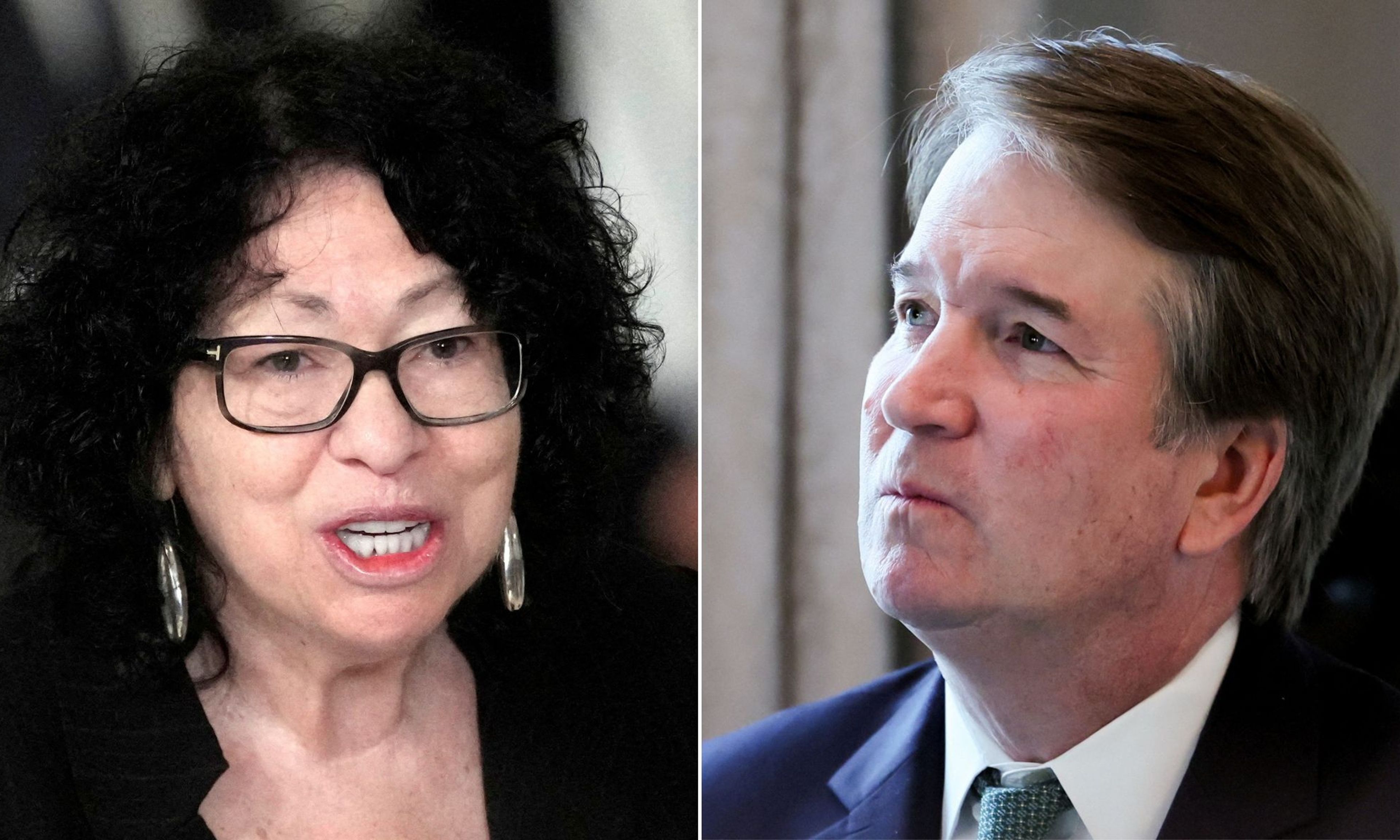
Left: Supreme Court Justice Sonia Sotomayor speaks in the Great Hall at the Supreme Court in Washington, D.C., December 18, 2023. Right: Supreme Court Justice Brett Kavanaugh in Washington, D.C., March 12, 2025.
Justice Sonia Sotomayor has apologized publicly to her colleague Justice Brett Kavanaugh, in a statement released by the Court: “At a recent appearance at the University of Kansas School of Law, I referred to a disagreement with one of my colleagues in a prior case, but I made remarks that were inappropriate. I regret my hurtful comments. I have apologized to my colleague.”
The apology arises out of Kavanaugh's concurring opinion in Noem v. Vasquez Perdomo, a case last summer on the emergency docket that stayed a rogue district judge from micromanaging the bases upon which Immigration and Customs Enforcement (ICE) could stop individuals in Los Angeles on suspicion of being illegal immigrants on the basis of four factors: “(i) presence at particular locations such as bus stops, car washes, day laborer pickup sites, agricultural sites, and the like; (ii) the type of work one does; (iii) speaking Spanish or speaking English with an accent; and (iv) apparent race or ethnicity.” Kavanaugh argued in the case not only that the judiciary was ill-suited to dictate enforcement decisions and that the plaintiffs lacked standing, but also that the criteria used by ICE were rational responses to the facts on the ground:
Whether an officer has reasonable suspicion depends on the totality of the circumstances. . . . Here, those circumstances include: that there is an extremely high number and percentage of illegal immigrants in the Los Angeles area; that those individuals tend to gather in certain locations to seek daily work; that those individuals often work in certain kinds of jobs, such as day labor, landscaping, agriculture, and construction, that do not require paperwork and are therefore especially attractive to illegal immigrants; and that many of those illegally in the Los Angeles area come from Mexico or Central America and do not speak much English.
Particularly in light of subsequent controversies over ICE tactics, Kavanaugh's concurrence has attracted a lot of ire from the left accusing him of racial stereotyping and the like, much of it entirely divorced from the question of whether he accurately described the facts. Sotomayor, in her dissent at the time, accused Kavanaugh of arguing that ICE could stop anyone who "appears to work a low paying job," ignoring his specific focus on day labor and other no-paperwork jobs in which employers have an incentive to hire illegal alien workers specifically to avoid paying legal wages, benefits, and taxes.
In her April 7 talk, Sotomayor continued that theme, criticizing Kavanaugh’s opinion without mentioning him by name and adding: “This is from a man whose parents were professionals. And probably doesn’t really know any person who works by the hour.” This yet again confuses Kavanaugh's point (the specific types of job sites where one is highly likely to encounter a large proportion of illegal workers) with hourly employment in general. Knowing somebody who punches a clock working for a big corporate employer that pays its workers on the books doesn't give you much insight into day-labor and landscaping jobs.
By the standards of debates among politicians, Sotomayor's jab is a pretty mild ad hominem attack. But it's still a breach of the usual decorum of the Court. The Senate insists on more civility than the House for the simple reason that 100 people elected for six-year terms have to get along with each other better than 435 people elected for two-year terms. The need for civility on the Court is correspondingly greater: There are only nine justices, and the typical modern justice serves a long time with the same colleagues. Five of the current justices have been there for 15 or more years; of the twelve previous justices appointed since 1967, all served at least 15 years, and only three of them left after less than about 24 years (I'm rounding up Thurgood Marshall, whose tenure ended at 23 years, 364 days); half served from 27 to 34 years. That's just the practical side; there's also the Court's culture and public image as a rational decision-maker that runs on legal reasoning rather than political posturing. Even when the justices give in to political motives, it remains important that they not be seen to play to the public.
The forces of our current politics and the frustrated isolation of the three liberal/progressive justices are placing a lot of pressure on that decorum, as the increasingly strident dissents of Sotomayor and especially Justice Ketanji Brown Jackson reflect. But it says something about the continuing strength of the Court's norms -- probably reinforced by Chief Justice John Roberts -- that Sotomayor felt compelled or convinced to apologize for a fairly tame potshot rather than pave a further step down a road that would be very damaging to the Court.

About the Author
Dan McLaughlin is a senior writer at National Review Online and a fellow at National Review Institute.
Featured Tags
Advertisement
Advertisement





Comments