Defense Tech and Drones: A Ukrainian Lesson
Written by Andrew Stuttaford
Share this story
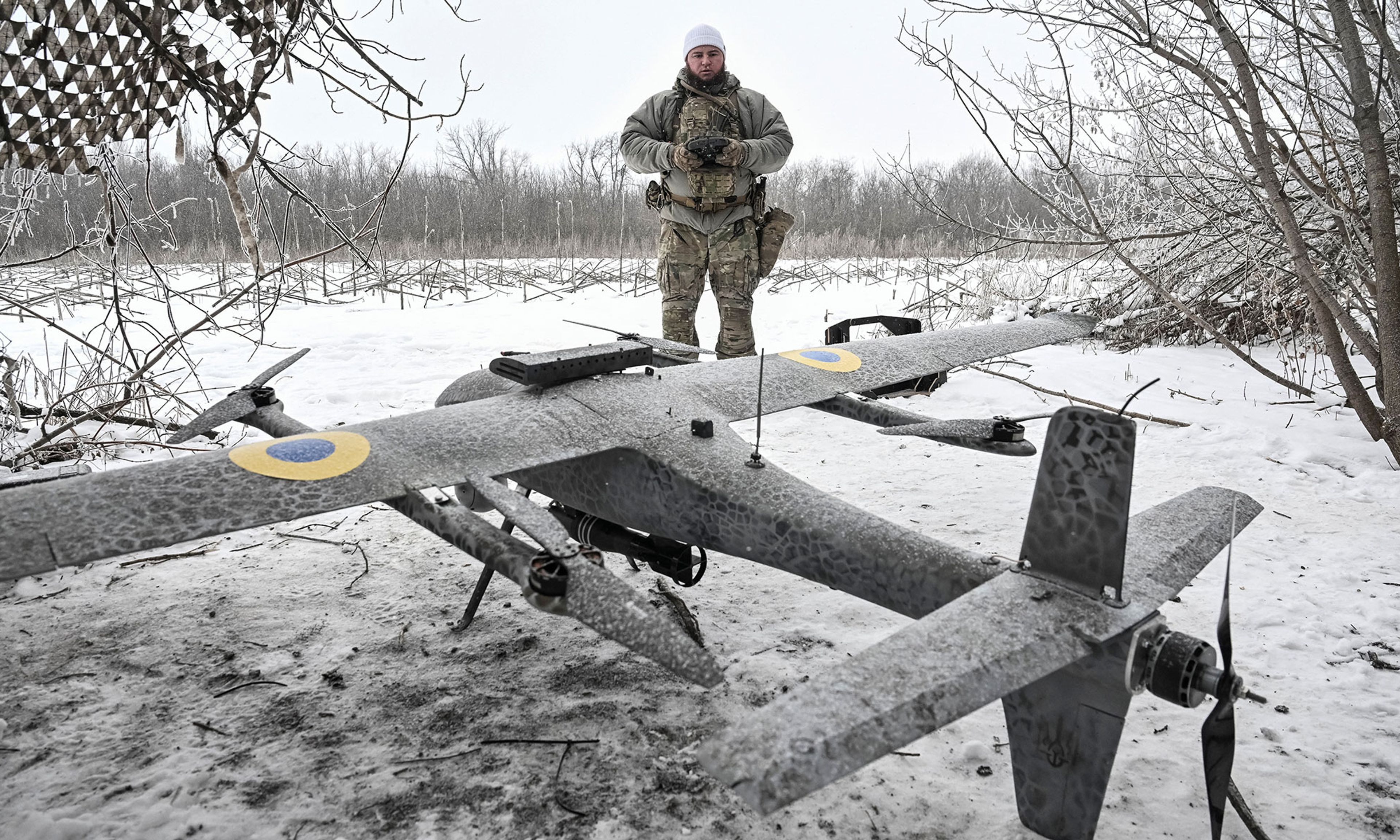
A Ukrainian National Police Special Purpose Battalion member prepares a Gara combat drone near the front line in Pokrovsk, Donetsk Region, Ukraine, January 23, 2026.
Attention is being paid. Ukraine’s President Volodymyr Zelensky has been in the Middle East promoting his country’s remarkable advance in anti-drone and drone warfare. According to the New York Times, Zelensky said that he has “negotiated air defense agreements with Saudi Arabia, Qatar and the United Arab Emirates.” It’s easy enough to see that the diplomatic and strategic implications of these agreements could go beyond the battlefield.
The Times adds:
In the Mideast conflict, Ukraine has sought to shift its image from a recipient of military aid to a supplier. It sees an opening to export its low-cost, innovative designs created during the war with Russia to compensate for shortages of weapons and ammunition. Ukraine’s military often relies on consumer technologies such as virtual-reality goggles for gamers and off-the-shelf drone components.
The agreements under negotiation with the United Arab Emirates and finalized with Qatar extend for 10 years, Mr. Zelensky told reporters on a conference call, and could be worth “billions.” He spoke from Qatar, one of the Persian Gulf states that has been targeted by Iranian drones.
Mr. Zelensky said he had signed deals with Saudi Arabia and Qatar and expected to finalize an agreement with the United Arab Emirates.
Meanwhile, The Atlantic’s Simon Shuster has visited the German defense giant, Rheinmetall and finds its CEO, Armin Papperger, underwhelmed by drones. Comparisons with Lego were made.
“Basic” drones (and Ukraine manufactures much more than that) are indeed low tech, but as Shuster argues, that is part of the danger that they represent:
[T]heir cheapness — especially when compared with the elaborate weapons systems produced by companies such as Lockheed Martin and Rheinmetall — is precisely what makes them so devastating. For only a few hundred dollars, Ukraine’s drones can do serious damage to a military vehicle worth millions. They have, in effect, done to tanks and cannons what muskets once did to knights in shining armor. What Papperger called Legos have gone a long way to saving an entire country.
Yes and no. Drones have indeed made an enormous contribution to Ukraine’s survival, and their impact on battlefield tactics has been extraordinary. But while drones are changing the way that tanks are used; it is unlikely to make them redundant (the same can be said of artillery). The war in Ukraine, like many wars before it, is being fought using a bewildering range of equipment. The First World War revolutionized military technology, but the Western Front’s trench raids were often fought with weapons that were essentially medieval.
In an earlier post, I quoted an observation by France’s Admiral Pierre Vandier that the Russo-Ukrainian war “is a mix of World War I and World War III — what could be a future war,” a phrase that, in its allusions to a mix of old war and new, comes to mind when reading Shuster’s description of how the Russian invaders now operate in the drone-dominated kill zone that the Ukrainians have established ahead of their front line:
In their ground assaults through that terrain, the Russians now prefer to advance on foot, sometimes using motorcycles, electric scooters, or even horses — all of which have a better chance than a tank of escaping the notice of a Ukrainian drone.
It is not hard to understand why the CEO of a business that manufactures tanks might want to talk drones down, although his comment about how Ukrainian drone manufacturing relied on “Ukrainian housewives” with “3-D printers in the kitchen” producing parts for drones — and that this was not innovation was ridiculously dismissive. Whatever Papperger may say, Ukraine’s innovation in this area has been astonishing. Shuster quotes testimony by Lieutenant General Steven Whitney, a senior Pentagon official, to the Senate Armed Services Committee in which he described Ukraine’s innovations in this area as “out of this world.” Necessity is the mother of invention. . . .
And the toll that drones have taken on tanks (on both sides) has been devastating.
Under the circumstances, the West has seemed a little slow on the uptake when it comes to drones. Defense establishments don’t always adapt well to innovations that upset the existing military order, but this point by Shuster is also intriguing:
NATO members pledged at a summit in December to increase their defense budgets over the next decade to 5 percent of gross domestic product, more than double the previous spending commitment.
To reach that goal, European politicians and military planners need to allocate billions of dollars in a hurry, which is easiest to do by ordering what are known as “exquisite” systems — state-of-the-art machinery such as ballistic missiles, warships, and fighter jets. Most drones are too cheap to move the needle toward NATO’s gargantuan spending targets.
However unlovely (and sometimes counterproductive) his tactics, Trump’s pressure on the Europeans to spend more was the right thing to do, and he has achieved more than his predecessors ever managed in that respect; but, however necessary they may have been in this case, benchmarks come with hazards, as can be seen from the failures of Soviet central planning or of its 21st century equivalent, the “race” to net zero, both examples of approaches dominated by targets. All too often, the emphasis put on "making the numbers" can create perverse incentives.
At the very least, the West needs to up its game. When contemplating how to respond to the threat — which includes a potential terrorist threat — posed by drones, and, for that matter, of how to take advantage of drones, Ukraine looks to be a good place to go for advice.
[slideshow slideshow="1594902" /]

About the Author
Andrew Stuttaford is the editor of National Review's Capital Matters.
Featured Tags
Advertisement
Advertisement




Comments