Share this story
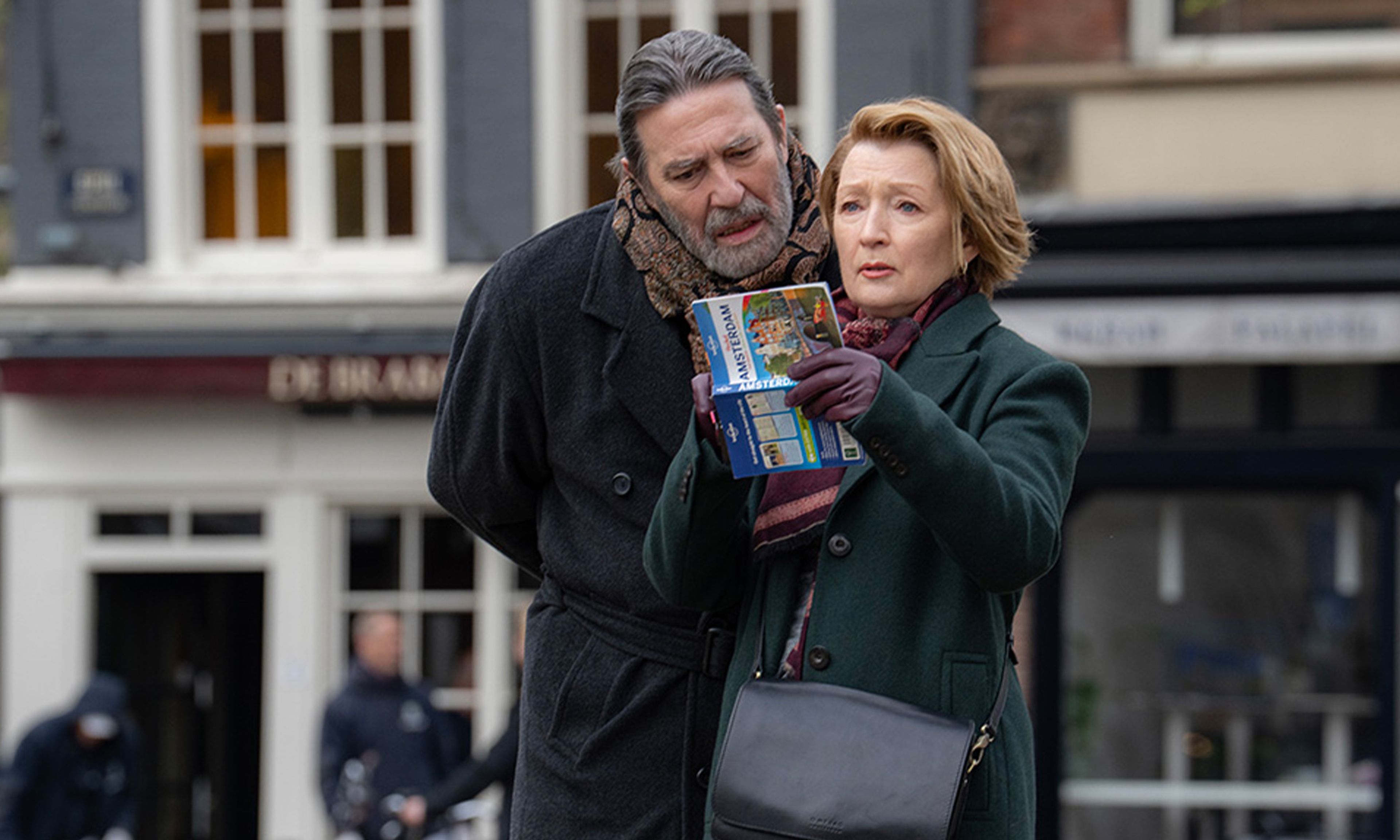
Ciarán Hinds as Gerry and Lesley Manville as Stella in <i>Midwinter Break</i>
Midwinter Break has one of the best characters I’ve seen on screen in years. Her name is Stella Gilmore (Lesley Manville), a retired Irish schoolteacher sensing she’s running out of time to keep a promise she made to God. Catholic, compact, and composed, what sets her apart from most figures we encounter at the movies is the sense that the choices we make in life actually matter.
Polly Findlay’s beautiful and elegant debut feature trusts you to sit with Gilmore, to watch as she and her husband, Gerry (Ciarán Hinds), move through Amsterdam and to work out for yourself what it all means. Many films these days would rather deliver a message than shape a question. Findlay, a celebrated theater director, knows better.
Some critics have called her approach “slow” and “depressing,” but that’s a misreading. Findlay’s classically made adaptation of Bernard MacLaverty’s beloved 2017 novel has the cadence of the long marriage it depicts. It moves in silences, in gestures, in the things two people have learned not to say.
The Gilmores are empty nesters, exiles from the Belfast they fled during the Troubles, the sectarian conflict that tore through Northern Ireland for 30 years and killed some 3,600 people. Stella feels her world getting smaller as Gerry retreats to the bottle and their son doesn’t come for the holidays. On Christmas morning she hands her husband an envelope — two tickets to Amsterdam. Whether the vacation is entirely the gift it appears to be, the film wisely leaves for later.
Findlay has clearly studied Rossellini’s masterpiece Journey to Italy, in which Ingrid Bergman and George Sanders play a couple drifting apart through a civilization whose permanence won’t quite let them stay that way. What both films understand, and what our culture tends to forget, is that beauty has a power to orient us. The transcendence Stella encounters — at the Begijnhof, a medieval courtyard where a hidden Catholic chapel still commemorates a Eucharistic host that survived a fire seven centuries ago — speaks directly to what she has spent her life reaching for: something that holds, that doesn’t burn away.
Gerry’s relationship to faith is more complicated. He’s not hostile to her beliefs but holds them at arm’s length. The sectarian violence he witnessed in Belfast has something to do with that. He loves his wife dearly; he just never quite found his way to where she lives.
A single scene crystallizes the dynamic between them. In their hotel room, Gerry can’t find his statin — there’s a low-grade panic in him, the kind that has nothing to do with the pill — and he asks for her help while she’s on her knees praying. She finishes, deliberately, without hurrying. Then she reaches into a travel bag that was beside him all along and hands him what he needs. One gesture, 40 years of marriage.
The heart of it all is a conversation Stella has with a fellow expatriate who lives on the sacred grounds of the Begijnhof. There, she finally gives voice to the promise she made when a bullet pierced her in Belfast. Manville is extraordinary here. She fully inhabits the moment, and you feel the full weight of the God-sized hole in her heart she’s desperately trying to fill.
Its final movements left me uncertain at first. Then, sometime after leaving the theater, it hit me. Her name is Stella, Latin for star. I don’t want to say more than that, except that the film’s closing shot knows exactly what it’s doing. Like poetry, it’s the kind of movie that works on you after you leave it. I’m much younger than these characters, but in the days since, I have found myself wanting to stop deferring the things that matter.
Midwinter Break insists that cinema can still turn our gaze upward — toward the stars we’ve been too busy, or too afraid, to follow.

About the Author
A veteran of political campaigns, Giancarlo Sopo is a cultural writer exploring the intersection of cinema, politics, and the conservative imagination. In addition to National Review, his commentary on culture, aesthetics, and public life has been featured in IndieWire, the New York Times, and CNN. Follow him on X (@giancarlosopo) and Letterboxd.
Featured Tags
Advertisement
Advertisement

Comments