Share this story
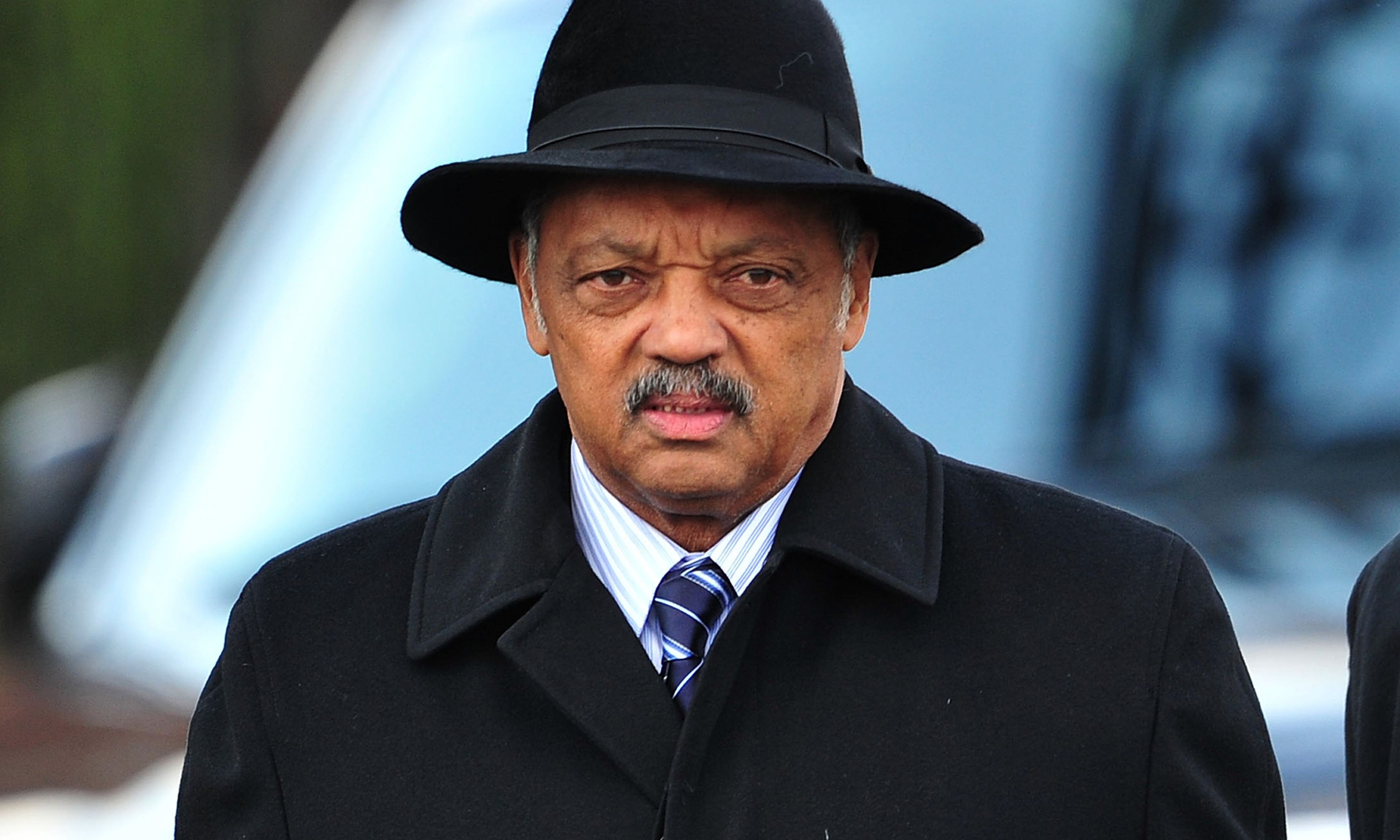
Reverend Jesse Jackson leaves the funeral service for Whitney Houston in Newark, N.J., February 18, 2012.
Jesse Jackson has died, at 84. In his youth an earnest crusader for black civil rights who was with Martin Luther King Jr. when he died, Jackson's place in history was secured in 1984 and 1988 when he became the first black presidential candidate to gain significant popular support. He won Louisiana and D.C. and garnered 3.2 million votes in 1984; and carried D.C., Puerto Rico, and eleven states and 6.9 million votes (29.3 percent of the overall vote, second only to nominee Michael Dukakis) in 1988. Jackson sweeping the Deep South on Super Tuesday that year on the strength of the black vote effectively handed the nomination to the northeastern liberal Dukakis over the comparatively moderate Al Gore, who had banked on southern moderate support to break the party out of the exhausted New Deal liberalism that had led to disaster under Walter Mondale. In the 1970s, Jackson spoke out passionately against abortion, calling it murder and equating it with genocide. A sample from 1977:
The question of "life" is The Question of the 20th century. Race and poverty are dimensions of the life question, but discussions about abortion have brought the issue into focus in a much sharper way. How we will respect and understand the nature of life itself is the over-riding moral issue, not of the Black race, but of the human race. . . . I was born out of wedlock (and against the advice that my mother received from her doctor) and therefore abortion is a personal issue for me. From my perspective, human life is the highest good, the summum bonum. . . .
In the abortion debate one of the crucial questions is when does life begin. Anything growing is living. Therefore human life begins when the sperm and egg join and drop into the fallopian tube and the pulsation of life take place. From that point, life may be described differently (as an egg, embryo, fetus, baby, child, teenager, adult), but the essence is the same. The name has changed but the game remains the same. Human beings cannot give or create life by themselves, it is really a gift from God. Therefore, one does not have the right to take away (through abortion) that which he does not have the ability to give. . . .
Politicians argue for abortion largely because they do not want to spend the necessary money to feed, clothe and educate more people. . . . There are those who argue that the right to privacy is of higher order than the right to life. I do not share that view. I believe that life is not private, but rather it is public and universal. If one accepts the position that life is private, and therefore you have the right to do with it as you please, one must also accept the conclusion of that logic. That was the premise of slavery. You could not protest the existence or treatment of slaves on the plantation because that was private and therefore outside of your right to concerned.
Another area that concerns me greatly, namely because I know how it has been used with regard to race, is the psycholinguistics involved in this whole issue of abortion. If something can be dehumanized through the rhetoric used to describe it, then the major battle has been won. So when American soldiers can drop bombs on Vietnam and melt the faces and hands of children into a hunk of rolling protoplasm and in their minds say they have not maimed or killed a fellow human being something terribly wrong and sick has gone on in that mind. That is why the Constitution called us three-fifths human and then whites further dehumanized us by calling us "[n***ers]." It was part of the dehumanizing process. The first step was to distort the image of us as human beings in. order to justify that which they wanted to do and not even feel like they had done anything wrong. Those advocates of taking. life prior to birth do not call it killing or murder; they call it abortion. They further never talk about aborting a baby because that would imply something human. Rather they talk about aborting the fetus. Fetus sounds less than human and therefore can be justified.
That was no longer Jackson's stance once he was seeking public office in the 1980s, and more's the pity. Charity toward the departed suggests leaving off further discussion of Jackson's public career here, but not without noting the man's abundant gifts as a public speaker in his prime. As P. J. O'Rourke described Jackson's convention speech in 1988: "I did, however, want to hear Jesse Jackson speak. He is the only living American politician with a mastery of classical rhetoric. Assonance, alliteration, litotes, pleonasm, parallelism, exclamation, climax and epigram — to listen to Jesse Jackson is to hear everything mankind has learned about public speaking since Demosthenes. Thus Jackson, the advocate for people who believe themselves to be excluded from Western culture, was the only 1988 presidential candidate to exhibit any of it."
R.I.P.

About the Author
Dan McLaughlin is a senior writer at National Review Online and a fellow at National Review Institute.
Featured Tags
Advertisement
Advertisement


Comments