Supreme Court Rightly Keeps the Texas Republican Gerrymander for 2026
Written by Dan McLaughlin
Share this story
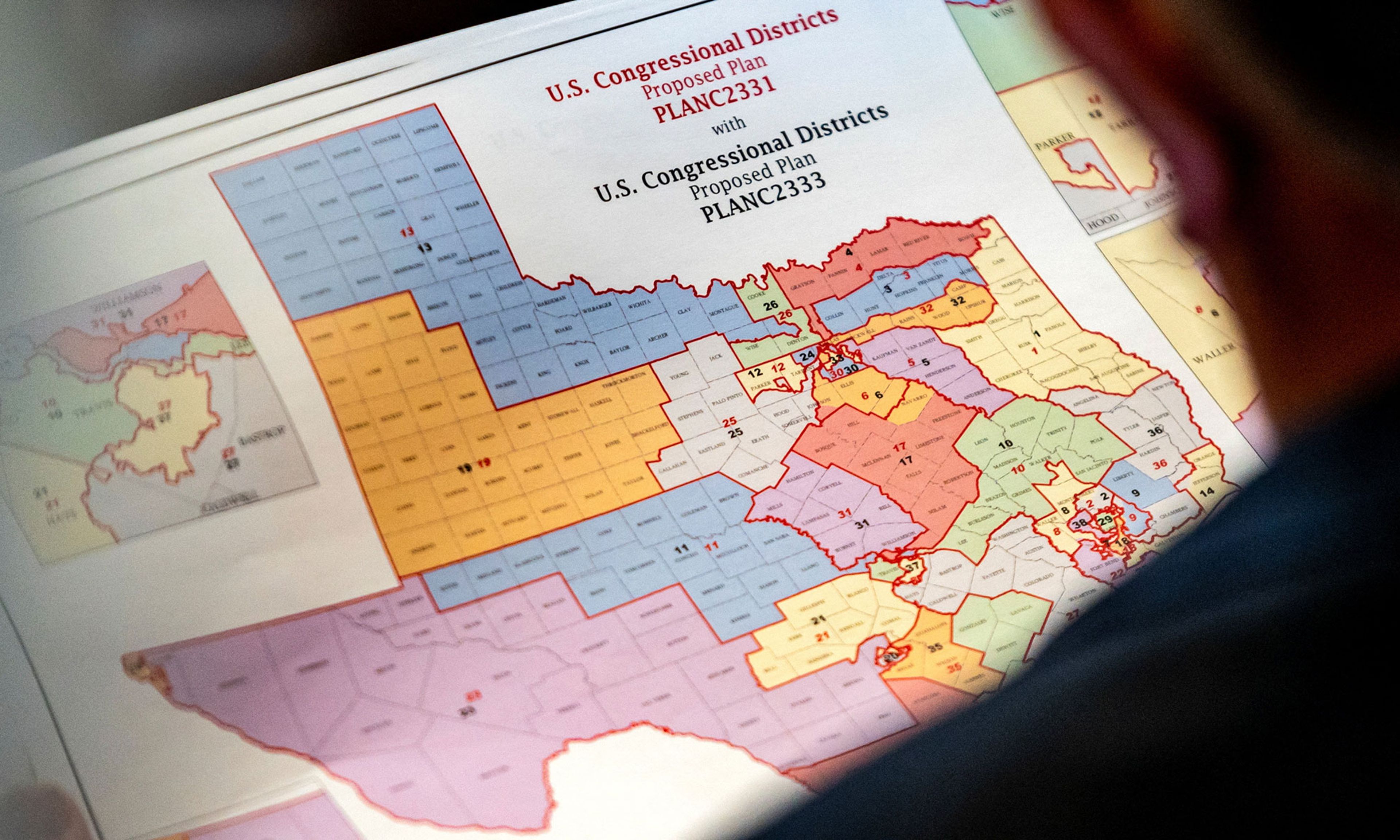
State Representative Matt Morgan (R) holds a map of the new proposed congressional districts in Texas, during a legislative session at the Texas State Capitol in Austin, Texas, August 20, 2025.
The Supreme Court this evening, along familiar 6–3 ideological lines, ruled in Abbott v. League of United Latin American Citizens that Texas can keep its obviously partisan-gerrymandered congressional map in use for the 2026 election. This is a logical and reasonable consequence of the Court's existing doctrines, in light of the need to settle the map in time for Texas House candidates to meet their state's impending filing deadlines.
Let's look at a few of the important considerations here.
First, it is good to settle election rules in advance. It is best to do so by resolving election cases (including challenges to district lines) well in advance of elections. But when suits are brought close to an election, the Court has long adopted the Purcell principle that federal courts should not unsettle state election laws and processes close to an election. Today, the Court extended that principle to situations in which House primaries were not only already underway, but were already beyond remedy: The state filing deadlines for House primaries had passed, so if a new map were drawn, candidates (including House incumbents) could not run for districts that might be drawn differently later by courts. That has consequences not only for House races but for the entire state election system: Representative Jasmine Crockett, for example, is now considering running for the Senate after her House seat was effectively eliminated.
Second, this was very openly a partisan gerrymander, which is not illegal under federal law. You can't sue for unfairness, only for illegality. Justice Samuel Alito, in his concurrence, said what everybody knows: "the dissent does not dispute—because it is indisputable—that the impetus for the adoption of the Texas map (like the map subsequently adopted in California) was partisan advantage pure and simple."
The dissent, by Justice Elena Kagan and joined by her two fellow liberal/progressives, tried to finesse that self-evident truth, framing the question asked by the trial court as follows: "In enacting an electoral map slanted toward Republicans, did Texas predominantly use race to draw its new district lines? Or said otherwise, did Texas accomplish its partisan objectives by means of a racial gerrymander?" (Emphasis added.) But that was always the wrong legal question: The Court's constitutional precedents ask whether race was the predominant consideration, not whether predominant partisanship resulted in the classification of partisans in ways that de facto also classified them by race.
Third, the Court is currently reconsidering its standard for racial gerrymandering, and the justices likely already know how that case will come out. Indeed, the previous Texas map was to some extent based on the idea that the Texas legislature was required by the Voting Rights Act to draw race-conscious districts (like Crockett's). In fact, the prior map had been challenged as discriminatory by the Obama Justice Department, and Governor Greg Abbott argued that rewriting the map was justified by shifts in the Court's jurisprudence that allowed it to be less race-conscious.
With the collapse of all remaining norms around redistricting, it would be better if Congress enacted some basic outer limits and otherwise just left states to do their political thing. But it is not the Court's job to impose rules that Congress hasn't written. Under the rules we actually have, there's no legal reason to delay the use of the new Texas map.

About the Author
Dan McLaughlin is a senior writer at National Review Online and a fellow at National Review Institute.
Featured Tags
Advertisement
Advertisement

Comments