Share this story
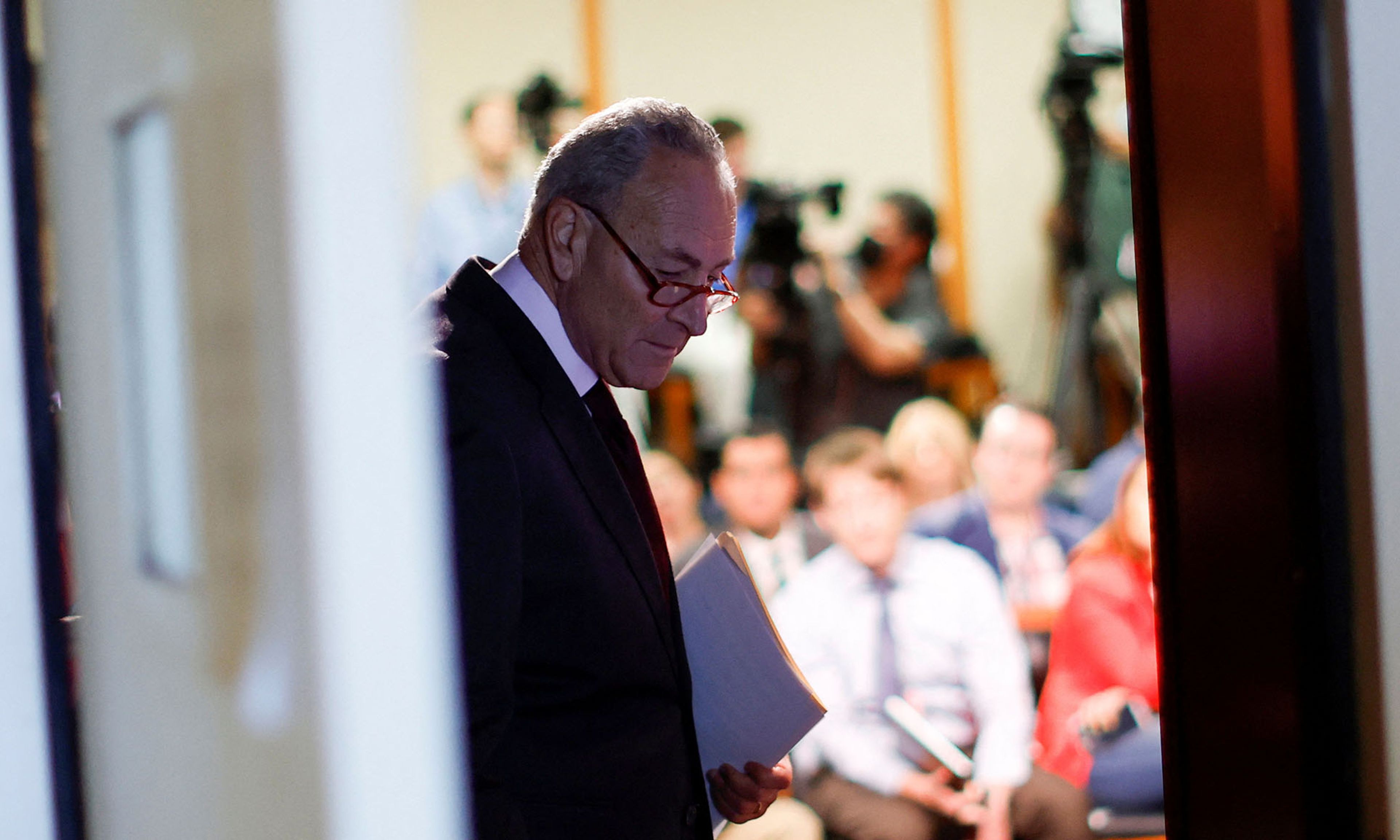
Senate Majority Leader Chuck Schumer (D., N.Y.) departs after a news conference to tout the $430 billion drug pricing, energy and tax bill at the U.S. Capitol in Washington, August 5, 2022.
The distance between rhetoric and action is one of the markers of the dysfunction of our political culture at the moment. Political speech should be directed to, or at least connected to, political action, which means that it needs to recognize the constraints to which policy-making is subject in our republic. Those constraints remain real, but our way of talking about politics has become disconnected from them, and too often this leaves us thinking that the constraints should be removed rather than that our political rhetoric should be pulled back to reality.
The structural constraints on political action in our system are charged with a difficult task: They are there to make sure that our politics is representative of the majority’s will and at the same time that it is protective of minority rights and prerogatives. These goals are obviously in tension, which means that our system is always and purposefully in tension with itself. This can be frustrating for both majorities and minorities — or in other words, for everyone. And it can be especially frustrating when majorities are very narrow, so that both legislative action and the lack of legislative action feel somehow excessive and illegitimate to a large portion of politically active citizens. The two houses of Congress, with their distinct overlapping electorates, and the supermajority requirement the Senate imposes on itself in most circumstances are there to force small majorities to deal with large minorities, and to moderate the pace and scope of action.
That has been plainly evident in the current Congress, in which the Democratic Party holds pretty much the narrowest majority in American history. Considering that fact in light of the institutional constraints on political action in our system, you’d assume that this majority would, at best, enact a small number of modest legislative measures, most of them bipartisan but maybe a couple making use of the exceptional procedures that allow a majority to act on its own. And that is in fact what has happened over the past 18 months.
The Democrats began this Congress by passing a reconciliation bill (which is exempt from the filibuster’s supermajority requirement in the Senate) nominally directed to Covid-19 relief. It’s a bill that could easily have been structured to be bipartisan, as the previous Congress had passed several large bills of that sort with bipartisan majorities. But they decided to make it unpalatable for Republicans so they could take ownership of it. The bill was misguided in some ways, given the threat of inflation that was evident by then, but it was plainly constrained by the narrowness of the Democratic coalition.
After that, the key legislative measures have been an infrastructure bill, a gun-control bill, and a bill funding subsidies for microchip manufacturers and some strategically significant R&D — all of which have passed with bipartisan supermajorities in the Senate. Still in process is a bipartisan reform of the Electoral Count Act that may or may not come together, and another partisan reconciliation bill, which passed the Senate this past weekend and is likely to pass the House. At less than half the size of the reconciliation bill the Democrats passed last year (and about a tenth the size of the bill some of them originally said they would pass this year), this latter measure is still fairly large but greatly curtailed by the dynamics of their coalition and the realities of the political moment.
If you had watched our politics on mute over the past 18 months, you might not have been that surprised by this list. But when you turn up the sound on our politics, you suddenly find yourself in a very different reality. The Democrats, having surprised even themselves by winning two seats in Georgia (with an assist from Donald Trump) and so ending up in a tied Senate they could control with the vice president’s help, somehow persuaded themselves that they could achieve their every fantasy. Joe Biden could be the next LBJ, every constituency in the party could get its ticket stamped in a multi-trillion dollar spending bill, and if they would just get rid of the filibuster they could also rewrite voting rules in every state, enact sweeping gun restrictions, codify the most radically permissive abortion regime in the developed world, and on and on. What couldn’t they do?
Of course, they couldn’t do any of that, because they hadn’t won anything close to the crushing majorities it would take. But in each case, the rhetoric had its own logic, so that it created periods of fevered delirium in our political culture in which the majority toyed with breaking the system and the minority insisted America was being run aground. It’s very hard to stay out of that kind of frenzy. None of us can really do it reliably.
To this day, I think the Democrats don’t grasp, for instance, how utterly mad their scheme to use the narrowest congressional majority in our lifetimes to change election rules in all 50 states at a time of exceedingly low public confidence in election rules really was. Read the speech President Biden delivered on that subject in Atlanta in January. Look at how he described the situation, his opponents, a state law he opposed, the law he supported. Biden’s not crazy, but that speech was totally bonkers. And it’s far from the only example.
This very great distance between action and speech makes it hard to know how to think about what actually gets done in our politics. Given the constraints they had, and maybe especially the very unusual circumstances of a tied Senate, the Democrats got a decent amount passed. The reconciliation bill they are pushing through now could have been much bigger, of course, even within these practical constraints. A year ago, Joe Manchin agreed with Chuck Schumer to spend twice what this bill has ended up spending. Schumer’s mismanagement of the process that followed will be studied as a cautionary tale by future Senate leaders. Mitch McConnell’s maneuvers to trip up and trim down those reconciliation efforts will be a salutary lesson for those same leaders. But on the whole, what this Congress is getting done is well within the range of what its partisan makeup should have led us to expect. It’s just nowhere near where the rhetoric around it has been.
One way for Democrats to deal with that is just to pretend they are achieving far more than they are. This is a natural move for politicians, and it is also how some observers and analysts seem inclined to resolve the tension. On Sunday, reporting on Senate passage of the reconciliation bill, the Politico “Playbook” offered the following example in an analytical tone:
There’s not much debate anymore over whether Biden has been a consequential president. In the long run, his first two years may be remembered as akin to LBJ when it comes to moving his agenda through Congress.
Seriously, that’s what they said. There was no punchline.
For many others on both sides of our politics, however, the preferred solution to the gaping distance between aggressive talk and modest action is to demand ways of enabling more aggressive action. Activists in both parties think their leaders should just pay less heed to structural constraints and “fight” more. Others want to break those constraints, whether by eliminating the filibuster or (particularly on the left) even changing the Constitution.
The explicit premise of such calls is that our system is not sufficiently representative of the will of the public. But their implicit premise seems to be that the system is not representative enough of the will of party activists, and indeed that it is perhaps too representative of a genuinely divided and constructively circumspect society.
But in truth, our politics has come to speak far too exclusively for the activists of both parties, especially thanks to the primary system, which fills political offices with men and women who take themselves to be answerable to a narrow, hyper-engaged slice of the public. Much of our political speech is directed to that activist slice. Our actual governing institutions have not been deformed to the degree that the parties' candidate-selection processes have been, though. That is why they better represent the broader society. And that in turn is a big part of the reason for the gap between rhetoric and action. And it is why many party activists want to deform those governing institutions too.
In fact, the last 18 months speak fairly highly of the design of our governing institutions, and their capacity to compel a deeply deluded political class to deal with reality against its will.
The filibuster has proven particularly important and valuable over this period, and not just to the right — or rather, not just because it restrained the left. Critics of the filibuster often insist that there is no evidence that it can effectively compel bipartisan bargaining over legislation, at least in our intensely polarized era. But there has been plenty of such evidence in this Congress (as there has been in general, of course). The filibuster substantially strengthened the Senate’s position relative to the House, and made possible (by making necessary) substantive bargaining across party lines on a range of meaningful issues. It has forced our polarized, divided, embittered parties to find ways to work together a little. That’s its purpose, and that of the Congress as a whole.
Of course, none of this is to say that conservatives ought to be sanguine about the direction of public policy in this period. Elections have consequences. The two reconciliation bills have been full of bad ideas and waste — and the bipartisan bills haven’t been empty of those either. But a better grasp of reality would help explain that too: Republicans would get something closer to a politics they like if they won more elections, and they would win more elections if they offered the voting public more appealing candidates and ideas. Here too, it’s easy to talk yourself into all kinds of wild conclusions, but the practical reality is relatively simple. Sure, the radicalism of the left could create many opportunities for the right in the coming years. But if Republicans can’t see that they need to get past Donald Trump, that they have to stop letting petty charlatans, infantile celebrities, and deranged conspiracists represent them to the public, and that they should help voters grasp how their lives could be better under Republican governance then they will not be able to seize those opportunities. Our political speech should better conform to these realities, not the other way around.
And that’s the case more generally: Narrowing at least a little that vast gulf between talk and action will require our politics to be better guided by the limits of action, since (as we constantly demonstrate now) there are no limits on talk. Rather than altering the structure of our system to let our action be as aggressive as our talk, we should try to moderate our speech so that it better falls into line with the limits of what our very good system of government guides us toward doing even in times when we’ve all gone mad.
This is actually what a commitment to representative democracy demands. The institutional constraints of the American system force us to deal with the pluralistic reality of American life. The frustration it creates, the necessity of dealing with the other party even when you won the last election, is more true to the state of our society, and more likely to produce the governance the electorate wants, than a simpler majoritarianism. The desire to escape this complex reality, to make narrow majorities look and feel like broad ones, is the problem in our politics, not the solution.
About the Author
Featured Tags
Advertisement
Advertisement

Comments