Share this story
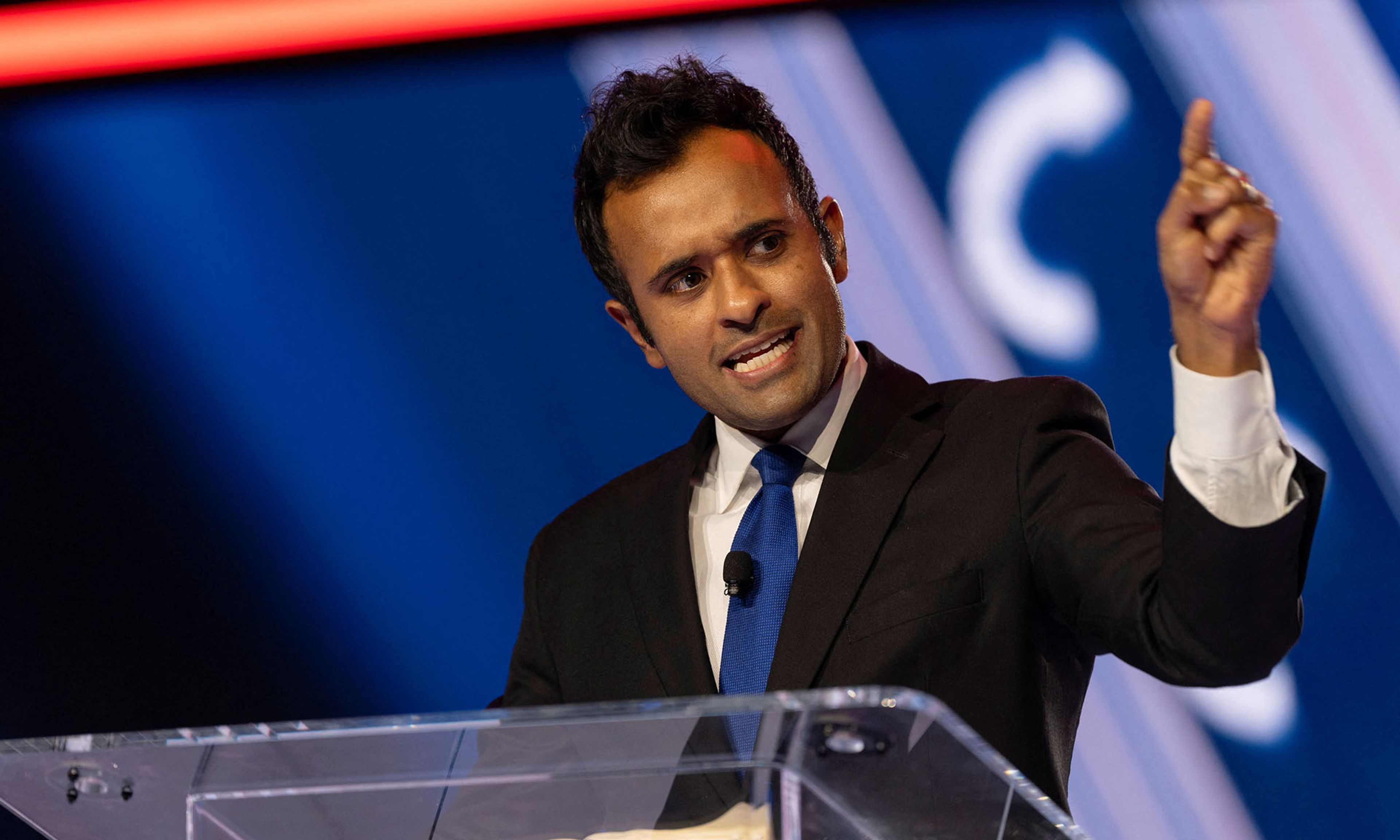
Vivek Ramaswamy speaks during Turning Point's AmericaFest, in Phoenix, Ariz., December 19, 2025.
Vivek Ramaswamy’s speech at Turning Point USA’s flagship event last month is worth watching — both for the content of the Ohio gubernatorial candidate’s remarks, and for the reaction of the crowd.
Because of their growing numbers and influence, some on the right seem to believe that the political success of the GOP playing footsie with racists, bigots, and antisemites. But not Ramaswamy, who accurately argued that the political right currently faces a time for choosing:
It is the American dream that makes American exceptionalism possible. And the answer of what it means to be a conservative — this is what it's up to us to answer. It is a fork in the road for the future of the conservative movement right now. What does it mean to be a conservative? It means we conserve those ideals that define our country. And now is a moment, a time for choosing in the future of our conservative movement to determine with clarity who's actually on that team of conserving the ideals versus who actually is not.
In his speech, Ramaswamy gave a positive vision for what it means to be an American and for what it means to be a conservative. But I want to highlight here what he argued conservatism is not:
If you believe in normalizing hatred towards any ethnic group — toward whites, towards blacks, towards Hispanics, towards Jews, towards Indians — you have no place in the future of the conservative movement. Period. And I will not apologize for that. I will not hedge when I say it. If you believe — and you will forgive me for giving you an exact quote from our online commentator Nick Fuentes — if you believe that Hitler was pretty f***ing cool, you have no place in the future of the conservative movement.
You could debate foreign aid to Israel all you want. That's fine. That's fair. But you have no place with that level of hatred. You could debate the right resolution to the Russia-Ukraine war — but if you believe Joseph Stalin is someone to look up to, you have no place in the future of the conservative movement. If you call Usha Vance, the second lady of the United States of America, a j**t, you have no place in the future of the conservative movement.
And if you can't say those things without stuttering, then you have no place as a leader at any level in the conservative movement.
What do Gen Z conservatives think of this? Very online influencers would seem to strongly disagree. But the audience at the Turning Point event cheered enthusiastically.
And I suspect that the solid majority of young conservatives are with the audience who cheered, and not with the very online influencers and their followers. I hope that theory is put to the test as the political right begins the fight for its post-Trump future.
In my latest Financial Times column, I offered some advice to conservatives about that fight:
What are conservatives to do? First, recognise that those of us who prioritise individual liberty, limited government, free markets, personal responsibility, economic opportunity, America’s “credal identity” and US global leadership are a faction on the political right, and not the whole of the right. Second, conservatives must push the broader political right to enforce ideological borders against extremism. Third, conservatives must resist the ascendant effort to redefine American identity as blood-and-soil nationalism.
I argue that, while we should defend their right to hold and express their appalling and dangerous views, conservatives cannot enter into a coalition with racists, bigots, sexists, and antisemites, or with those who would ally with such extremists:
Why? Because conservatives cannot do so without repudiating their deep commitment to the inestimable and inherent dignity of each and every human being.
This core conviction animates specific policy views. For example, because we hold their dignity in such high regard, conservatives are especially concerned about low-income Americans becoming trapped in dependency by welfare programmes. And conservatives are willing to spend blood and treasure advancing democracy abroad in part because we prize the dignity of those living under tyranny.
I arrived at these commitments from my Catholicism. Pope Benedict XVI expressed this beautifully: “Each of us is the result of a thought of God. Each of us is willed, each of us is loved, each of us if necessary.”
Others can find the foundational importance of universal human dignity in the Declaration of Independence, which 250 years ago set our new nation towards advancing the aspiration that all people are “created equal,” with “certain unalienable rights,” and that governments derive “their just powers from the consent of the governed.”
This year — the 250th anniversary of the Declaration — is a good year for conservatives to remember what it is we wish to conserve, and why. This is a good year for conservatives to remember what our commitments require of our allies — and leaders.
And when selecting our political leaders, we should remember what Ramaswamy so clearly said: “If you can't say those things without stuttering, then you have no place as a leader at any level in the conservative movement.”

About the Author
Michael R. Strain holds the Paul F. Oreffice Chair in Political Economy at the American Enterprise Institute.
Featured Tags
Advertisement
Advertisement



Comments