Share this story
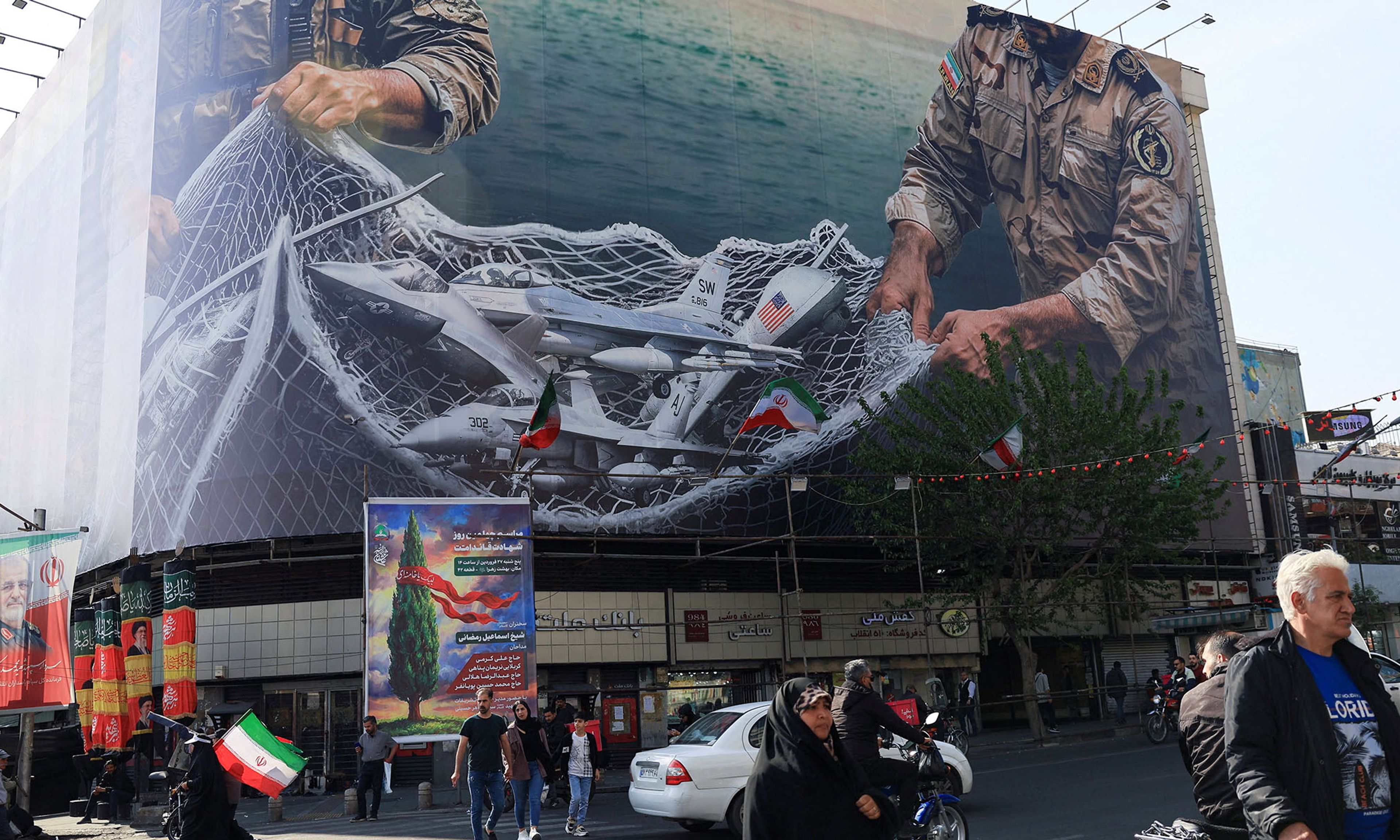
People walk near an anti-U.S. billboard on a building in Tehran, Iran, April 16, 2026.
Sure, the Iranian regime’s leadership is smashed and scattered, its remnants now publicly warring with one another. Yes, its air-defense networks were crushed in the opening hours of the war, followed swiftly by the destruction of its air force, navy, and the defense industrial base it needs if it is to rebuild its depleted arsenal of missiles, drones, and launchers. Iran’s biggest tactical accomplishment of the war, the downing of a single F15-E fighter jet, was muted by America’s response: the most impressive combat rescue operation in U.S. military history, featuring the establishment of a temporary American airbase inside Iranian territory. Iran’s industrial capacity is in tatters, its ports and transit hubs are crippled, and Tehran has never been more geopolitically isolated -- both in its region and farther afield.
Despite all this, in The Economist’s estimation, the Islamic Republic has managed to scratch out a victory for itself over its American adversaries. Its memes are just so dank that, apparently, you have to hand it to the brutal Islamist theocrats in Tehran.
Somehow, the “murderous dictatorship appears to be winning the propaganda battle against the land of the free and the home of Hollywood,” the British magazine averred. The MAGA movement’s proficiencies in that department notwithstanding, Iran and its allies are “out-trolling” the president in the online battlespace.
Iran’s allies around the world and the firms inside Iran that enjoy privileged access to the internet (which is still cut off for its citizens) are circulating AI-generated videos that advance pro-Iranian narratives. They are “witty and show fluency in their enemy’s culture,” The Economist contended. They take aim at an “unpopular war” waged by an “unpopular president,” and therefore appeal to an audience of willing dupes overseas:
The soundtrack is often thumping rap, with English lyrics. The figures are frequently made of Lego. Mr. Trump is portrayed as a vain, cowardly liar who declares victory even as his pants are, literally, on fire. Pete Hegseth, America’s secretary of war, is shown as a vomiting drunk with crusader tattoos.
The Economist’s staffers conceded that the “fluency” in Western culture that awed them isn’t that difficult to achieve. After all, “most AI models are trained on Western content,” which “makes it easy to generate new slop that riffs on Western cultural tropes.” That’s another way of saying that American cultural products have achieved a level of commercial dominance that renders U.S. popular tastes the lingua franca of the international scene.
Still, The Economist’s easily impressed contributors were affected by the degree to which Iranian propagandists could both know and capably manipulate their political priors.
In Iran’s videos, Israeli Prime Minister Benjamin Netanyahu is portrayed as a malevolent puppeteer, dragging Donald Trump into his war -- a trope that appeals to Democrats and the international left. America is cast as a land run by “plutocrats” who spend their days sampling the criminally hedonistic diversions on “Epstein Island,” which also flatters the global far-left’s biases. The clips accuse the U.S. and the Israelis of knowingly committing crimes of war -- accusations that Trump’s critics are all too eager to believe.
The Economist is correct that Iran’s propagandists know their audience. The magazine’s writers seem to fit squarely within it.
They do concede that there are antisemitic themes in these videos, as well as a lot of conspiratorial unreality (including the notions that America is run by the Illuminati, that Princess Diana’s death was no accident, and fanciful claims about the extent of the damage done to U.S. bases in the region by Iranian missiles and drones). “Yet all these nasties flit past your eyes so fast they are easy to miss,” The Economist insists, preemptively absolving those who are inclined to swoon along with the magazine over the propagandization of their prejudices. And, after all, Trump deals in unreality on the internet all the time. The subtext is clear: The Iranians are merely fighting fire with fire.
Indeed, the U.K. outlet closes with a note of triumphalism over how “the world’s cultural superpower is being out-trolled by a regime that whips women for showing their hair.” Its unnamed writers allowed themselves a victory lap: “For the man who let this happen, ‘loser’ seems like an understatement.”
For The Economist and its fellow cheap dates, this is the entire value proposition of the Iranian misinformation campaign. If Trump and America haven’t been humiliated in the theater of war, at least they look like failures on the internet. The piece suffices as depressing proof, not of Iran’s propagandistic acumen, but of the desperation of Trump’s critics for some evidence that America and its allies have been chastened by this campaign. It’s not much, but they’re making the most of what they’ve got.

About the Author
Noah Rothman is a senior writer at National Review. His third book, Blood and Progress: A Century of Left-Wing Violence, will be published by Hachette in May 2026.
Featured Tags
Advertisement
Advertisement

Comments