Share this story
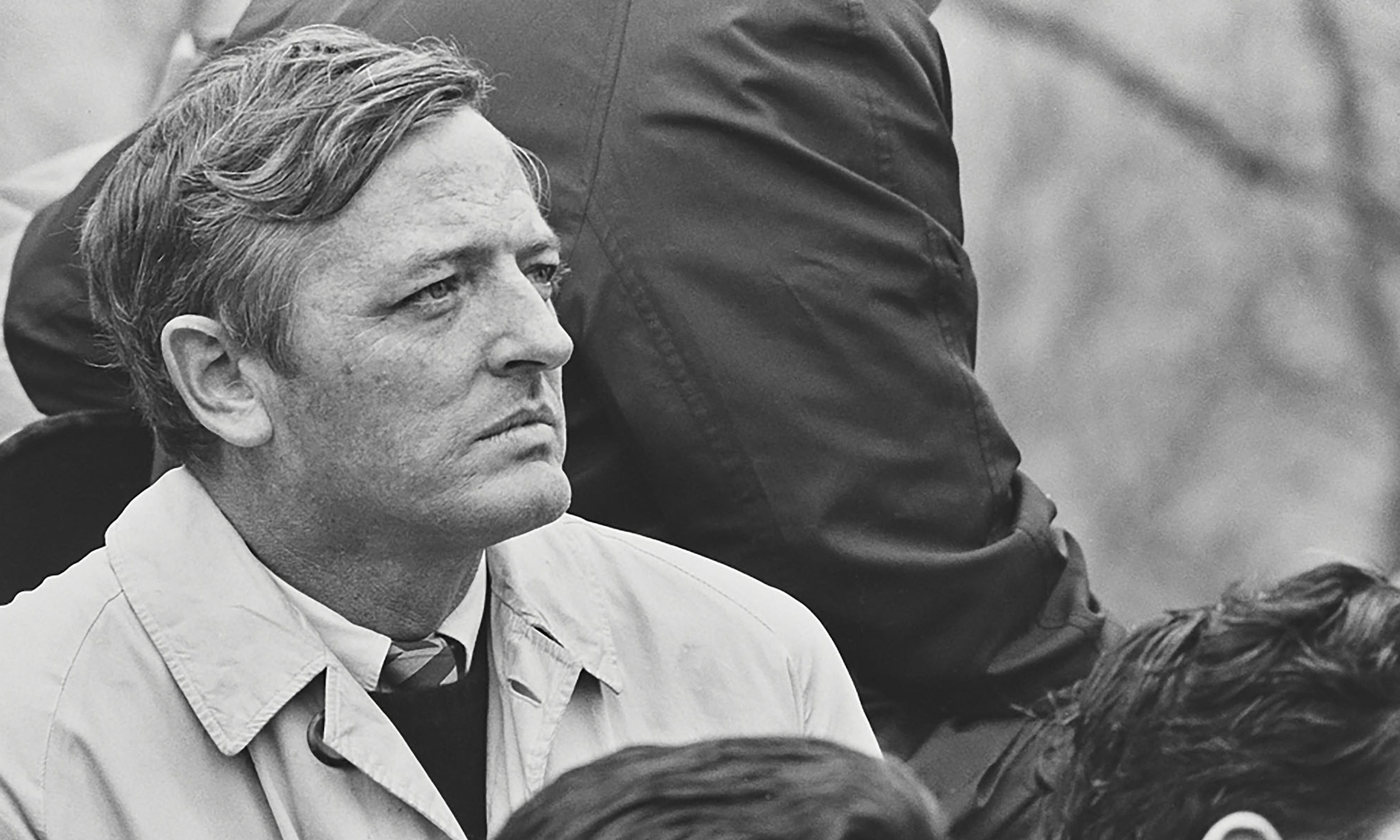
William F. Buckley attends a Martin Luther King speech outside the United Nations building in New York City, April 15, 1967.
I can’t remember when I first encountered Bill Buckley -- in print, I mean, not in the flesh. Actually, I may have first encountered him on the air -- on his show, Firing Line. Early ’80s, probably.
That show had reach. I think of a conversation I had with our Dorothy McCartney. Let me quote from a column I wrote, at the time of her passing (July 2011):
I first knew of her because her name was in Firing Line’s closing credits: She was Bill’s -- William F. Buckley Jr.’s -- research assistant. So the credits would say, “RESEARCH: DOROTHY MCCARTNEY,” something like that.
When I first came to NR, I said to her, “You’re famous.” She sort of blushed and said, “No, I’m not.” I said, “Yes, you are, for the credits!” Grinning, she continued to protest. But then she confided the following: “Once, I was at a bank on Long Island, and handed over a document that gave my name. The teller said, ‘Are you the Dorothy McCartney?’”
Yup.
Like many others, I devoured all of WFB’s books -- collections, journals, novels. The whole menu. As I have said a hundred times, it’s not that he taught me what to think, it’s that he taught me how to think. What an impartation.
Also, certain words, phrases, and exclamations simply . . . seeped into you. Became part of your mental equipment.
In an essay last week, I found myself talking about “an act of lèse-majesté.” That must have come from WFB. A couple of weeks before that, I found myself saying, “All I want in life is for my printer to work.”
I’d once heard Bill utter those exact words. (He was speaking of his home printer, and so was I.)
In addition to reading his books, I read his magazine, of course. There was a certain subversiveness in that. Last month, I filed a report from Copenhagen, and I spoke of a professor and newspaper columnist there: Peter Kurrild-Klitgaard.
He first went to America in 1987, when he was twenty. “I remember getting off the plane at JFK and feeling like I was ten feet tall. The opportunity, the dynamism, the energy” -- America! He was a graduate student at Columbia University. He remembers going down into the subway station at 116th Street and Broadway. At the newsstand there, he would ask for National Review -- which took a little daring.
I recall the quip made by William Safire: “I have to go to the corner newsstand to buy a Hustler magazine in order to have something respectable to hide my National Review in.”
With specificity, I can tell you when I first encountered WFB in the flesh. It was in September 1995 (possibly October). The Weekly Standard had just started. I was working there and we had published, or were about to publish, a review by WFB of Irving Kristol’s latest book. The reviewer stopped by the offices.
He had a warmth and a magnetism that really had to be experienced to be believed. Later, my friend and colleague David Pryce-Jones would refer to Bill’s “thousand-watt smile.”
In ’97, I reviewed a book of WFB’s: The Right Word, his collection on language. (Marvelous volume.) Soon, I had a long, long lunch with him at the Jefferson Hotel. We covered matters political, artistic, and personal (not excluding marriage and death).
A few months later, he emailed me, “Do you ever gad about in a car?” (He may have been the last person to say “gad about.”) We drove from Washington to Stamford to spend a weekend at Bill and Pat’s.
There were plenty of adventures after that. (Some of them, I relate in a piece published last December, here.)
In 1998, Rich Lowry did me the honor of asking me to become National Review’s managing editor. “Trade Georgetown for Brooklyn Heights for a couple of years,” he said. (I never made it to Brooklyn Heights, but I did make it to New York, for a couple of years, plus.)
Before leaving D.C. for New York, I had a call with NR’s associate publisher -- who said, “Hello, Jay, this is Jack Fowler. Welcome aboard and all that stuff.” (He did not exactly say “stuff.”) You remember the movie line “You had me at hello”? Jack had me from those opening sentences.
At NR, there was a cavalcade of personalities. “Inclusio unius est exclusio alterius,” Bill would often caution -- “To include one is to exclude others.” But I will let some names tumble out: Dorothy, Rich, Jack (aforementioned). Rick, Ramesh, Ed, Dusty, Kevin, Russell, Kathryn, Kate, JJM, Frances, Tony, Jeff, Linda, Luba, Jonah, Chris, Cris (different spelling), Mike, Van, Neal B., Priscilla . . .
Priscilla was Priscilla Buckley, one of my predecessors as managing editor. In my office was a filing cabinet with her labels on it -- labels made out in her distinctive hand. One of them said “Odds & Ends.” That’s what I, too, used that drawer for.
At some point, Priscilla asked me to write the foreword to a book of hers -- a collection about her sundry pursuits and passions. One of those was golf. Here is a fact I love: In competition at her club, she won the trophy named after her.
A word about Frances, maybe? Frances Bronson was Bill’s secretary -- formidable woman, who put the fear of God into many. Essentially, though, she was a fun-loving product of London’s East End. “Hiya, ducks,” she’d say. She loved music and the musical theater. Late in her life, I took her to a recital by Alice Coote, the English mezzo-soprano. On the program were several classic English songs. Frances knew every note and every word.
Dusty? More formally, he was Thomas L. Rhodes, and he was National Review’s president. He had been a scrappy Welsh-American kid, living in Spanish Harlem. Long story. In fact, I told it in a little biography I wrote of Dusty, at the behest of his wife, Gleaves. She wanted it for their grandchildren. I began with a trio of limericks, in tribute to Dusty.
Dusty liked to compose and recite limericks, when paying tribute.
For the millennium -- 1999 turning into 2000 -- we had a standout issue. Saul Bellow, Jean-François Revel, and Richard Pipes were among the contributors. Czesław Miłosz sent his regrets (from Krakow). (I wrote about this in a 2017 piece: “Notes, Asides, and Memories.”)
I think of another issue -- the one whose “Production Tuesday,” as we say at NR, was 9/11. (Let me throw another link at you: I discussed this in a speech I delivered on the first anniversary of 9/11 -- here.)
Over the years, I have gotten to know a great many readers. Some are fast friends. I began my Impromptus column in March 2001. A few readers, I have been corresponding with since the ’90s. The previous century.
I’m fond of saying that, for some reason: “the previous century.”
Last year, I was speaking to a group of students at Cornell and I said (something like), “But remember, I come from the previous century.” My young colleague Manfred said, “From the previous millennium.” Well, that too.
My time at NR has now come to an end. Readers who would like to remain in touch with me may do so at jnordlinger@gmail.com. God bless you all.
About the Author
Jay Nordlinger was a senior editor of National Review and a book fellow at National Review Institute.
Featured Tags
Advertisement
Advertisement


Comments