Share this story
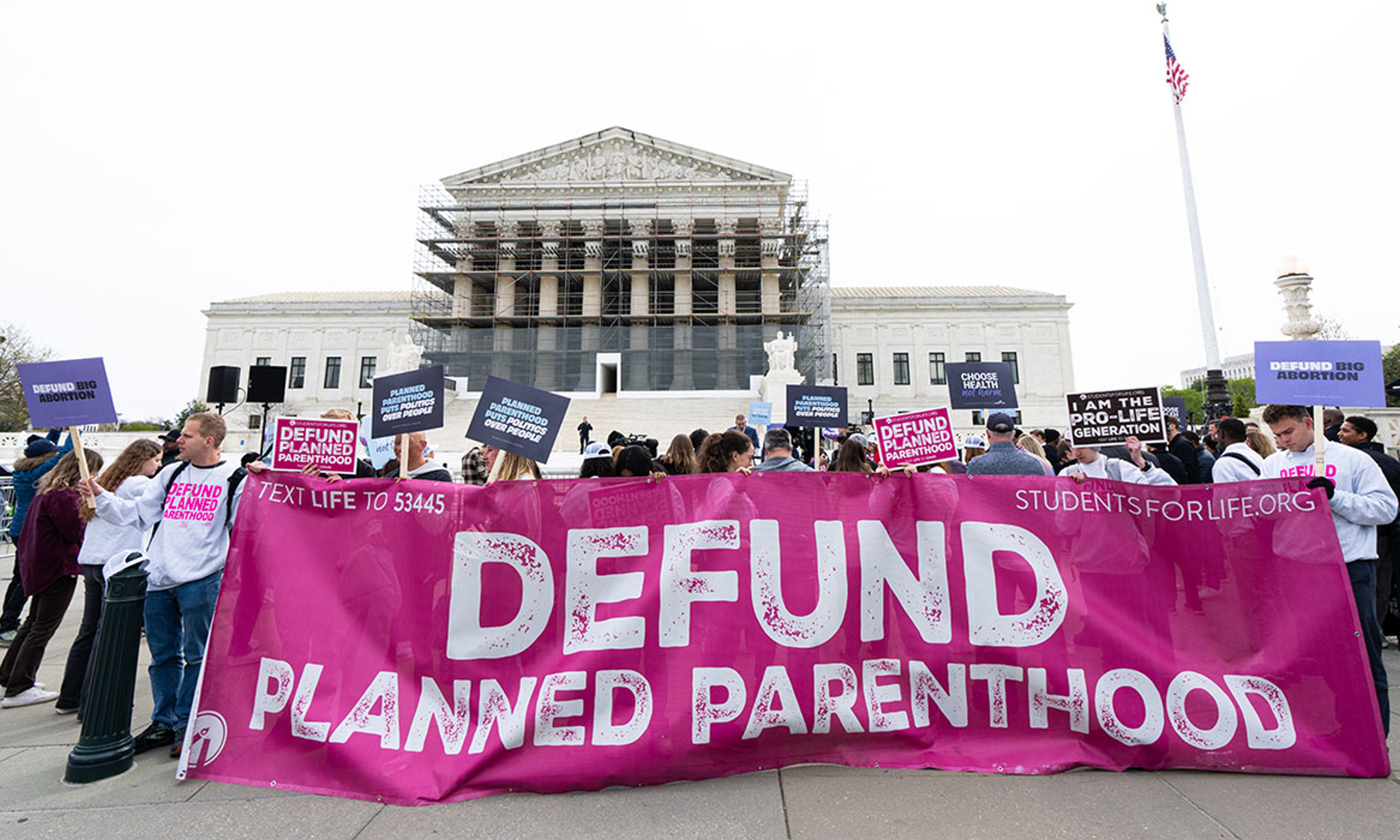
Activists opposing funding for Planned Parenthood demonstrate in front of the Supreme Court as the <i>Medina v. Planned Parenthood South Atlantic</i> case is heard in Washington, D.C., April 2, 2025.
The news on life and death never takes a vacation. So, here’s another dose of NR’s new pro-life weekly newsletter. Thanks for stopping by. Make sure you and those you love get this in your email inboxes. Hopefully, it will be something welcome for you to open on Friday mornings! Sign up here.
Kathy Hochul, Come Hang Out with Me at the Albany Amtrak Station
Whoa. Who’s that? Seems disturbingly familiar.
Oh. It’s just me. Staring back at me.
It felt strange standing at a newsstand and seeing my syndicated column right there on the cover of the local paper. I’m not actually sure I’ve ever had that experience in my more than 20 years of having a syndicated column with United Media and now Andrews McMeel Universal.
But there I was, at the Albany, N.Y., Amtrak station. After my initial surprise, I felt grateful that The Saratogian was running and highlighting my recent assisted-suicide column in a capital-area paper. We may share a name and a state, and we may both be baptized Catholics, but I don’t expect Governor Kathy Hochul has to wait for (late) trains. Still, every pickup of the column — and in wonderful print! — increases the possibility that she’ll read it. This was the column.
I want her to feel the Pope Francis vibe, though. She is more likely to listen to him than to me. Meanwhile, we’re still waiting — and praying — as she determines whether or not assisted suicide becomes law in the Empire State.
Planned Parenthood’s Cultural Grip Loosens?
The big news is not surprising news: The Supreme Court upheld South Carolina’s Medicaid cuts. Dan McLaughlin writes about the decision here. In the short term, it reinforces the campaign, or movement, to defund Planned Parenthood — which has organized rallies this weekend to encourage the Senate to come through with its own relevant funding cuts, through the reconciliation bill. Many pro-life activists are hoping for something more to celebrate on this Fourth of July.
If Congress does defund Planned Parenthood, the organization will be counting on blue-state governors to come through with emergency funding. But the future of health care in America must be led in no small part by alternatives to Planned Parenthood. We know that there are many other federally funded community health centers around the country (see this recent conversation I had with Tessa Cox of the Charlotte Lozier Institute about their research on the landscape), but what we really need are more wholistic options — including faith-based ones such as the Heart of Christ clinic in Detroit. Louis Brown, of the Christ Medicus Foundation, has the vision, as he mentioned in a short reflection on the three-year anniversary of the Dobbs decision, which we are marking this week.
On the occasion of the Dobbs anniversary, I had a conversation with a Miami radiologist and pro-life doctor, Grazie Christie. She’s a frequent commentator, a volunteer at local pregnancy-care centers, and a member of the Florida State Board of Education. Watch our conversation here. I also shared some memories and thoughts about the future, from my office at NR headquarters, talking to my computer, as we do. Maybe I’m talking with you, too?
Life in Post-Dobbs America
There are several events — including Celebrate Life with the organizations Students for Life, And Then There Were None, Sidewalk Advocates for Life, and others (and Riley Gaines, with child, will be there) — in Washington, D.C., this weekend. I plan to say a prayer outside Manhattan’s Planned Parenthood, formerly named after the organization’s eugenicist founder, Margaret Sanger. The clinic is set to close, but at the moment it remains open and provides chemical abortions and gender transition treatments (puberty blockers and referrals).
The day of the Dobbs oral argument, I spoke at the rally outside the Court, emceed by the glorious Alison Centofante. She is perfect for the role because she exudes the kind of joy about life that we need to communicate — that the world needs the pro-life movement to communicate, in the most magnetic ways. Now, three years out, I asked Alison and others to share their thoughts on our post-Dobbs America. This is a little of what she wrote:
Let’s be honest: everything in our culture tries to scare women away from motherhood. From medicine to marketing, the message is the same — babies will ruin your body, your future, your identity. But I’m watching women rise in resistance. Choosing to have a baby in today’s world isn’t weakness — it’s radical strength. To say yes to sacrifice, to stretch marks and sleepless nights, to real legacy and love — that’s a countercultural revolution. It’s the most rebellious cool thing you can do — it’s a respectful middle finger to a world who too easily looks down on children and the devoted moms and dads who raise them.
How’s that for encouragement? You can read more from Alison here.
You can also read reflections on the third anniversary of Dobbs by Abby Johnson (who mentions a powerful night in Manhattan we got to experience together), by Dan Darling of the Land Center for Cultural Engagement at the Southwestern Baptist Theological Seminary, and by Alexandra DeSanctis, an NR contributor over at the Ethics and Public Policy Center. And you may see a few more during this Dobbs anniversary weekend elsewhere in National Review. So keep an eye out.
So much can be deflating — including (especially, sometimes?) on the right. There’s a slightly below-the-surface debate underway about whether women should stay at home or work outside the home. The old-school mommy wars, trad wife style. Our Haley Strack got into it a little. Look, families necessarily look different in different homes. Women who have degrees often don’t want their skills to atrophy. Often, too, they really have no choice but to work outside the home. Let’s not shame anyone for making choices that contribute to her family and community. Yes, the women-can-have-it-all promises are as realistic as most Barbie dolls. But it is amazing the things mothers are capable of — especially with a husband who has stepped up to the plate. A dear friend of mine lost her husband a few years ago, and the only time I ever heard her swear was to say: “Being a single mother is so f***ing wrong.” She, a single mother now, wasn’t making a moral judgment. She was stating a fact. It’s impossible. And yet she pulls off the impossible. That’s what we all must be committed to supporting. That’s what the pro-life movement is about.
Do You Know First Choice?
First Choice is the pregnancy resource network in New Jersey, whose case against the state attorney general is headed to the Supreme Court next term. This week, I talked about it with Erin Hawley of the Alliance Defending Freedom. (No, neither organization is subsidizing this newsletter, but we’d be happy to talk — anyone can donate to National Review Institute or support our beloved National Review magazine.)
Key to our conversation is Aimee Huber, director of the New Jersey centers. Get to know her over these next months. Get to know your local pregnancy care director. And, if you are one, thank you. Watch my conversation with Erin Hawley and Aime Huber here.
Making a Killing Across the Pond
The British House of Commons is a disgrace to free societies. It has voted in favor of assisted suicide, despite all kinds of warnings — maybe especially shocking among them the warning that the practice might be extended to those who are suffering from eating disorders, as it sometimes has been in other jurisdictions where it is legal.
Assisted suicide poses many dangers (as Sally Pipes recently wrote about in Forbes). One of the most pernicious examples, however, involves a baby in Canada. She has Down syndrome, and she has been denied a liver transplant, despite allegedly being a good candidate for one. The family doesn’t trust the care she is getting — which involves a recent overdose of medication — as doctors have actively suggested to them the euphemistically named Medical Aid in Dying, a go-to term for the efficiency of eliminating medical problems (such as, sometimes, human life).
There is much more to say, but here I am after the vote, in a mood and at an important historic site in upstate New York.
The Drugging of America
Back to Albany: Apparently, when I got to the station, I had just missed a woman’s death. An Amtrak employee told me a woman had overdosed on the train. (Erin DeLullo, by the way, has an amazing Substack newsletter on the fentanyl problem in America, highlighting heroes who are saving lives in the midst of it. It’s called The Poisoning, and I’m a paying subscriber.) I bring it up because what’s happening to children on account of opioids absolutely has to be of concern to pro-lifers, to conservatives. In Arizona alone, 42 children (that we know of) have either died or come close to dying because of fentanyl poisoning since 2020. I mention Arizona because the Center for the Rights of Abused Children is based there and is part of the solution there and nationally. You may have seen the National Adoption Month interview I did with its founder and CEO, Darcy Olsen, here. If you are a lawyer who can donate time to represent children, check out the center’s legal clinic and get in touch. (I’m happy to make a connection: klopez@nationalreview.com)
Democrat for Life — Keep Hope Alive (And, Yes, Jesse Jackson Was Once Pro-Life)
Let’s end this week’s Lifeline with a reflection from Dan Lipinski, the pro-life Democrat who represented Illinois in the U.S. House until he was primaried by the abortion industry. (Its political involvement is one of myriad reasons to defund Planned Parenthood.) Here’s the former congressman, now distinguished visiting fellow at the Hoover Institution at Stanford University and Pope Leo XIII Fellow on Social Thought at the University of Dallas:
Listening live to the Supreme Court’s oral arguments on Dobbs was surreal. One month later at the University of Notre Dame, I speculated about what I thought was almost impossible — the political world in a post-Roe America.
On this third anniversary of Dobbs, I look back at my predictions and see that while the worst-case scenario has not come to pass, some of my concerns have been realized. But I remain hopeful.
The good news is that trigger laws in some states immediately resulted in abortion limits. The extreme federal abortion bill — worse than Roe — has so far failed to become law, though Democrats did pass it in the House in 2021 and will likely bring it back.
With regard to implementing federal laws limiting abortion, the bad news is that many Republicans did what I had predicted for years. With the political stakes suddenly raised, they declared abortion to be exclusively a state issue. Never mind their boasts in 2017 of passing a 20-week abortion limit in the House.
The national Republican Party now takes pro-life voters for granted because almost all pro-life Democrats have been eliminated from federal office. The abortion groups knew what they were doing when they prioritized getting rid of Democrats such as me.
At the state level, on the whole the news has been bad as we have seen a number of disastrous results on ballot referenda.
So what should pro-lifers do now?
While the primary focus should be on the states, we should work for federal abortion restrictions at the federal level which are sensibly achievable in the foreseeable future.
Especially with Democrats in deep turmoil, we should support pro-life Democratic candidates to try to create a beachhead in the party and force Republicans to compete again for pro-life votes.
Most importantly, we need to win people over to the truth and beauty of protecting life.
In a just world, Lipinski would still be in office. Check out his regular column in The Pillar.
And come back to the Lifeline next time. Send me your ideas and stories and complaints. If you are at a university or with a group that works on college campuses, let’s talk. Now is the time to link up calendars for talks on the culture of life and more. This November will be the 100th anniversary of Bill Buckley’s birth, so if you want to know why WFB would want all cool college kids and everyone else to be pro-life, I’m your gal (again: klopez@nationalreview.com).
Later. And sign someone up for this newsletter. Thank you.

About the Author
Kathryn Jean Lopez is a senior fellow at the National Review Institute and the religion editor of National Review. Sign up for her weekly newsletter here. She is the author of A Year with the Mystics: Visionary Wisdom for Daily Living.
Featured Tags
Advertisement
Advertisement





Comments