Share this story
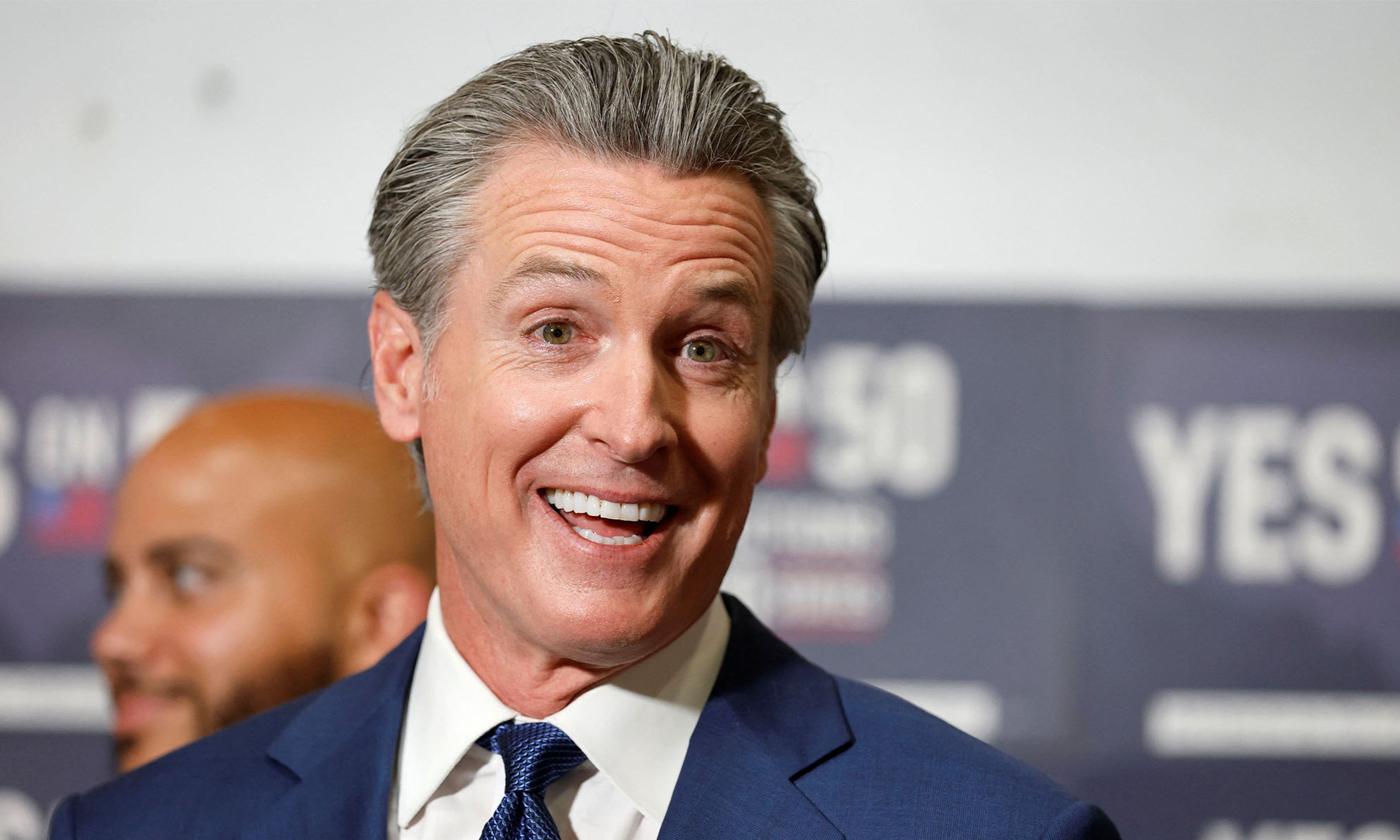
California Governor Gavin Newsom speaks after he and other lawmakers signed the "Election Rigging Response Act" in Sacramento, Calif., August 21, 2025.
On the menu today: What would it take to get you to reverse and dismantle one of your father’s biggest accomplishments? For one California lawmaker, it’s the potential to gain five seats in the U.S. House of Representatives.
Governor Newsom Makes His Move
Back in December 2021, all 14 members of the California independent redistricting commission unanimously approved new redrawn lines for 120 districts for the state legislature, 52 for Congress, and four for the California State Board of Equalization for use in 2022 elections. The commission had heard from the public and engaged in considerable debate. Plenty of factions within the Golden State didn’t like all the results . . . but no one sued. No one could come up with an argument that the lines were unfair, biased, or discriminatory that would hold up in court.
In November 2022, Democrats won 40 of the 52 seats in California, or almost 77 percent of the seats. Statewide, Democrats won 63.3 percent of the vote. Republicans could gripe, but that’s the way the cookie crumbles -- sometimes a candidate wins with 51 percent, and sometimes, like Kevin McCarthy that year, a candidate wins with 67 percent.
In 2024, Democrats won 43 of the 52 seats, or 82.6 percent of the seats. Statewide, Democrats won 60.4 percent of the vote. Republicans won 39.2 percent of the vote, but ended up with just 17 percent of the seats.
This is the map that California Democrats insist is so unfair to themselves and must be redrawn even more to their favor to be fair and just.
California voters authorized a bipartisan commission to redraw state legislative district lines, and they passed the VOTERS FIRST Act in 2008. Two years later, voters decided to give the commission responsibility to redraw congressional districts as well. That passed overwhelmingly -- 61.2 percent for yes, 38.7 percent for no.
The year 2010 wasn’t that long ago, but the idea of putting the redistricting process into the hands of an evenly split bipartisan commission had broad appeal. The Congressional Voters FIRST Act was supported by the Republican then-Governor Arnold Schwarzenegger and his former Democratic rival, Gray Davis.
One of the other big supporters of redistricting reform back then was California state senator Alan Lowenthal, a Democrat from Long Beach. In fact, you could argue that Lowenthal was one of the architects of the proposal to have congressional district lines redrawn by the commission.
Lowenthal ran for Congress himself in 2012 and defeated Gary DeLong. The first bill he introduced in Congress, the “Let the People Draw the Lines Act,” required states to implement independent redistricting commissions to end gerrymandering of congressional districts and give citizens more direct control over the redistricting process.
Throughout Lowenthal’s time in Congress, bipartisan independent redistricting remained one of his most ardent crusades, and he pushed for legislation and filed amicus briefs at the Supreme Court in cases involving gerrymandering.
In 2017, Lowenthal said, “The political gerrymandering of our Congressional districts — which attacks at the bedrock right of every American to fair representation — has seriously undermined the public’s trust in our democratic system. It is time to get the back room out of the ballot box. . . . [E]very citizen in every state deserves to have the same ability as citizens in states like Californian now have to draw their congressional district boundaries without the influence and gamesmanship of politics.”
A joint press release with GOP Representative Brian Fitzpatrick noted, "Lowenthal led the charge on redistricting reform while in the California State Legislature, eventually leading to the citizens' referendum that created an independent redistricting commission."
The Founders built the House of Representatives to be the chamber closest to the people, and therefore, must be accountable to the voters. For far too long, politicians from both parties have used gerrymandering to draw their own districts, choosing who will be voting for them. Requiring states to implement independent redistricting commissions, similar to California and Arizona, will restore the peoples voice in the process and make politicians accountable to the voters.
In the 2022 election cycle, Lowenthal chose to retire. But that same year, his son, Josh Lowenthal, ran for the California State Assembly and won a seat in the chamber. And yesterday, Josh Lowenthal voted to undo one of his father’s signature accomplishments:
Assemblymember Josh Lowenthal, a Long Beach Democrat whose father had pushed for nonpartisan redistricting as a state lawmaker and Congressman.
“It’s imperative that Californians have a voice in selecting the political party that controls Congress in 2026,” said Lowenthal in an emotional speech from the floor before the vote. “So today, I proudly join with my father, the architect of this commission, in urging its temporary suspension.”
Temporary, you see! Surely, once California’s state lawmakers feel like there’s no longer a need to maximize their partisan advantage, they’ll give the power right back to the bipartisan commission! As we all know, lawmakers love to give back emergency powers, particularly ones that influence their political ambitions and future bids for office.
(In other news, there are 44 national emergency declarations still in effect. The oldest, the National Emergency with Respect to Iran, was declared by Jimmy Carter back on November 14, 1979. In 1973, the federal government realized that four national emergencies had never been declared over, including one by Franklin Roosevelt that declared a bank holiday from March 6 to March 9, 1933.)
Despite Lowenthal’s emotional speech, there was not much hesitation among California Democrats.
The state assembly passed the measure 57 to 20, and “lawmakers on the floor erupted in applause even before they closed the vote. The Senate passed it hours later on a party-line vote, 30-8. [Governor Gavin] Newsom declared a Nov. 4 special election shortly afterward.”
Cal Matters reports that some are calling the new lines the “Gavinmander.”
As noted earlier this week, the state of California faces a lot of serious and worsening problems: high unemployment, high cost of living, high poverty rates, a major deficit, high state taxes, high crime rates, high rates of seriously underperforming students in public schools, and an extremely slow process of rebuilding Los Angeles. And Governor Gavin Newsom has decided that redrawing the U.S. House district lines is one of his top priorities.
But these new lines are not a done deal; in November, the voters of California must approve the new lines, and as much as the Golden State is heavily Democratic, a majority has always liked the idea of independent commissions controlling the redistricting process.
The early polling is contradictory. Axios reported, “David Binder, a prominent Democratic pollster who has long worked for Newsom, found that 57 percent of California voters backed the redistricting measure, while 35 percent opposed and 8 percent were undecided.”
But earlier in the month, a survey by the Politico Citrin Center Possibility Lab found that “by nearly a two-to-one margin, voters prefer keeping an independent line-drawing panel to determine the state’s House seats. Just 36 percent of respondents back returning congressional redistricting authority to state lawmakers.”
The UC Berkeley Institute of Governmental Studies poll, conducted for the Los Angeles Times, found, “When voters were asked whether they agree with California’s redistricting maneuver, 46 percent said it was a good idea, while 36 percent said it was a bad idea. Slightly more, 48 percent, said they would vote in favor of the temporary gerrymandering efforts if it appeared on the statewide special election ballot in November. Nearly a third said they would vote no, while 20% said they were undecided.”
I strongly suspect that the wording of the question influences the responses.
I’d prefer to see as many competitive House seats as possible, and neither party has particularly clean hands when it comes to this extremely longstanding process. (It’s named after former Massachusetts Governor Elbridge Gerry, over a redistricting bill signed in 1812. The redistricting plan was supported by Joe Biden*.)
It is just deeply, painfully ironic that because of 2028 presidential ambitions, two of the Democrats who are the loudest and most strident in their denunciation of Texas redrawing its district lines this year are Newsom and Illinois’s JB Pritzker, governors of two of the most ludicrously gerrymandered states in the country. It’s like a MeToo rally being led by Bill Clinton and Eliot Spitzer.
*For every hyperactive fact-checker and “right-wing disinformation” activist out there, this is a joke.
ADDENDUM: We keep hearing about how menacing and unstoppable the Russian forces in Ukraine are. In fact, you don’t have to look too hard to find arguments that the Russian army is not only bigger than it was before the war, it’s “stronger than ever.”
Karl Rove’s most recent column points to reporting from the Wall Street Journal about Mikhail Simdyankin, a Saint Petersburg warehouse manager who decided to sign up with the Russian army once the signing bonus hit 2 million rubles -- $24,819.97 in dollars. He had no previous military experience and figured he would end up in some role in logistics.
The Russian army sent him to the front lines in Ukraine after three weeks of training. He was wounded with what is described as “a debilitating limp,” but Simdyankin’s commanders ordered him to charge ahead anyway.
Simdyankin survived against the odds. Most of the 100 soldiers in his assault group were severely injured or killed in less than a month. His mission to the factory turned into a harrowing sprint — but what he saw when he reached the garrison left him even more shaken.
“Our commanders saw us as expendable,” said Simdyankin, who is now being held at a prisoner-of-war camp. “They didn’t care whether or not we survived.”
This account is based on interviews with Russian soldiers held as prisoners of war at four locations throughout Ukraine and conversations with Ukrainians who fought against them for control of the factory. The Wall Street Journal also reviewed intercepted radio communications and videos recorded by soldiers on both sides to capture a rare picture of Russian troops’ experience of the war.
How strong is an army if a bunch of their guys have three weeks of training?

About the Author
Jim Geraghty is the senior political correspondent of National Review.
Featured Tags
Advertisement
Advertisement


Comments