Is Pursuing Regime Change in Iran Worth the Risk?
Written by Jim Geraghty
Share this story
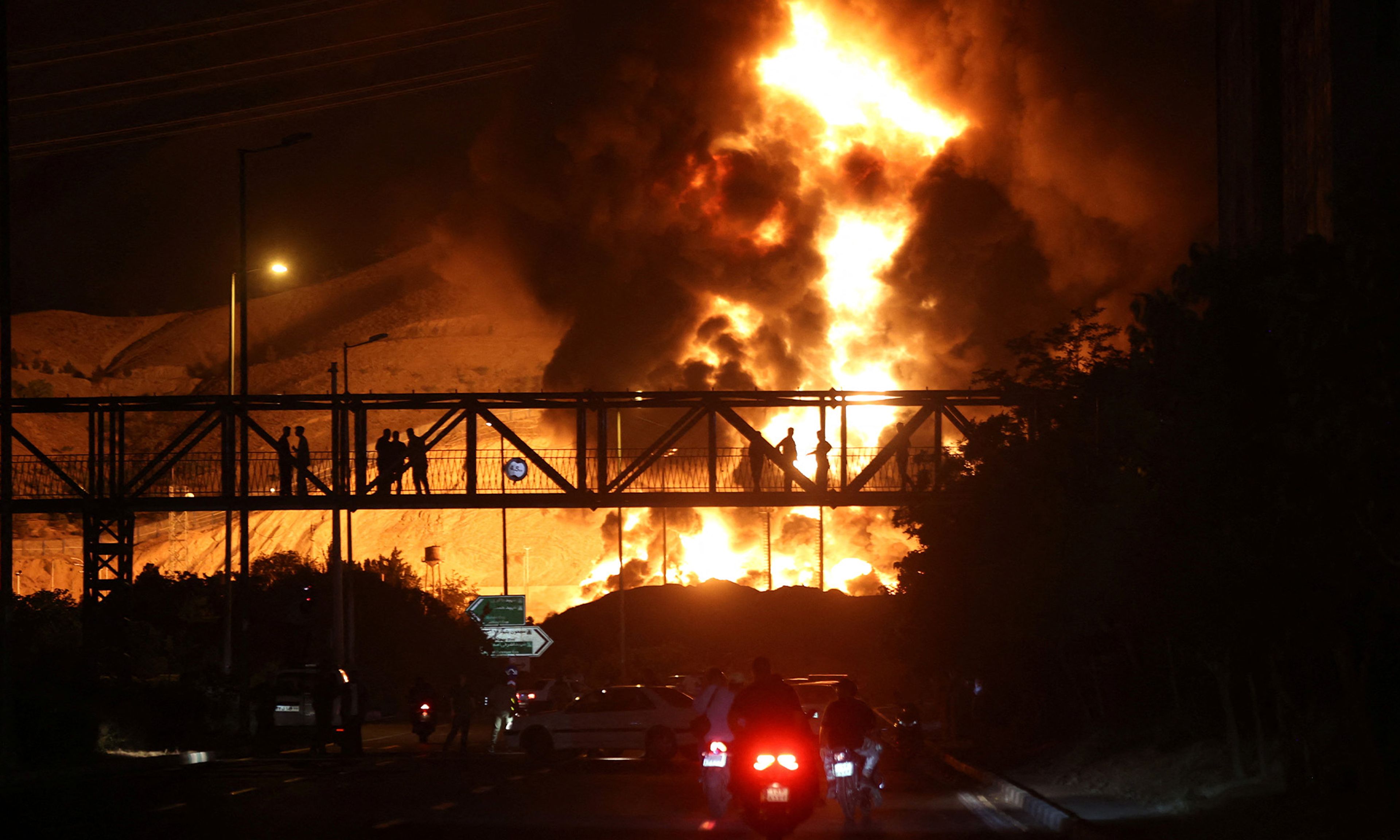
Fire of Israeli attack on Sharan Oil depot is seen following the Israeli strikes on Iran, in Tehran, Iran, June 15, 2025.
On the menu today: A busy night on the Iran front as President Trump urges Iranian citizens to evacuate Tehran and cuts short his trip to the G-7; the Iranian regime urges its people to “enjoy martyrdom”; Israeli Prime Minister Benjamin Netanyahu says that regime change isn’t the intended objective of the ongoing airstrikes and covert operations but may be a result of it; Ayatollah Khamenei is reportedly in a “difficult mental state” -- I’ll bet he is!; and one particular administration official wasn’t invited to the big Camp David meeting in the run-up to the Israeli strikes. I’ll bet you can guess which one, with the benefit of hindsight.
Turning Up the Heat on the Islamic Republic of Iran
Monday night brought two signs that the U.S. position in the Israel-Iran war may be changing.
At 6:30 p.m. Eastern, President Trump posted on Truth Social:
Iran should have signed the “deal” I told them to sign. What a shame, and waste of human life. Simply stated, IRAN CAN NOT HAVE A NUCLEAR WEAPON. I said it over and over again! Everyone should immediately evacuate Tehran! [Emphasis added.]
Tehran is home to nearly 10 million people; evacuating the entire city and/or metropolitan area would be a considerable challenge. Nonetheless, videos on social media showed long lines of cars of Iranians trying to get out of the city Monday night. Keep in mind, Tehran has no public bomb shelters; an Iranian journalist who asked to not be identified told the BBC why:
We don't have the luxury of shelters. We have a subway, which is very good and clean, comparing to Cairo, subways or somewhere else. But subways are not open to the people after 10.30. Otherwise, you can go to the basement of your own building, which is the ruling establishment since the beginning of the revolution, has never ever thought about the shelters because there is a culture which is the culture of martyrdoms. So in this society going to the shelters when there is a jet fighting or looming around it indicates your chicken heartness. So, you should brave and brace for the bombardments and enjoy martyrdom.
“Enjoy martyrdom.” Funny, I don’t see the Ayatollah above ground, getting ready to enjoy it himself.
About an hour after Trump’s evacuation post, the White House announced the president would return to Washington from the G-7 summit in Canada on Monday night to attend to many “important matters.” Before leaving, President Trump agreed to sign on to a modified statement to the G-7 leaders; the updated version “omitted language that called for both Iran and Israel ‘to show restraint,’ which appeared in an earlier draft of the agreement viewed by The Washington Post.”
On paper, the United States of America is not a direct combatant in the Israel-Iran war. In practice, we have longstanding diplomatic, security, and cultural ties to one combatant and the other combatant uses “death to America” chants about as frequently as commas. (They haven’t dropped the habit; crowds of Iranians are still chanting it during this conflict.)
And while U.S. military forces are not involved in attacking Iranian sites, U.S. military forces are involved in shooting down incoming Iranian ballistic missiles that have been fired at Israel:
Iran has fired about 200 ballistic missiles in four barrages and more than 200 drones toward Israeli territory so far in response to multiple waves of Israeli strikes, an Israeli military official said. Before the retaliatory strikes even began, U.S. jet fighters, Navy destroyers and ground-based air-defense systems had positioned to help counter any attack, according to U.S. officials. . . .
U.S. ground-based interceptors also helped defend Israel in the latest barrages, the officials said. The U.S. operates several Patriot antimissile batteries across the region, moving them around to address perceived aerial threats. They are concentrated in Arab countries on the Persian Gulf, where the U.S. operates sprawling military bases, as well as Jordan and Iraq.
As the current administration’s State Department puts it, “Steadfast support for Israel’s security has been a cornerstone of American foreign policy for every U.S. Administration since the presidency of Harry S. Truman. Since its founding in 1948, the United States has provided Israel with over $130 billion in bilateral assistance focused on addressing new and complex security threats.”
Israeli Prime Minister Benjamin Netanyahu gave an interview on Fox News Channel’s Special Report with Bret Baier Sunday. Netanyahu said Israel wasn’t intending to topple the regime that runs Iranian territory . . . but that he does see that scenario as a potential outcome:
Bret Baier: What is the goal of these strikes? You talked early in one of your speeches after the attacks began, with a message directly to the Iranian people. Clearly some of these strikes have targeted Iranian leadership, military, nuclear scientists and other leaders. So, is regime change part of the effort here?
Benjamin Netanyahu: It could certainly be the result, because the Iran regime is very weak. I think it's basically left with two things: its plans to have atomic bombs and the ballistic missiles. That's basically what Iran has. They certainly don't have the people. Eighty percent of the people will throw these theological thugs out. I mean, they, they murder them. They oppress them for 46 years, They have yearned for freedom. I mean, they shoot women because they their hair is uncovered, they shoot students. They just suck --
[awkward break in the transcript]
-- the, the oxygen from this brave and gifted people the Iranian people. Uh, and you know, the Persian people and the Jewish people have had an ancient friendship [that] goes back to the times of Cyrus the Great. That could happen again, but again the decision to act, to rise up at this time is the decision of the Iranian people. We decided to act, because we had to. We saw enough uranium, enriched uranium for nine bombs and all they had to do was weaponize them.
Right now, the Iranian air defenses are somewhere between minimal and nonexistent. Iran’s proxy groups -- Hamas, Hezbollah, the Houthis -- have been battered. Syrian airspace is open. Iran’s capacity to fire ballistic missiles shrinks each day.
If the U.S. wanted to launch its own military strikes against Iranian nuclear facilities, or against Iranian government targets in hopes of triggering the collapse of the regime, there will rarely if ever be a better opportunity than this. Then again, we know through our experiences in Afghanistan and Iraq that “regime change” always looks easier before you get started.
But there’s a cost to regime preservation, as well.
Since the first days of the Iranian Revolution in 1979, the men who rule the Islamic Republic of Iran have been a cancer upon the world. The regime is the globe’s foremost sponsor of terrorism, beginning its reign of terror with the hostage crisis and continuing it in the Beirut barracks of American servicemen, the U.S. Embassy in Beirut, the hijacking of TWA flight 847, Khobar Towers, and in the cities of Iraq. They hate Americans and Israelis but don’t care whom they hurt in their global campaign of chaos. The Iranians have bombed a Jewish community center in Argentina, Israeli diplomats driving through the streets of New Delhi, a tourist bus in a coastal town in Bulgaria, a taxi in Bangkok, Thailand. Their “diplomats” have been found supplying explosives to terrorists. It goes well beyond Israel; Iran stands accused of supporting terrorism, bombings, cyberterrorism, planned assassinations, attempted assassinations, successful assassinations, and other mayhem in Albania, Bahrain, Denmark, France, Kenya, the Netherlands, Sweden, and Thailand. It is as if the men who rule Iran get up every morning and ask, “How can we hurt more innocent people today?”
It's understandable for people to worry who would rule in the aftermath of a toppled regime. But “better than the ayatollah and the mullahs” must rank among the lowest bars to clear ever.
You’re Having a Better Start to Summer Than Khamenei Is
An Israeli news channel is reporting that Ayatollah Khamenei is in a “difficult mental state” because everyone he worked with is dead and he's having a "hard time with the replacements."
Ah, so it’s kind of like the U.S. under President Joe Biden.
Ayatollah Khamenei is 86, four years older than Biden. To steal a joke from Misanfrog, I can hardly wait for the postwar tell-all books of Khamenei aides belatedly admitting there were signs of mental decline as he ruled the country.
Bunker Buster
The fate of the Fordow Fuel Enrichment Plant may well be in the hands of President Trump. Built into the side of a mountain near the city of Qom, the Fordow site is 262 to 295 feet underground.
Israel has bunker-buster bombs, but not the largest, heaviest, and most powerful ones that the U.S. has. As our Mark Wright wrote a few days ago, “It’s important to understand that the Iranian nuclear enrichment facility at Fordow, which is buried very deep underground and well protected, will likely require the world’s best bunker-busters to destroy it.”
Remember all those B-2 bombers that were moved to Diego Garcia in March -- probably at least a quarter of the fleet? As this newsletter wrote back then:
Northrop B-2 Spirits are what the U.S. Air Force uses when it needs to drop very powerful bombs in a very stealthy manner. Among those very powerful bombs is the Massive Ordinance Penetrator (MOP) Bunker-Buster, a 30,000 pound bomb that is described as “the most powerful and deeply burrowing non-nuclear bunker buster on earth.” In fact, the B-2 is the only plane that can carry a MOP.
Do you know how we know that no matter the condition of the Iranian nuclear research facilities at Fordo, Isfahan, or Natanz, the Iranian government does not have access to a functioning nuclear weapon? If the Iranians had one that worked, they would have used it by now.
Our Missing DNI
The editors at Axios made a correction to a story from early last week that makes a lot of things look a little different in light of subsequent events. The gist of the story:
President Trump and his entire top foreign policy team huddled in Camp David for hours on Sunday to discuss U.S. strategy on the Iran nuclear crisis and the war in Gaza, two U.S. officials and another source with knowledge tell Axios. The meeting on Iran and Gaza was attended by Trump, Vice President Vance, Secretary of State Marco Rubio, Secretary of Defense Pete Hegseth, chief of staff Susie Wiles, special envoy Steve Witkoff, CIA director John Ratcliffe and other senior officials. Trump said Monday that "generals and admirals" also attended the meetings but declined to say what was discussed.
The curious correction: “Editor's note: This story has been corrected to reflect that Tulsi Gabbard, director of national intelligence, did not attend the meeting.”
So, the president and his entire national-security team gather for a high-stakes meeting, almost certainly knowing that a massive Israeli airstrike against Iran is days away, and the U.S. director of national intelligence isn’t invited? What does that tell us? Maybe someone in the Trump inner circle doesn’t want to trust Gabbard with the knowledge that an Israeli strike against Iran is imminent?
That meeting was Sunday; Tuesday afternoon, Gabbard released her social-media video declaring, “We stand here today closer to the brink of nuclear annihilation than ever before.” You think she’s a little irked that she’s been cut out of the loop?
Finally, here’s Gabbard, testifying before the Senate Intelligence Committee, March 25: “The IC [Intelligence Community] continues to assess that Iran is not building a nuclear weapon and supreme leader Khameni has not authorized the nuclear weapons program that he suspended in 2003.”
Here’s General Michael “Erik” Kurilla, commander of U.S. Central Command, testifying before the Senate Armed Services Committee, one week ago:
Should the [Iranian] regime decide to sprint to a nuclear weapon, it is estimated that current stockpiles and the available centrifuges across several enrichment plants are sufficient to produce its first 25 kg of weapons-grade material in roughly one week and enough for up to ten nuclear weapons in three weeks. [Emphasis added.]
Netanyahu, in his interview with Baier:
The intel we got, and we shared with the United States was absolutely clear. Was absolutely clear that they were working on a secret plan to weaponize the uranium. They were marching very quickly, they would achieve a test device and possibly an initial device, within months, and certainly less than a year. That was the intel we shared with the United States. I think we have excellent intel in Iran. I think we've proven that.
Why is our intelligence community -- or at least those who speak publicly on its behalf -- utterly convinced that the Iranians are not pursuing a nuclear weapon, while Israel sees an imminent existential threat? Are the Israelis just that much better at spying in Iran? Or does this divide reflect two intelligence communities who are seeing what they want to see?
ADDENDUM: In case you missed it yesterday, the U.S. government is now part-owner of the U.S. Steel Company. You may remember “Government Motors.” Now we have “U.S. Government Steel.”

About the Author
Jim Geraghty is the senior political correspondent of National Review.
Featured Tags
Advertisement
Advertisement




Comments