Share this story
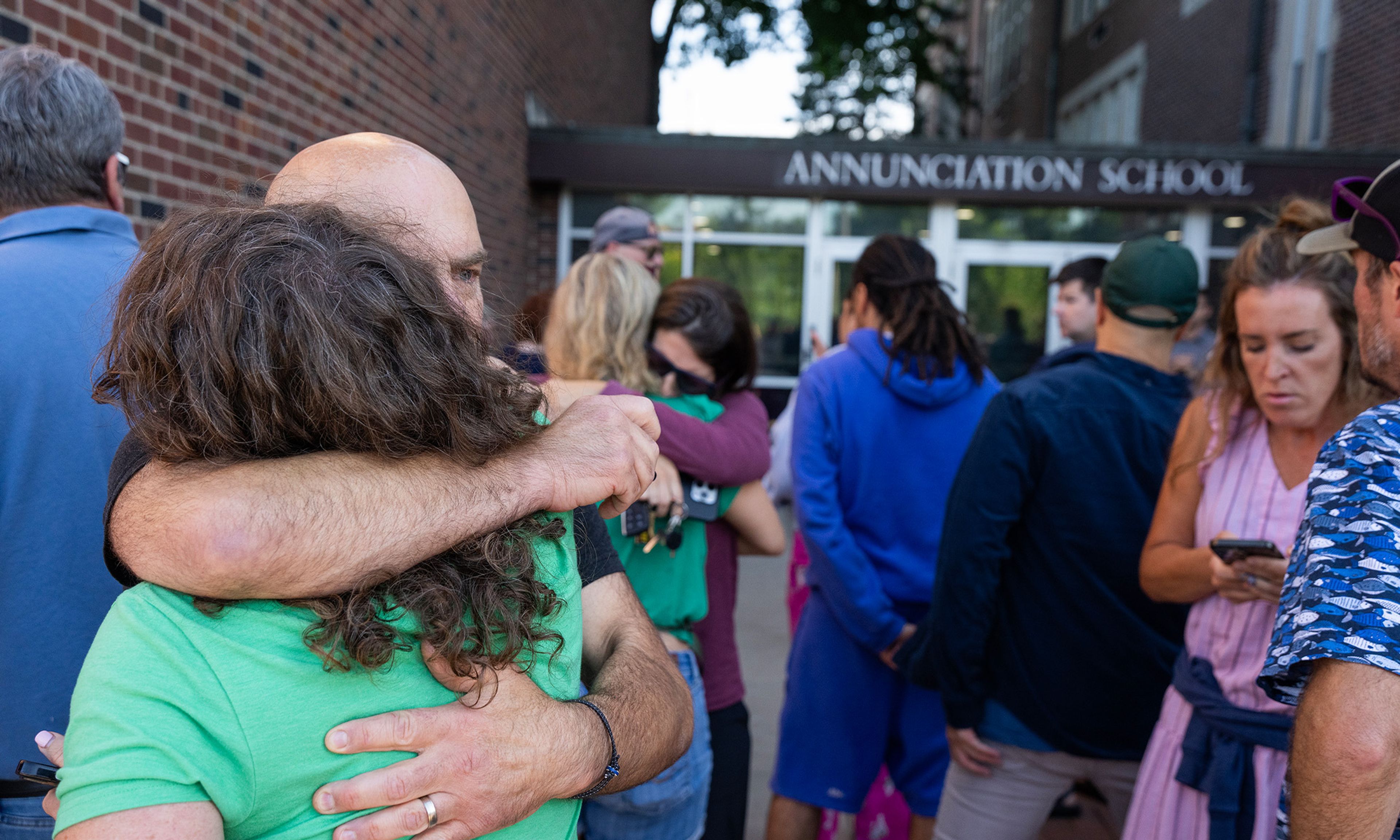
Parents await news during an active shooter situation at the Annunciation Church in Minneapolis, Minn., August 27, 2025.
On the menu today: I hate writing this newsletter the morning after a mass shooting. But not paying attention to the horrific phenomenon will not make it go away. Meanwhile, President Trump’s executive order that bans flag burning without explicitly banning flag burning reminds me of the Biden administration’s “requests” to social-media companies to remove certain posts during the pandemic because they deemed them “misinformation.” When you craft a law to “work around” the First Amendment, you usually end up violating it.
There Are No Easy, Simple Solutions to the Problem of School Shootings
The mass shooting and murder of two children at Annunciation Catholic School in Minneapolis Wednesday was carried out by a man named Robert Paul Westman. In 2019, that then 17-year-old man and his mother applied to legally change his name to Robin M. Westman and legally change his gender identity with the state because he “identifies as a female and wants her name to reflect that identification,” according to court records. The state granted that change a year later.
No matter how you feel about using the preferred pronouns of an individual, that privilege gets rescinded when you murder an eight-year-old and a ten-year-old in cold blood as they pray. What, are we worried about offending the now-dead gunman?
(Count how often you see Westman referred to in gender-neutral terms like “the shooter” or “the perpetrator” instead of “the gunman” in media accounts today.)
You can see news organizations like the New York Times writing this morning that the gunman’s “motive is a mystery.” I think when you shoot dozens of rounds through the windows of a Catholic church, while children from the adjoining school are attending Mass, at least one motive, of murderous hatred toward Catholics, is self-evident. This doesn’t mean that other motives don’t also exist, but this target was not selected randomly. The gunman’s mother retired from her job at the Annunciation church in 2021 and donated to scholarship funds at the school. The gunman graduated from the elementary school in 2017.
The gunman posted videos and a manifesto online. It is the usual mishmash of self-pity, blind rage, spectacularly unconvincing explanations and excuses, and invocation of trendy causes -- “Kill Donald Trump,” “Israel Must Fall,” etc. The gunman wrote the names of other mass shooters on his gun magazines, as well as “Where is your God?” “Suck on this,” and “F*** everything you stand for.”
Again, considering all this, is the motive really such a “mystery” as the Times contended?
As the New York Post wrote, “In the deranged writings, he gleefully fantasizes about ‘being that scary horrible monster standing over those powerless kids’ and reverently confesses admiration for the 2012 Sandy Hook massacre.”
The gunman apologized to his siblings and parents for “forever tainting the rest of [their] lives.” But clearly, he didn’t feel bad enough about that consequence to not carry out his plans for mass murder.
Time and again, I have written about mass shooters and how many fit a psychological profile as “grievance collectors.” Willard Gaylin, one of the world’s preeminent psychology professors, writes about the dangers of “grievance collecting” in his book Hatred: The Psychological Descent into Violence:
Grievance collecting is a step on the journey to a full-blown paranoid psychosis. A grievance collector will move from the passive assumption of deprivation and low expectancy common to most paranoid personalities to a more aggressive mode. He will not endure passively his deprived state; he will occupy himself with accumulating evidence of his misfortunes and locating the sources. Grievance collectors are distrustful and provocative, convinced that they are always taken advantage of and given less than their fair share. . . .
Underlying this philosophy is an undeviating comparative and competitive view of life. Everything is part of a zero-sum game. Deprivation can be felt in another person’s abundance of good fortune.
At the heart of the grievance collector’s worldview is that he is not responsible for the condition of his life; a vast conspiracy of malevolent individuals and forces is entirely at fault. There is always someone else to blame, and these mass shooters always find ways to excuse their own actions and deflect the responsibility to others.
When a mass shooter justifies their heinous actions in some twisted version of right-wing ideology, the issue that interests the media and Democratic politicians the most is the right-wing ideology. When a mass shooter justifies their heinous actions in some twisted version of left-wing ideology, the issue that interests the media and Democratic politicians is gun control.
Police said Westman acted alone and had no criminal history. He was 23; in Minnesota, you must be 21 years old to purchase a handgun and 18 years old to purchase a rifle or shotgun from a federally licensed firearms dealer (FFL). He legally purchased the guns used in the killings.
Minnesota has “red flag” laws that took effect on January 1, 2024. Obviously, no one who knew the gunman filed a petition for an “extreme risk protection order.”
As of this writing, we do not know of any psychological treatment that the gunman was receiving, in the distant or recent past. We do not know of any medication he was taking. According to the Washington Post, “RISE Dispensary, a medical marijuana shop, said in a statement that Westman had worked at a Minnesota store for several months this year, but was not employed at the time of the shooting.” (It used to be a common joke that marijuana should be legalized because stoners were usually laid back, zonked out, and mostly wanted to eat Doritos. For a bunch of users, sure, but there is increasing evidence of negative mental health consequences for some other habitual users.)
It is likely in the coming days that you’re going to see someone argue, “This is why we need red-flag orders in every state,” But having this law on the books didn’t change anything in this case. This horror is more accurately described as evidence that people need to use a red-flag order when it is warranted, in order for the law to have the desired consequence.
The Washington Post manages a daily updated database of school shootings, which is a good and useful public service. It also allows you to see that what gets counted as a “school shooting” is often very far from the horrors of Columbine or Sandy Hook. Some recent cases:
- On May 7, at Lee M. Thurston High School in Redford, Mich., “A student shot another student in the hand while on a bus as school was dismissing.”
- On April 28, at Jim Hill High School in Jackson, Miss., “Three current students and one non-student had a confrontation and fired numerous shots toward the main entrance of the school.” Thankfully, no one was injured.
- On March 19, at Carver High School in Winston Salem, N.C., “A 17-year-old male and two juveniles fired a handgun at two students while on a baseball field.” Again, thankfully, no one was injured.
- On January 14, at Newburgh Free Academy in Newburgh, N.Y., “An 18-year-old male former student fired into a crowd following a fight at dismissal time resulting in no injuries.”
This doesn’t mean that these incidents aren’t serious and frightening, or don’t require a serious response from authorities. Once you discharge a firearm, there is a chance somebody could get killed. Anyone handling a firearm should have the four rules of safety tattooed on their inner eyelids:
- Never point your gun at anything you do not intend to shoot, including when loading or unloading.
- Treat every firearm as if it is loaded.
- Never touch the trigger on a firearm until you actually intend to shoot. Keep your fingers away from the trigger while loading or unloading.
- Don’t shoot unless you know exactly what your shot is going to strike. Be sure that your bullet will not injure anyone or anything beyond your target.
But the Post itself noted that the coverage of mass shootings presents an inaccurate picture of the most common types of gun violence that occur in schools:
Almost all the deadliest assaults were committed by white gunmen, a reality that has left much of the public with the false impression that school shootings almost exclusively affect white students. Children of color, however, are far more likely to experience campus gun violence: more than twice as much for Hispanic students and over three times as much for black students.
At schools with majority black student bodies, shooters typically target a specific person, limiting the number of people shot — and the subsequent media exposure.
Black students make up 16.6 percent of the school population, but they experience school shootings at twice that rate.
When something terrible and frightening happens, people want to feel safe. And nothing makes people feel safe like simple narratives. A lot of people on the left want to believe that violence is primarily a right-wing problem, and a lot of people on the right want to believe that violence is primarily a left-wing problem. A lot of people who instinctively believe that trans individuals are victims and the Catholic Church or Christians as a whole are oppressors cannot deal with a situation where the roles are reversed. A lot of people want to believe that the Second Amendment can be wished away and that private gun ownership can be easily banned.
And a lot of people want to believe that if we just passed the right law, the problem of mentally disturbed individuals who collect grievances in order to justify an unspeakably cruel act of murderous violence will be solved.
ADDENDUM: The editors of NR weigh in on President Trump’s executive order on flag burning:
Trump’s workaround is to state that flag-burning won’t be prosecuted as such, but that prosecutors should charge flag-burners whenever possible for other offenses they may commit in the course of protests. But this is the very definition of selective prosecution if the charges are not ones that would have been brought anyway — and the federal executive branch is now putting in writing that this is its intention. It may take some time for anyone to be prosecuted in a case that would result in a challenge to this, but once such a prosecution is initiated, the Justice Department will be hard-pressed to get a conviction.
I think our Charlie Cooke puts it correctly and succinctly:
Twice, the Supreme Court has ruled that Americans may not be prosecuted for burning American flags. If the Trump administration’s response to that command is to start investigating those Americans instead, that decision will be rendered a dead letter.
This reminds me of the insistence that the Biden administration didn’t violate the First Amendment because it didn’t order social-media companies to remove certain posts it deemed misinformation, including humor and satire. It merely strongly requested that social-media companies remove the posts -- strong requests that the social-media companies interpreted as “pressure.”
The First Amendment does not mumble, equivocate, or stutter. “Congress shall make no law respecting an establishment of religion, or prohibiting the free exercise thereof; or abridging the freedom of speech, or of the press; or the right of the people peaceably to assemble, and to petition the Government for a redress of grievances.” If the purpose of your law or action is to abridge something that the Supreme Court has already specifically stated is a form of free speech, then you are violating the First Amendment. This is not that complicated!

About the Author
Jim Geraghty is the senior political correspondent of National Review.
Featured Tags
Advertisement
Advertisement
Comments