Nuclear-Armed India and Pakistan Come to Blows
Written by Jim Geraghty
Share this story
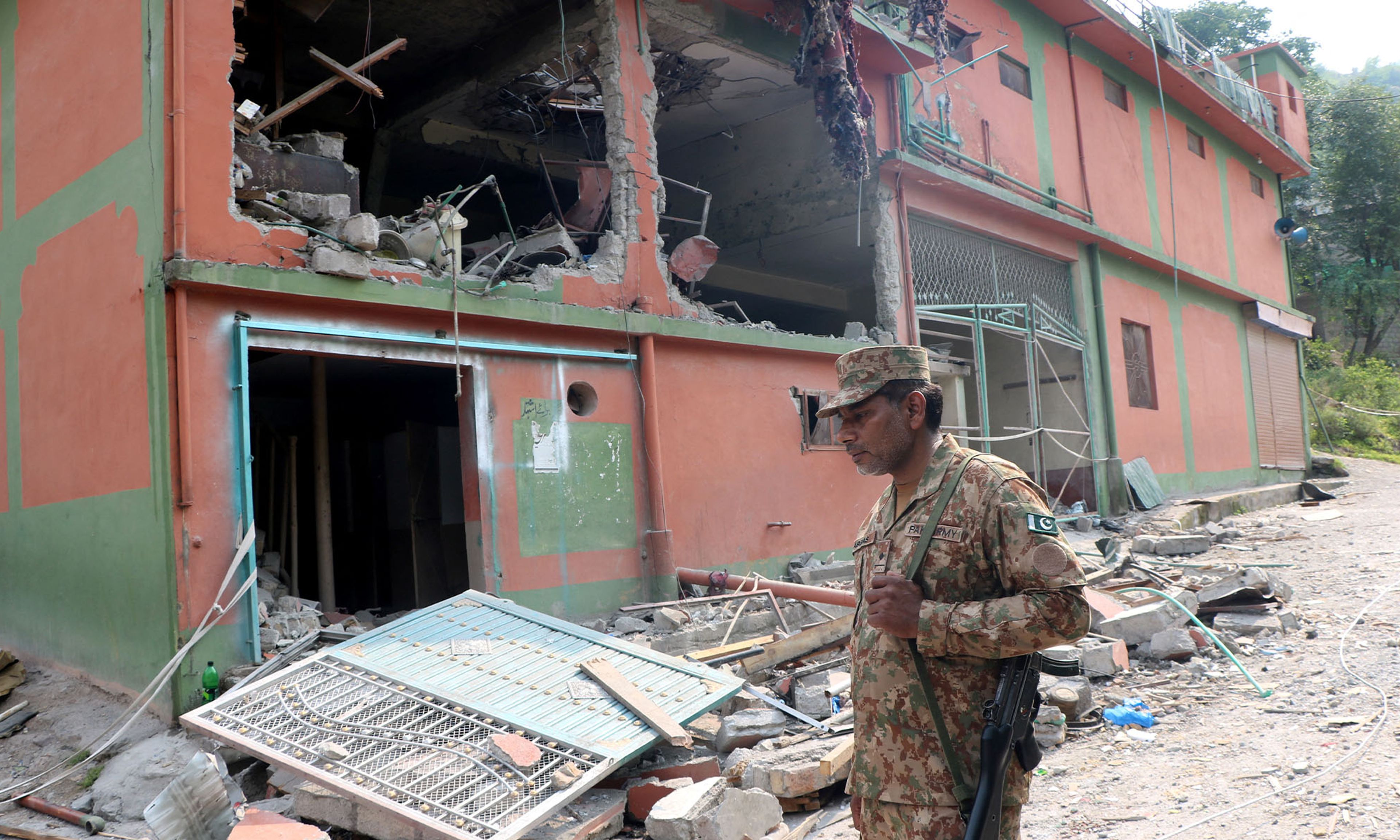
A Pakistan Army soldier stands in front of the damaged Bilal Mosque after it was hit by an Indian strike in Muzaffarabad, the capital of Pakistan-administered Kashmir, May 7, 2025.
On the menu today: In discussions of U.S. assistance to Ukraine, it’s not hard to find those who argue that the U.S. is risking a nuclear confrontation with Moscow by sending military assistance to Kyiv that will be used to kill Russian soldiers (and some North Koreans as well). Indeed, way back on March 16, 2022, I looked at the capacities of Russian tactical nuclear weapons and tried to lay out the possibilities of how Vladimir Putin and his forces might use them. None of us know what the future holds. But the Russian invasion that Belarusian president and Putin lackey Alexander Lukashenko predicted would be over in three or four days is now in its fourth year, and despite a lot of verbal saber-rattling, Putin has not yet risked using nuclear weapons to force Ukraine into submission. (Rare credit where it’s due: China’s Xi Jinping reportedly personally warned Putin against it, and implied China would no longer back Russia if that occurred.)
One wonders if those who envision mushroom clouds as a likely result of U.S. policy toward Ukraine spent much time worrying about India and Pakistan. Because right now, we’ve got the military forces of two nuclear-armed rival neighboring countries in a state of war.
Just a Bit of Shooting Between Nuclear-Armed Neighbors, That’s All
India launched early morning missile strikes on both Pakistan and Pakistan-administered parts of Kashmir this morning, while the Pakistan government claimed it had shot down five Indian Air Force jets in “self-defense.” Pakistani Prime Minister Shehbaz Sharif described the attack as “an act of war” and ordered his country’s military to enact “self-defense” with “corresponding actions.”
On April 22, Islamists massacred 26 Indian tourists in Pahalgam, a town in Kashmir -- the largest number of civilian casualties in a terrorist attack in India since the November 2008 attacks in Mumbai.
A day later, Kashmir Resistance, also known as The Resistance Front (TRF), claimed responsibility for the attack:
TRF emerged in 2019 and is considered an offshoot of the Pakistan-based Lashkar-e-Taiba, according to the South Asia Terrorism Portal, a Delhi-based think tank.
Lashkar-e-Taiba, listed as a foreign terrorist organization by the United States, is the Islamist group accused of plotting attacks in India and in the West, including the three-day assault on Mumbai in November 2008.
“This is basically a front of the LeT. These are groups which have been created over the last years, particularly when Pakistan was under pressure from the Financial Action Task Force and they were trying to create a pattern of denial that they were involved in terrorism in Jammu and Kashmir,” said Ajai Sahni, head of the South Asia Terrorism Portal.
Pakistan insists it had nothing to do with the attack; it merely provides “political, diplomatic and moral support” to Kashmiris who want separation from India.
Earlier this year, Pakistani President Asif Ali Zardari accused the Indian government of subjecting Kashmiris to “oppression, violence, and systemic brutalities.” He contended, “Since August 5, 2019, [India] has been taking steps, aimed at altering the demographic and political fabric of IIOJK, to turn Kashmiris into a disempowered community in their homeland. Despite this, the spirit of the Kashmiri people remains unbroken and their struggle for freedom cannot be suppressed.”
Unsurprisingly, the Indian government rejects this accusation and accuses the Pakistanis of waging war against them through terrorist proxies. Indian Foreign Secretary Shri Vikram Misri, in a statement this morning:
India had given inputs about [The Resistance Front] in the half-yearly report to the Monitoring Team of the United Nation's 1267 Sanctions Committee in May and November 2024, bringing out its role as a cover for Pakistan-based terrorist groups. Earlier too, in December 2023, India had informed the monitoring team about LeT and Jaish-e-Mohammad operating through small terror groups such as the TRF. Pakistan's pressure to remove references to TRF in the April 25 UN Security Council Press Statement is notable in this regard.
Despite a fortnight having passed since the attacks, there has been no demonstrable step from Pakistan to take action against the terrorist infrastructure on its territory or on territory under its control. Instead, all it has indulged in are denials and allegations. Our intelligence monitoring of Pakistan-based terrorist modules indicated that further attacks against India were impending. There was thus a compulsion both to deter and to preempt.
Earlier this morning as you would be aware India exercised its right to respond and pre-empt as well as deter more such cross-border attacks. These actions were measured, non-escalatory, proportionate, and responsible. They focused on dismantling the terrorist infrastructure and disabling terrorists likely to be sent across to India.
What’s that, India? You say you must send military forces across the border to hunt down a terrorist who murdered your people, hiding in Pakistan’s territory, with no sense that the local government is even trying to do anything about it? Fellas, we know exactly how you feel.
A few days ago, the Hudson Institute’s Aparna Pande appeared on CNN, laying out how the Pakistani-aligned attack on Indian civilians, and the then-expected Indian military retaliation, fit into a recurring historical pattern:
We have seen this film play out before, basically since 1989. Every few years, a terror attack takes place inside India, which is almost always linked to a Pakistan-based jihadi group. The two countries escalate tensions, and because they are nuclear armed neighbors, the global community comes in to try and diffuse the crisis. So, it is likely that India will seek a punitive action without making it necessarily escalatory.
What we are not yet sure of is . . . whether India will exercise strategic restraint as it did after the Mumbai attacks in 2008 or it’ll implement a surgical strike like in 2016, or an air strike like in 2019. If that happens, will Pakistan pretend, as it did in 2016, that nothing happened, or retaliate as it did in 2019? As you know, it’s difficult to calibrate a military strike between two nuclear armed neighbors.
The good news is, we’ve been here before, and the conflicts have always died down after a few days; Pande expects something similar in the near future:
I don’t believe that the India and Pakistan are going to all-out war. And again, the reason is that the two countries, every few years, go to what you and I would call brinkmanship. The terror attacks takes place, both sides ramp up and both sides put pressure on the global community. India wants the global community to call out Pakistan, because India sees this as a playbook that every few years, the Pakistani military has domestic challenges and it -- so, it seeks to escalate with India through a terror attack.
Pakistan would like a resolution of the Kashmir dispute, which it believes will only happen if the domestic -- if the International Community applies pressure. And so, both go to brinkmanship to convince the global community to do something, which either side is not able to get that.
I would just note that the “global community” is a little busy these days -- the aforementioned war in Ukraine, a trade war between the U.S. and China, Israel still taking intermittent airstrikes in Gaza, and so on. As much as President Trump seems to get along personally with Indian Prime Minister Narendra Modi, it’s fair to wonder how much time, energy, and effort he and his administration are willing to expend on mitigating or resolving this conflict. In the Wall Street Journal’s coverage of the crisis:
“The Indians are turning to the United States to restrain and limit Pakistani action it seems,” said Asfandyar Mir, a senior fellow at the Stimson Center, but, “U.S. influence on Pakistan in this moment may be limited.”
As the New York Times notes, Pakistan isn’t even a big buyer of U.S. weapons systems anymore; the Pakistani government buys 81 percent of their weapons from China. India, meanwhile, buys a lot fewer of their weapons systems from Russia these days and is buying more from France, Israel, and the U.S.
As the editors wrote April 25, “The early U.S. response, backing India in the aftermath of the massacre, has been appropriate and strong. But Pakistan is a major non-NATO ally of the U.S., and nothing in South Asia is easy. A war between Pakistan and India would be devastating. Anything the U.S. can do to prevent it, it should.”
ADDENDUM: Another for the “now it can be told” file:
More than 60 service members were injured as a part of former President Joe Biden's floating aid pier in Gaza, a Pentagon Inspector General report published on Tuesday said, a number significantly higher than had been previously disclosed.
While there were no deaths or known direct attacks on the pier, the Pentagon had said three U.S. troops suffered non-combat injuries in support of the pier in May, with one medically evacuated in critical condition.
But the new report by the Pentagon Inspector General said that the number was actually 62.
“Based on the information provided, we were not able to determine which of these 62 injuries occurred during the performance of duties or resulted off duty or from pre-existing medical conditions,” the report said.
Shortly after the trucks left the pier, significant portions of the aid were stolen:
The U.N. said that 10 truckloads of food aid -- transported from the pier site by U.N. contractors -- were received on Friday at a World Food Program warehouse in Deir El Balah in Gaza.
But on Saturday, only five truckloads made it to the warehouse after 11 others were cleaned out by Palestinians during the journey through an area that a U.N. official said has been hard to access with humanitarian aid.
“They’ve not seen trucks for a while,” a U.N. official, speaking on condition of anonymity, told Reuters. “They just basically mounted on the trucks and helped themselves to some of the food parcels.”
You’ll probably recall that many of us were skeptical of the project from the beginning; it always appeared “half-baked, hastily assembled, and more driven by political fears than a clear-eyed assessment of the situation on the ground,” and I always got the feeling the idea had come from “the big guy” himself.
The pier was disassembled after 20 days after multiple interruptions from weather and high waves.

About the Author
Jim Geraghty is the senior political correspondent of National Review.
Featured Tags
Advertisement
Advertisement



Comments