Share this story
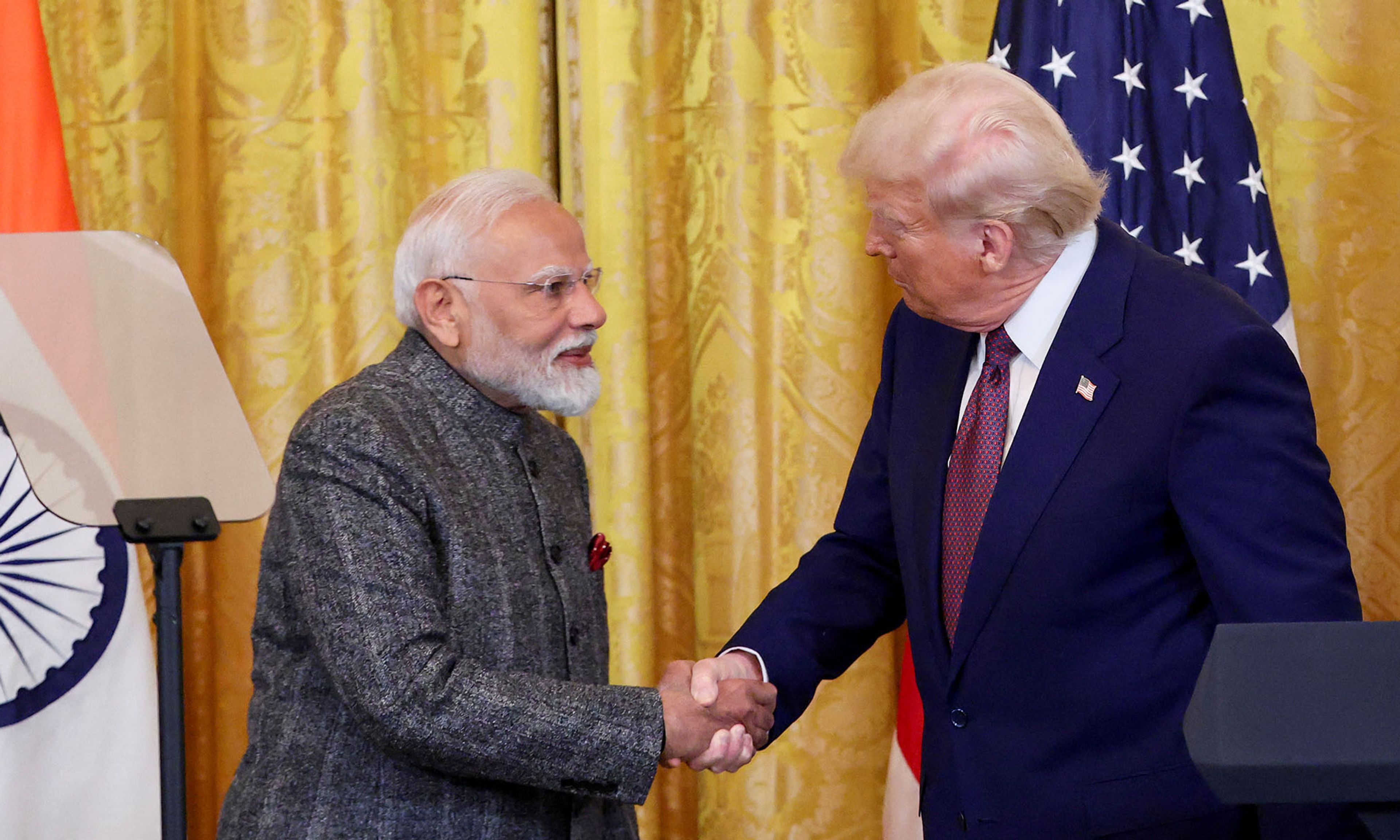
President Donald Trump and Indian Prime Minister Narendra Modi shake hands as they attend a joint press conference at the White House in Washington, D.C., February 13, 2025.
On the menu today: All other things being equal, the new U.S.-India trade deal is good news, but it’s been a long, messy road to get here. Elsewhere, U.S. Attorney for the District of Columbia Jeanine Pirro contends she can arrest anyone who brings a gun into her jurisdiction. And some thoughts on what it takes to get into the Pro Football Hall of Fame. Read on.
A Long and Winding Trade Deal Road
As of 2024, India was the 10th-largest trading partner of the United States. They’re still collecting data for 2025, but through November, the U.S. had exported $42 billion in goods and services to India and imported $95 billion from India — and that’s with the two countries imposing new tariffs on each other’s goods. The new trade deal announced by President Trump and Indian Prime Minister Narendra Modi yesterday represents a big sigh of relief for the two countries, but there are still a lot of details that haven’t been ironed out.
President Trump posted on Truth Social Monday afternoon:
It was an Honor to speak with Prime Minister Modi, of India, this morning. He is one of my greatest friends and, a Powerful and Respected Leader of his Country. We spoke about many things, including Trade, and ending the War with Russia and Ukraine. He agreed to stop buying Russian Oil, and to buy much more from the United States and, potentially, Venezuela. This will help END THE WAR in Ukraine, which is taking place right now, with thousands of people dying each and every week! Out of friendship and respect for Prime Minister Modi and, as per his request, effective immediately, we agreed to a Trade Deal between the United States and India, whereby the United States will charge a reduced Reciprocal Tariff, lowering it from 25% to 18%. They will likewise move forward to reduce their Tariffs and Non Tariff Barriers against the United States, to ZERO. The Prime Minister also committed to “BUY AMERICAN,” at a much higher level, in addition to over $500 BILLION DOLLARS of U.S. Energy, Technology, Agricultural, Coal, and many other products. Our amazing relationship with India will be even stronger going forward. Prime Minister Modi and I are two people that GET THINGS DONE, something that cannot be said for most. Thank you for your attention to this matter!
Here’s how Modi described the deal, on X:
Wonderful to speak with my dear friend President Trump today. Delighted that Made in India products will now have a reduced tariff of 18%. Big thanks to President Trump on behalf of the 1.4 billion people of India for this wonderful announcement. When two large economies and the world’s largest democracies work together, it benefits our people and unlocks immense opportunities for mutually beneficial cooperation. President Trump’s leadership is vital for global peace, stability, and prosperity. India fully supports his efforts for peace. I look forward to working closely with him to take our partnership to unprecedented heights.
You may have noticed that Modi didn’t say anything about ceasing to purchase Russian oil. For what it’s worth, the Kremlin says it has not heard anything from the Indians about the impending end of oil purchases, and Indian refiners told Reuters that they have so far not been ordered by the government to stop such imports. But over the past two months, Indian imports of Russian oil have declined significantly. The New York Times reported, “Kpler, an analytics firm, noted that India’s imports of Russian oil were down to 1.1 million barrels a day in January, the smallest amount since November 2022.”
You may have also noticed that Modi didn’t say anything about committing to buy $500 billion in goods. If India is buying about $40 billion in U.S. goods per year, that number might represent a goal to be reached over the course of a decade.
One of the ironies of Trump spending much of the past year in a trade war with India is that the Indian public was the foreign population that was most optimistic about a second Trump term. In November 2024, a survey for the European Council on Foreign Relations and Oxford University’s Europe in a Changing World research project found that 85 percent of Indians thought the election of Trump was a good thing for American citizens, by far the highest in the world. The Saudis were at 69 percent, and the Russians were at 59 percent.
On “Liberation Day,” Trump imposed a 25 percent tariff on goods from India, and then in August imposed an additional 25 percent on Indian goods as punishment for buying oil from Russia.
The trade war, among other decisions of the new administration, alienated the Indians to a degree. The same survey, conducted a year later, found 71 percent of Indians believed that the U.S. would have less global influence in the next decade compared to today and that the percent who thought Trump’s election had been good for Americans had dropped to 67 percent. With that in mind, the Indian perception of the U.S. hadn’t been completely ruined; 54 percent of respondents in India still characterized the United States as “an ally that shares our interests and values,” and 62 percent said they expected U.S.-India relations to get stronger in the next five years.
The Trump administration had a legitimate gripe that India had, on average, higher tariffs on U.S. goods than the U.S. had on Indian goods:
A report from the Indian Council for Research on International Economic Relations (ICRIER) highlights the stark contrast in tariff structures between the two nations. India imposes an average tariff of 17 percent, whereas the US maintains a much lower average of 3.3 percent. The gap is even wider in agriculture, where India’s simple average tariff is 39 percent, compared to five percent in the US. Trade-weighted rates further emphasize the disparity — India’s is 65 percent, while the US stands at just four percent.
But as noted above, it wasn’t like those tariffs were proving to be an impassible impediment to U.S. exports to India. That 2024 figure of $41 billion in U.S. goods and services exported to India represented the sum nearly doubling in ten years (and remember that in that span, the Covid-19 pandemic was a significant disruption to world trade).
You’ll recall I traveled to India on a reporting trip last autumn. I heard an earful from Indian government officials that they wanted to get to a deal on tariffs, and were willing to play ball, so to speak. But they said they sometimes felt like the Americans didn’t know what they wanted, and insisted they wouldn’t get pushed around:
The Indians aren’t thrilled about Trump’s new tariff regime, but they’re willing to negotiate new terms, and those negotiations are, as of this writing, still ongoing. One of the recurring complaints I heard on my trip was the Indian sense that Trump himself doesn’t seem to know what he wants from negotiations. (Japanese trade negotiators have made a similar complaint.) In May, Trump claimed that India “offered us a deal where basically they are willing to literally charge us no tariff.” The Indian government disputed Trump’s characterization of their offer; Trump repeated it again in September, fuming that “they should have done so years ago” but not elaborating on why he hasn’t accepted the offer that’s allegedly on the table.
The economic adviser characterized the tariffs as a minor headache, a relatively small factor in the $4 trillion Indian economy. “Instead of having 7.5 percent growth,” he said, “we’ll grow at about 6.8 percent” this year. He emphasized that India is not interested in a deal that leaves a low level of U.S. tariffs in place as some sort of symbolic tribute to Trump or concession for past tariffs on U.S. goods. “We would not take 15 percent, like Europe did.”
Eh, at least right now, it looks like the Indians ended up settling for 18 percent, and that “no tariff” arrangement that Trump mentioned appears to be a reality.
But it’s also worth noting that this deal comes after the European Union and India signed a free trade agreement in which they agreed to reduce their tariffs on most goods to zero over a number of years. The U.S. negotiators may well have felt it was time to get to “yes,” accept the concessions that were already on the table, and put the dispute behind them.
Michael Kugelman, a resident senior fellow for South Asia at the Atlantic Council, wrote last night, “U.S.-India ties have floundered for much of the past year. This trade deal is just what the doctor ordered: It’s a confidence-building measure that can help the two sides work through their various issues — including all the trust that the Trump administration has squandered in New Delhi in recent months.”
India is an extraordinarily complicated country, and Washington and New Delhi are probably never going to completely see eye-to-eye. But they are a democracy with 1.4 billion people that is targeted by Islamist terrorists and is in an intense rivalry with China that includes intermittent violent border disputes. The U.S. would benefit from having them on our side as often as we can arrange it, and our interests align.
The Second Amendment Is Right There, People, You Can Read It
You would think familiarity with the law would be a prerequisite to be the U.S. attorney for the District of Columbia. You would be incorrect.
U.S. Attorney for the District of Columbia Jeanine Pirro, appearing on her old employer of Fox News Channel, Monday: "You bring a gun into the District, you mark my words, you're going to jail. I don't care if you have a license in another district, and I don't care if you're a law-abiding gun owner somewhere else. You bring a gun into this District, count on going to jail and hope you get the gun back. And that makes all the difference."
You may recall Bill Essayli, assistant U.S. attorney for the Central District of California, posting on X on January 24, “If you approach law enforcement with a gun, there is a high likelihood they will be legally justified in shooting you. Don’t do it!” That is, once again, not the law; nor was FBI Director Kash Patel correct when he claimed, “As [DHS Secretary] Kristi [Noem] said, you cannot bring a firearm loaded with multiple magazines to any sort of protest that you want. It’s that simple.”
Some Republican members of Congress appear to be getting tired of Trump administration officials completely mischaracterizing gun laws and the Second Amendment.
Representative Greg Steube of Florida responded on X, “I bring a gun into the district every week, U.S. Attorney Pirro. I have a license in Florida and DC to carry. And I will continue to carry to protect myself and others. Come and Take it!” Amy Swearer observes, “Let's not pretend like D.C.'s murder problem ever had anything to do with out-of-state permit holders accidentally wandering across the District line without having first spent $700 and 6-12 weeks getting their D.C. paperwork in order.”
Back in September, looking at a long run of federal prosecutors working under Pirro failing to get indictments from grand juries, I wrote, “Maybe the president has to look beyond the Fox News green room to get the best potential U.S. attorney.”
ADDENDA: In case you missed it yesterday, the Trump administration is preparing for negotiations with the Iranian regime in Istanbul later in the week, which suggests the president’s pledge to the Iranian protesters that “help is on its way” is now forgotten.
Elsewhere, a Vogue correspondent gushes about California Governor Gavin Newsom being “embarrassingly handsome,” “lithe, ardent, energetic, a glimmer of optimism in his eye; Kennedy-esque,” and chooses to describe the way he sits, at length, while lamenting that during her interview she just didn’t have time to ask about “the LA wildfires, contraction and corporate consolidation in Hollywood, homelessness, the coming AI apocalypse.” If you had written the piece as a parody of vapid, shallow, unilluminating coverage of political figures, it would have come across as over the top.
Over in that other Washington publication, I turn to a lighter topic: The Pro Football Hall of Fame selection committee snubbing former New England Patriots head coach Bill Belichick by not including him in his first year of eligibility:
Add it all up, and you have just enough reasons for at least 10 Hall of Fame selection voters to conclude, “someday soon, coach, but not this year.” They’ve concluded that with all the controversies, Belichick just isn’t of the moral character to be elected in his first year of eligibility, to join the ranks of, er . . . O.J. Simpson.

About the Author
Jim Geraghty is the senior political correspondent of National Review.
Featured Tags
Advertisement
Advertisement
Comments