Why Furious Progressives Probably Can’t Do Anything About Chuck Schumer
Written by Jim Geraghty
Share this story
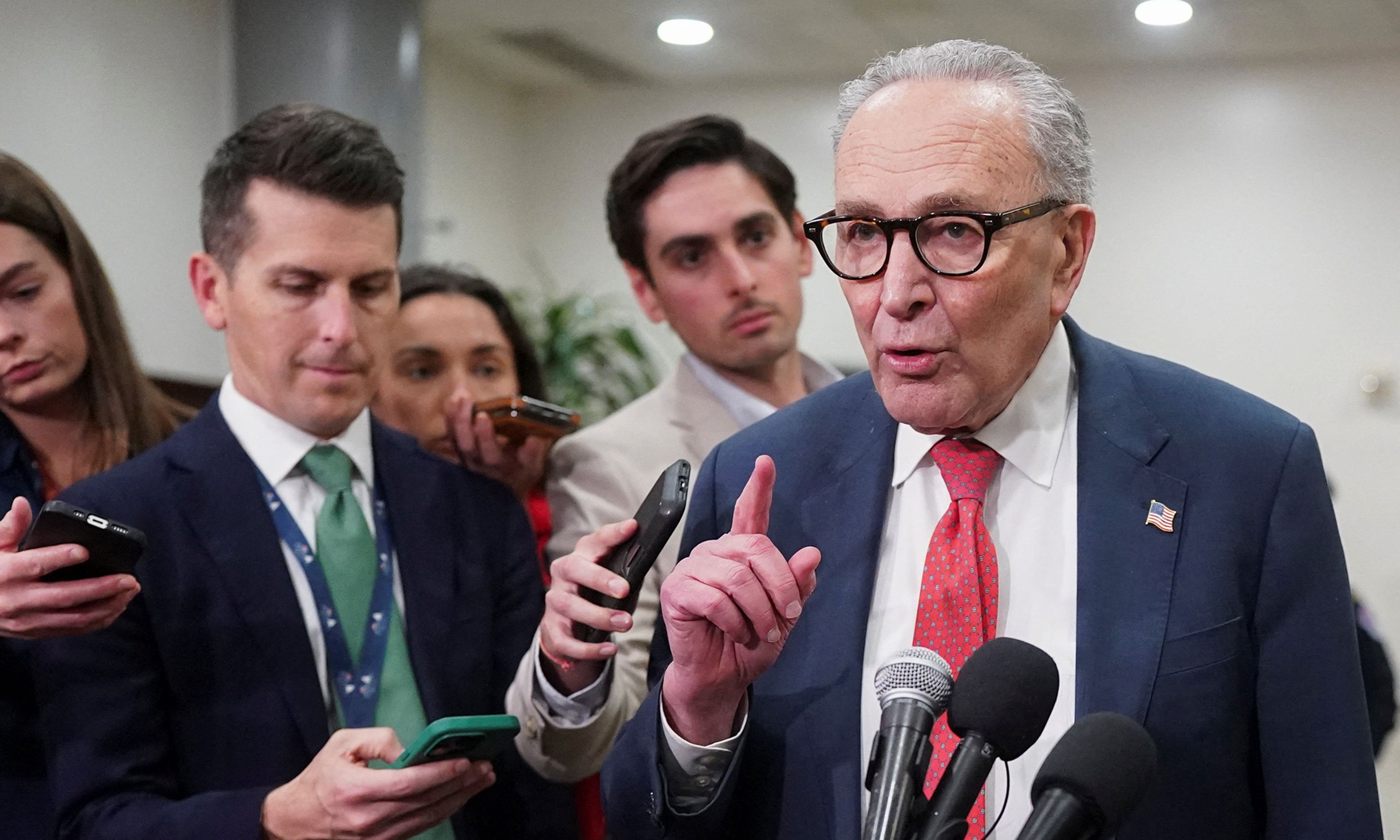
Senate Minority Leader Chuck Schumer (D., N.Y.) speaks with members of the media at the U.S. Capitol, in Washington, D.C., November 5, 2025.
Today is November 11; thank a veteran. On the menu today: The progressive grassroots insist that they’re madder than ever about Chuck Schumer, but there’s no sign of any coalescing around an alternative leader for Democrats in the Senate. Meanwhile the Democrats continue to chant “no more kings,” although it’s not the hereditary transfer of government power part that really bothers them.
Everybody Hates Chuck, Part Two
The big story as the week continues is the progressive grassroots’ apoplectic rage at Senate Minority Leader Chuck Schumer over how the longest federal government shutdown in U.S. history is coming to a close. These grassroots told us they were really mad back in March, but now they’re seething and fuming and stomping their feet and telling us they are really, really mad. They’re “furious.” They’re “angry.” They’re “outraged.”
It other words, it’s a day ending in a “y.”
If only someone had warned them that no one wins government shutdown fights, and written something like, “Senate Democrats are eagerly marching forward into a box canyon by intending to filibuster a spending bill and force a government shutdown.” Or something like, “Schumer and the Democrats will have gotten themselves into a high-stakes fight with Trump where one of the party’s key constituencies — government workers — feel the most pain, and it gets worse the longer it drags on.”
Progressives who wanted the shutdown to go on even longer -- recall that the next time they tell you how much they care about people -- should be thankful Schumer got the shutdown to last as long as it did. According to Axios, a bunch of Senate Democrats were willing to end the shutdown after two weeks -- a month ago! Schumer convinced them to keep the government closed until November, when open enrollment for the Affordable Care Act exchanges began.
Grassroots activists almost always hate the congressional leaders of their party -- or at minimum, those activists regularly feel that their leaders aren’t “fighting” hard enough. Ask Mitch McConnell. Or Bill Frist. Or Trent Lott. Or Bob Dole.
Leading a party in the Senate is not about pounding the table and emoting; it’s about knowing your caucus well and knowing what legislation they can support and which bills will give them grief back home. It’s about building relationships with senators, both in your own party, and the opposition. And the job really ought to be more about persuasion, not about “fighting.” If you define “fighting” as angrily denouncing the opposition, any old schmuck can fight.
And when you’re in the minority in the Senate, you’ve got extremely little leverage. You can argue that Schumer is playing his hand badly -- and he is -- but he was also dealt a weak hand.
It is worth noting that the modern progressive grassroots, who practically froth at the mouth at the mention of the word “Israel,” have another reason to hate Schumer. Here’s Ryan Cooper, writing in the American Prospect last week, irate that Schumer never endorsed Zohran Mamdani and, presumably, voted for Andrew Cuomo over Mamdani:
This is not remotely the first time that Schumer has put his own personal politics — namely, fervent Zionism (as well as a longtime reliance on Wall Street money) — above the interests of his party. Don’t take it from me, take it from him. “My job,” he told Bret Stephens back in March, “is to keep the left pro-Israel.” . . .
Schumer’s vote for Cuomo shows that he either shares those prejudices or most certainly doesn’t think they’re disqualifying. This is precisely disqualifying, however, for anyone who would be a leader of a deeply multiethnic party, and doubly so for one whose membership has shifted its sympathies from Israelis to Palestinians to the tune of more than 70 percentage points over the last two years.
Got that? You can’t be pro-Israel and lead the Democratic Party anymore. (In that light, you wonder how much of the current fury over the government shutdown fight denouement is really an expression of long-simmering frustration that the Democratic leader in the Senate is openly pro-Israel.)
But okay, progressive grassroots, let’s concede that Schumer, who turns 75 later this month, is the embodiment of old school Establishment Democrats. He’s usually a weak communicator; he’s got a nasal, hectoring voice and he does not look inspiring or vigorous with his slumped shoulders and glasses perched at the end of his nose. He’s led the Democrats in the Senate since 2016, and you can easily make a case that it’s time for some new blood.
One problem for Democrats is that just about everybody in their current Senate leadership is similarly old and uninspiring. The current whip is Dick Durbin of Illinois, who voted to reopen the government and turns 81 later this month. Conference vice chair Elizabeth Warren is 76 and in her third term. Fellow vice chair Mark Warner is 70 and he is in his third term. The Senate Democratic Outreach chair is . . . er, 84-year-old Bernie Sanders.
Tammy Baldwin of Wisconsin, secretary of the caucus, is the young one, at age 63.
So, who do you want to replace Schumer, progressives?
(One reason to doubt that Schumer will be knocked off his perch anytime soon is the lack of buzz around any other Democratic senator as an alternative.)
Keep in mind, a significant chunk of the Democratic Senate caucus is thinking of running for president in 2028. Almost all of them have no chance, but that’s not going to stop them. Some of them ran in 2020 and got nowhere, and they’re still not deterred. Apparently, Cory Booker of New Jersey, Amy Klobuchar of Minnesota, and Kirsten Gillibrand of New York are all thinking about it, believing that Democratic primary voters will say, “Oh, we made a terrible mistake last time. We should have nominated you now.”
(That woman in Iowa still just wants some ranch.)
Senators Chris Murphy of Connecticut, Mark Kelly of Arizona, Elissa Slotkin of Michigan, and Raphael Warnock of Georgia also apparently have various degrees of interest in running in 2028.
(The guy who probably deserves more attention than he gets is Senator Ruben Gallego of Arizona, who is apparently doing events in swing states for no particular reason.)
Now, it’s not impossible to run for president while being Senate minority (or, conceivably, majority) leader. Dole did it in 1996. But it’s extremely difficult to do both jobs well, and trying to do both simultaneously seems like a sure-fire way to do both jobs badly.
So, if you don’t want a senator in the current leadership, and it’s unwise to pick a Democratic senator with presidential ambitions, who’s left?
Tina Smith of Minnesota and Gary Peters of Michigan are retiring in 2026, so you can cross them off the list.
If you want a new Senate Democratic leader on the younger side, that rules out another bunch. Richard Blumenthal of Connecticut turns 80 in February. Ed Markey of Massachusetts is facing a primary challenge and is 79. Mazie Hirono of Hawaii just turned 78. Peter Welch of Vermont is 78 as well. Ron Wyden of Oregon is 76, and Jack Reed of Rhode Island turns 76 tomorrow.
If the progressive Democrats think Schumer is too pro-Israel to lead the party in the Senate, they’re never going to accept John Fetterman of Pennsylvania.
If progressives want to get rid of Schumer, they need to unite behind an alternative. And the pickings are pretty slim.
No Kings, Just Aristocracy
“No kings!” Democrats told us. The president is not a king, and his sons are not supposed to be the heir apparent. America does not have a royal family! Government positions and political power are not some family heirlooms that can just be handed down from parent to child.
“No kings!” is the position of the soon-to-retire former speaker of the House, Nancy Pelosi, and her daughter, recently announced California state senate candidate Christine Pelosi.
“No kings!” is the position of New Jersey Democratic representative Rob Menendez, and his father, former Senator Bob Menendez, who is currently incarcerated in federal prison in Allenwood, Pa., serving an eleven-year sentence for bribery, extortion, honest services fraud, obstruction of justice, and conspiracy. (What was his son’s slogan in his reelection bid last year? “Rob Menendez, the name you can trust”?)
That’s the position of New Hampshire Democratic Senator Jeanne Shaheen, and her daughter, congressional candidate Stefany Shaheen.
(Stefany Shaheen, congressional candidate, denounced the deal to end the government shutdown, a deal that was negotiated by . . . her own mother. Senator Shaheen, there are at least five other Democrats running for that House seat. You could endorse any one of them.)
That’s the position of Florida Democratic Representative Kathy Castor, daughter of former Florida state senator and state education commissioner Betty Castor.
That’s the position of Delaware Democratic Representative Lisa Blunt Rochester, daughter of Ted Blunt, former Wilmington City Council president.
That’s the position of Rhode Island Democratic Representative Seth Magaziner, son of Bill Clinton adviser Ira Magaziner.
That’s the position of Jimmy Panetta, son of former White House chief of staff and CIA Director Leon Panetta.
That’s the position of New York Democratic Representative Grace Meng, daughter of former state assemblyman Jimmy Meng.
That’s the position of New York Democratic Representative Yvette Clarke, daughter of former New York City councilwoman Una Clarke.
That’s the position of Ohio Democratic Representative Emilia Sykes, the daughter of state Senator Vernon Sykes and former state Representative Barbara Sykes.
No kings! Just an aristocracy.
Republicans have plenty of second-generation elected officials, too. Just in the Senate, Shelley Moore Capito of West Virginia is the daughter of a governor, Lisa Murkowski of Alaska is also the daughter of a governor, and Rand Paul is the son of former representative and presidential candidate Ron Paul. House Republicans Gus Bilirakis of Florida, Bob Latta of Ohio, and Mike Collins of Georgia all had fathers who were representatives. Oklahoma’s Tom Cole’s mother was a state representative and state senator.
ADDENDUM: Another reminder that the National Review Institute’s Burke to Buckley Fellowship program is back in New York City and Miami this spring for food, friendship, and first principles! Burke to Buckley is intended for mid-career professionals from a wide variety of professions and industries. Over seven sessions, your cohort will gather to discuss key subjects in American conservatism through foundational texts. Upon completion of the program, you will join a network of hundreds of alumni across the country.
Experts from academia and National Review guide the conversation on topics including Burke, Prudence, and the Spirit of Conservatism, Economic Freedom and Political Freedom, and Conservatism, Democracy, and Foreign Policy. For more information and to apply, click here. Apply today! Applications close November 30.

About the Author
Jim Geraghty is the senior political correspondent of National Review.
Featured Tags
Advertisement
Advertisement



Comments