Share this story
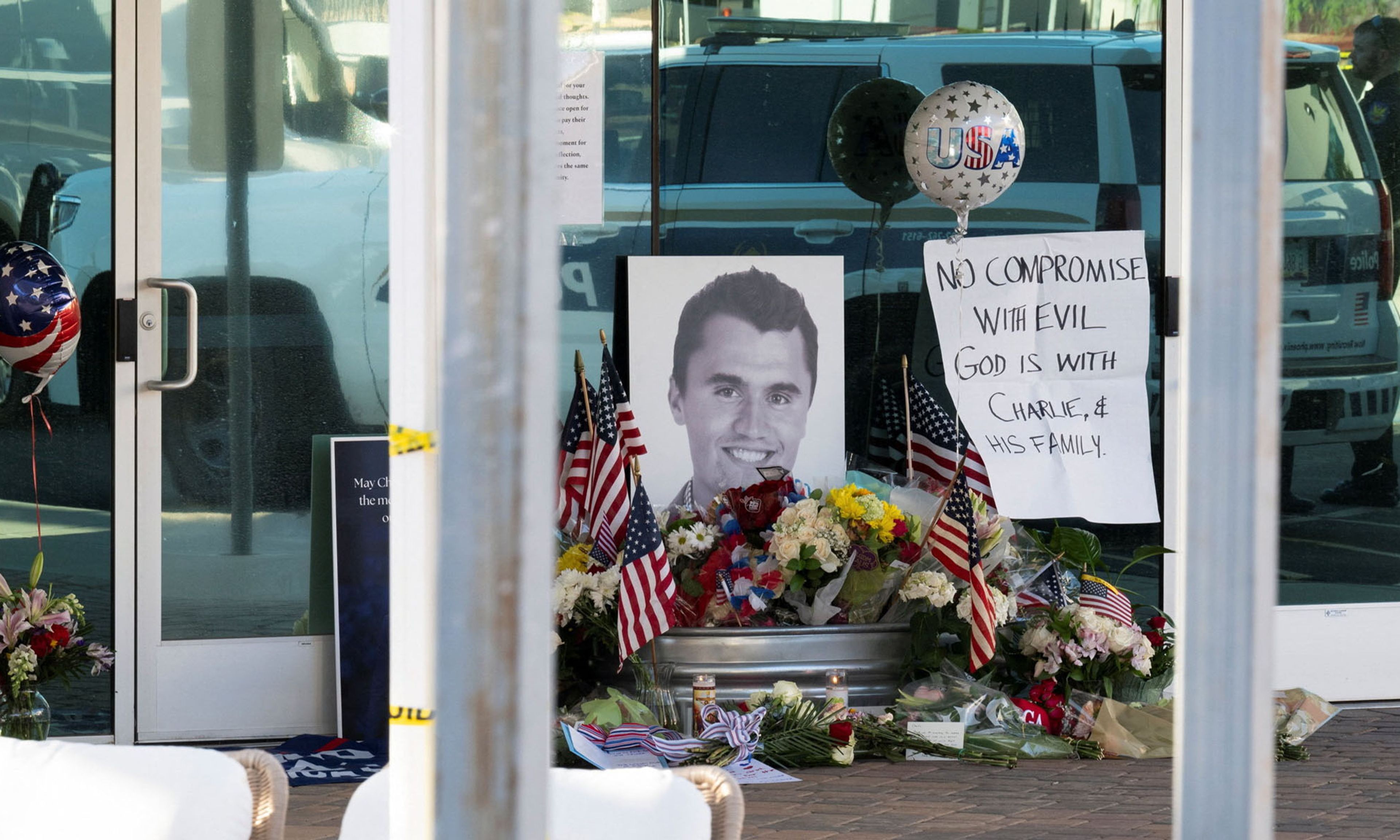
A memorial is held for Charlie Kirk at the Turning Point USA headquarters in Phoenix, Ariz., September 10, 2025.
Dear Weekend Jolter,
A hauntingly timed report about the speech climate on campus revealed Tuesday that the percentage of students who think it’s okay to “shout down a speaker, block entry to a campus speech, or use violence to stop a campus speech” is at a record high. One day later, Charlie Kirk was assassinated on a Utah campus.
The public, on-camera killing was, as NR’s editorial said, “a shocking event that may herald a turn toward greater political violence in America.”
Let’s hope not. But it is not the only portent of a social unraveling. The environment for free speech has been deteriorating for some time now, at least on campus (as the Foundation for Individual Rights and Expression documented). Incidents of political violence are happening at alarmingly regular intervals. Our old colleague Kyle Smith observed on Wednesday the dire development that it has now “jumped the barrier from office holders/seekers to their supporters/pundits.” Meanwhile, the news slugs from the past month alone are the stuff of Billy Joel songs: Charlotte stabbing. Charlie Kirk. Epstein files. Kids slain at church.
It is a restive and combustible time. Even before Wednesday’s assassination, social media was roiling over the horrific stabbing of a young Ukrainian refugee on a Charlotte train, footage of which emerged last Friday. The anger is splitting in different directions, fueled by videos that show everything. Most destructive are the corners looking for, as Michael Brendan Dougherty describes it, a “racial reckoning” for the right. But many are justifiably aghast at the initial reaction by media and public officials. Mayor Vi Lyles’s early response was pseudo-compassionate cant that confused victim and victimizer: the assailant “appears to have suffered a crisis,” “we will never arrest our way out of issues such as homelessness and mental health,” “I am not villainizing those who struggle with their mental health or those who are unhoused,” etc. The mayor eventually put out a sensible statement calling it a “tragic failure” by the courts and vowing increased security on public transit. Elsewhere, the moral equivalences and abstractions persisted.
Shocking acts of violence stirred into a pot boiling daily with agitation, either for or against whatever the Trump administration has most recently done, makes for a dangerous brew indeed. The failure of some -- certainly not all -- in the political and media establishments to discuss these events in good faith makes distrust in institutions worse. A sense of righteousness that justifies any action, as John Noonan writes, is becoming a common thread.
But the solution is to not despair. To ensure expression in the public arena. To engage with others in debate, and avoid silos. To keep the faith and hold the line.
“You are inheriting a country where politics feels like rage,” Utah Governor Spencer Cox told young Americans, at an emotional press conference on Friday. Getting the tenor exactly right, the governor also said: “We can choose a different path.” Embrace and discuss differences, he implored, and get the hell off social media.
Mark Antonio Wright writes:
We are staring into the abyss. The moment when Americans of goodwill abstain from entering the public arena — as politicians, as activists, as citizens — will be the moment we refuse our God-given right to govern ourselves. If we are cowed by violence and the threat of violence into staying silent and avoiding political discourse, we are no longer free.
He writes again:
Anger, however — if it is to be righteous — should not morph into hate. There’s too much hate out there right now. In some ways, that’s understandable. I’d be lying if I said that I did not feel it at times.
But we must approach our countrymen in good faith.
Jeff Blehar adds:
You can make sure that Charlie Kirk didn’t die in vain by getting out there in the arena yourself, and speaking your mind.
As NR’s editorial observes, one of the awful effects of the Utah shooting is that speakers may think twice before voicing their opinion in public, ceding ground not only to “the heckler’s veto” but “the assassin’s veto.” That would turn a national tragedy into a societal one. We can pull back from that abyss. We must.
NAME. RANK. LINK.
EDITORIALS
The Charlie Kirk editorial-obit, once more, is here: Charlie Kirk, R.I.P.
The Charlotte editorial is here: Lessons from the Charlotte Horror
Russia is testing the West anew: Russia’s Poland Incursion Was No Drone Accident
Florida’s blanket approach on vaccines is the wrong way: Don’t Abandon the MMR Vaccine
ARTICLES
Philip Klein: Why I Am Not Judging Bystanders on the Charlotte Train
Charles C. W. Cooke: What the Hell Is Charlotte’s Mayor, Vi Lyles, Talking About?
Larry P. Arnn: Charlie Kirk: A Serious Man
Jim Geraghty: The American Mainstream’s Tacit Acceptance of Left-Wing Violence
Jim Geraghty: White House Cries ‘Hoax’ as Epstein Note Haunts Trump
Noah Rothman: The End Game
Henry Olsen: Israel’s Qatar Strike on Hamas Suggests Arab Cooperation
Abigail Anthony: Barnard, Columbia Ranked Worst in the Country for Free Speech on Campus
Olena Kovalska: Russia Is Not a Defender of Christianity
Audrey Fahlberg: Biden White House Commuted Death-Row Inmates’ Sentences Without First Hearing from Victims, Emails Show
Richard Brookhiser: Zohran Mamdani Missed New York’s Turnaround — So He Learned Nothing from It
James Lynch: Jimmy Lai’s Son Grapples with Possibility His Father Dies in Prison After Years of CCP Persecution
Kathryn Jean Lopez: Remembering WFB: Quick Reflections on William F. Buckley Jr. Stamp Day
Kamden Mulder: DHS Launches ‘Operation Midway Blitz’ Immigration Crackdown in Chicago Despite Local Pushback
Guy Denton: Both Parties Need to Get Serious About the Population Crisis
Brittany Bernstein: Georgia Judge to Dismiss Racketeering Charges Against All 61 ‘Cop City’ Rioters
Brittany Bernstein: Amazon Sold Teens a Lethal Chemical Popularized by Suicide Forums. Should It Be Held Liable?
CAPITAL MATTERS
Judge Glock reports on an exciting new industry: The Growing Business of Government
LIGHTS. CAMERA. REVIEW.
Armond White marks a classic’s 40th: The Breakfast Club’s Nostalgia and Anxiety
Brian Allen’s got an in-the-news column, right here: Is the Smithsonian Weaseling Out from White House Questions?
JOLT, EXTENDED EDITION
More from our Charlie Kirk editorial:
Just 31, Kirk had a stratospheric rise. He cofounded Turning Point USA shortly after graduating from high school, after giving an impressive speech at Benedictine University’s Youth Government Day. At the time, the left’s dominance of higher education meant that most students had very little exposure to conservative speakers. Over the next decade, he built TPUSA into a sprawling organization with a large roster of energetic speakers, massive networking events, chapters in 850 colleges and universities, and a robust social media presence. If that wasn’t enough, he had a huge podcast, and, in 2024, Kirk and his Turning Point Action grassroots group played a critical role in President Trump’s victory by helping to organize low-propensity young voters to turn out.
This spoke to extraordinary energy and initiative, and everyone who knew him well testified to his personal warmth and Christian faith (which he talked about frequently in public).
Kirk’s rise came during an era when younger leftists abandoned the free-speech values that their ideological predecessors once espoused. It featured escalating attacks on conservative speakers — efforts to cancel them, to shout them down, to throw objects at them, to make threats. Despite all of this, Kirk continued to tour college campuses, to take hostile questions, and to engage with people who passionately disagreed with him. He did his ideological adversaries the favor of taking their questions seriously. This alone was a significant contribution to our civil society.
Then, on Wednesday, Kirk was shot and killed while on stage fielding a question about shootings by transgender individuals.
In a free republic, citizens are supposed to resolve their differences by arguing passionately with one another and then voting for public executives and lawmakers. Political violence is a direct threat to the foundations of our free society, and it must be condemned by all people of goodwill, with no throat-clearing or “buts.”
Audrey Fahlberg gives an alarming picture of how rushed the commutation process really was at the end of the Biden administration:
The Biden White House approved commutations for dozens of violent death-row inmates without first consulting victims and their families, according to internal communications which suggest that the sweeping clemency decisions made in the final days of Biden’s presidency were the result of a chaotic, insular White House process.
In his final weeks in office, Biden announced some of the most far-reaching acts of clemency in American history, issuing preemptive pardons for five members of his family, commuting 37 federal death-row inmates’ capital sentences to life imprisonment, and issuing commutations for thousands of inmates convicted of drug-related offenses, some of them violent.
While these monumental decisions were being made, Biden’s own Department of Justice and the families of the affected victims appear to have been kept in the dark.
The newly obtained email correspondence sheds light on a key period of the Biden presidency that is now under investigation by the Trump White House and congressional Republicans.
In the final weeks of Biden’s presidency, Justice Department officials were emailing their counterparts in the White House Counsel’s Office about their efforts to get in touch with death-row inmates’ victims’ family members, only to learn that Biden had already decided to commute the inmates’ sentences.
In the end, Biden commuted 37 of 40 federal death-row inmates’ capital sentences even though many victims opposed the idea of clemency. In other cases, the Justice Department’s efforts to get in touch with the victims were unsuccessful or stymied by the White House Counsel’s Office, internal documents show.
Biden verbally approved the commutations of 37 capital sentences during a December 11 meeting with White House Chief of Staff Jeff Zients, Deputy Chief of Staff for Policy Bruce Reed, and White House Counsel Ed Siskel, according to an email sent by Senior Adviser to the Chief of Staff Rosa Po to Staff Secretary Stefanie Feldman and other White House aides on December 21.
But six days after Biden had approved the commutations, Justice Department pardon attorney Elizabeth Oyer penned a memo to the White House Counsel’s Office and Office of the Deputy Attorney General informing individuals on Biden’s clemency team about the Justice Department’s attempts to get in touch with death row inmates’ victims to get a sense of how they’d feel about commutations.
“There are 40 individuals on federal death row. Our office has received applications seeking commutation of sentence in 28 of those cases,” Oyer wrote in her December 17 memo, sent after Biden’s decision had already been made. “In each instance, we have endeavored to solicit the views of the victims regarding the prospect of commuting the applicant’s death sentence.”
Days after Biden approved the commutations, most of the affected victims and their families were telling the Department of Justice they didn’t want to see the president grant leniency to the offender in their case.
James Lynch reports on the unfortunately interminable case of Jimmy Lai:
The son of Jimmy Lai, the Hong Kong businessman and democracy advocate currently imprisoned by the Chinese Communist Party, is worried about his father dying in prison if something is not done soon to secure his freedom.
One of the world’s most prominent anti-authoritarian dissidents, Lai has been in solitary confinement for the better part of five years on dubious charges brought by the CCP during its crackdown on civil liberties in Hong Kong.
Lai is a free speech champion and owned the newspaper Apple Daily. He is facing politicized charges for purported collusion with foreign governments and inciting hatred against Chinese people and Hong Kongers.
Almost 78 years old, Lai has diabetes, and his son Sebastien is increasingly worried about his father’s health. With Hong Kong’s naturally warm temperatures, Sebastien said his father “bakes” in prison.
“He might die,” Sebastien Lai said bluntly during a press briefing in Washington, D.C., Tuesday morning. Sebastien said that if President Donald Trump does not take further action, he thinks the most likely outcome is that his father won’t survive his ongoing trial, which is expected to conclude later this year or early next year. Trump has called for Lai’s release, and Sebastien emphasized his gratitude for Trump’s support.
“He has the will, he has the drive, and he has the experience,” Sebastien Lai said of Trump. “It’s about getting [British Prime Minister Keir Starmer] to follow his lead.”
Trump will be going to the United Kingdom later this month for a state visit with Starmer. The pair met in Scotland in July to discuss trade and the wars in Ukraine in Gaza while Trump was visiting to open his newest golf course. Jimmy Lai is a citizen of the U.K. and his son speaks with a distinct British accent.
Representative Chris Smith (R., N.J.) also attended the briefing and believes Trump is doing everything he can to advocate for Lai’s freedom.
“Everything is on the table,” Smith said after National Review asked about Trump using his leverage to push for Jimmy Lai’s release. Smith expects Trump to take “serious action” if his patience on the Jimmy Lai issue is exhausted.
CODA
There's still room for music. Just a few decades behind the times, I finally got around to watching The Last Waltz, the Scorsese concert doc about the Band’s farewell show. Now that was a lineup, and a film with more cameos than Happy Gilmore 2. I enjoyed it all, but let’s be honest: Van the Man probably stole that show. One of my great concert regrets is missing the chance to see him at Jazz Fest about a decade ago. Van, if you’re reading this, we’ve got a great club up the street from me called the Birchmere . . .
Thanks for reading. Take care of yourselves, and your families.

About the Author
Judson Berger is the managing editor of National Review Online.
Featured Tags
Advertisement
Advertisement


Comments