Share this story
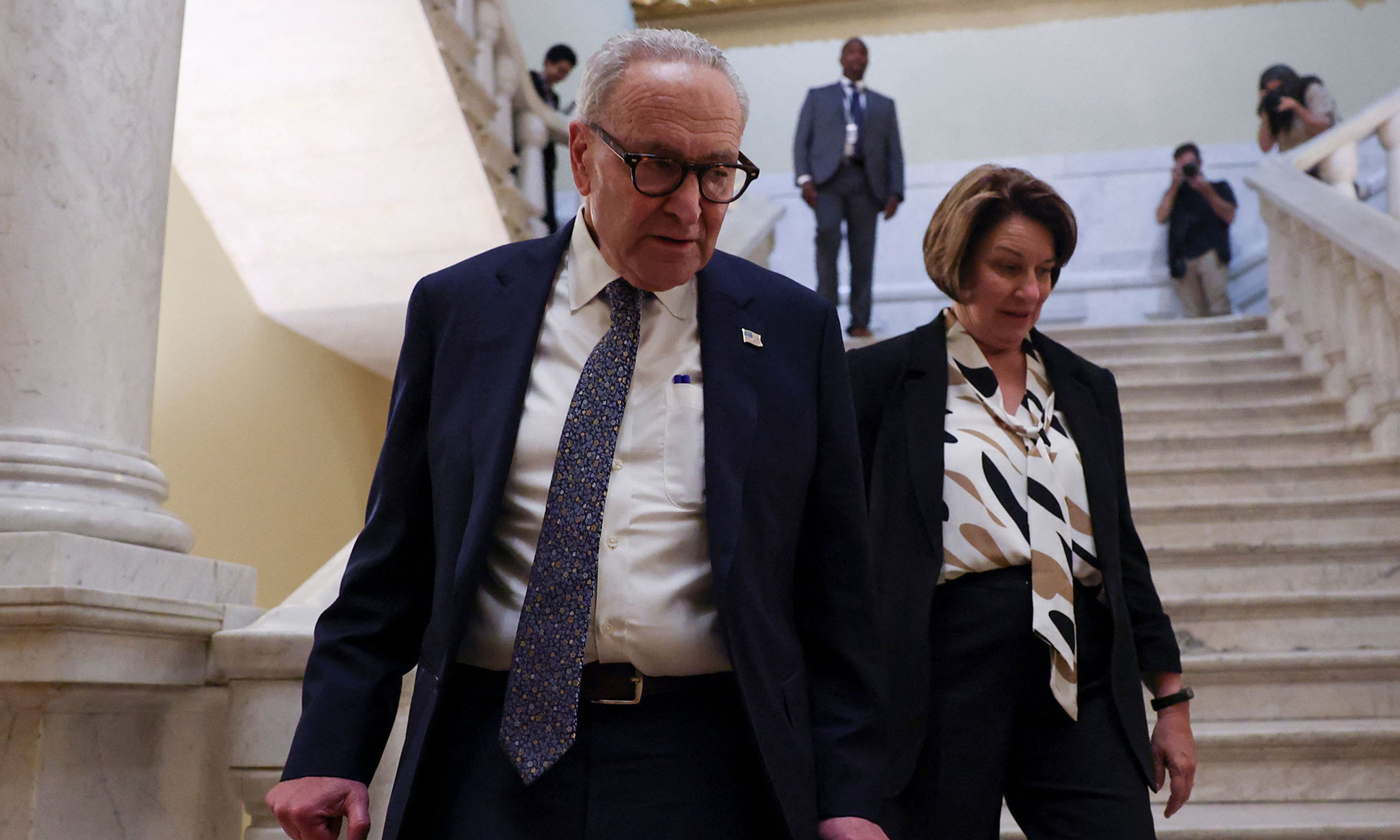
Senate Minority Leader Chuck Schumer (D., N.Y.) and Sen. Amy Klobuchar (D., Minn.) leave after a press conference following a Senate vote hours before a partial government shutdown took effect on Capitol Hill in Washington, D.C., September 30, 2025.
Dear Weekend Jolter,
The go-to charge during Washington shutdowns is that the holdout party is taking the government hostage. But what Democrats might not fully appreciate is that President Trump is obviously Keanu in that cliché and is at least willing to wound the hostage, whom he never had much affection for anyway, to end the standoff and humiliate his opponents for good measure.
As Audrey Fahlberg reported in the hours after this week’s shutdown deadline passed, the president reminded Democrats that the administration is prepared to make it hurt:
“A lot of good can come down from shutdowns,” Trump told reporters on Tuesday, a nod to Office of Management and Budget Director Russ Vought’s memo to agency heads to draft mass layoffs in the event of a shutdown, among other prospective government program changes. “We get rid of a lot of things that we didn’t want, and they’d be Democrat things.”
The Trump administration proceeded to halt funds to Democrat-led states and prepare for workforce layoffs. Then on Thursday, Trump previewed a meeting with his budget director “to determine which of the many Democrat Agencies, most of which are a political SCAM, he recommends to be cut, and whether or not those cuts will be temporary or permanent,” adding: “I can’t believe the Radical Left Democrats gave me this unprecedented opportunity.”
The Obama administration also was accused of maximizing the pain of the 2013 shutdown by closing the parks, among other measures. Yet congressional Republicans at the time faced the brunt of the criticism, a dynamic that could play out this time around, with the parties and roles reversed. That possibility, combined with a sense that Democrats felt pressured by their base to engage in this fight and have little leverage to extract major concessions, makes for an unpredictable situation that, as NR’s editorial says, could backfire on the minority party spectacularly.
As the editorial notes, some Democrats have found inspiration in the 2013 fight, since Republicans came back to win the Senate majority the next year. This time, Democrats can count on help from the media in blaming the 2025 shutdown on Republicans. That, however, is where the rose-colored lenses begin to transition.
“Historically,” the editorial continues, “the public has tended to place the blame on the party that rejects a clean bill and forces a shutdown to make policy demands on issues that aren’t directly related to disagreements over the government spending levels. In this case, Democrats aren’t even asking to restore funding that was cut — they are demanding that Republicans expand a program they have been opposing for the past 16 years.” And while the 2014 midterms might give Democrats heart, that election was more “a story of the disastrous rollout of Obamacare” than of the shutdown.
While the Trump administration has few qualms about using the standoff to continue downsizing government, Senate Republicans are eager to keep the public pressure on Democrats -- and plan to keep holding votes on a House-passed spending measure until they relent. Complicating the PR campaign, Democrats’ attempt to spin the current impasse as GOP-caused is facing pushback, even in the media.
There is a chance, however, for a deal that gives Democrats some of what they want, amid talks on possibly extending expiring Obamacare subsidies, a key sticking point. Here’s Phil Klein on why Republicans shouldn’t cave. And here’s Audrey on the cold, hard politics of the negotiations:
The political motivations for such a deal are obvious. Once the government gives something to constituents, it’s hard to take it away without facing immense political pushback from recipients, industry beneficiaries, and special interest groups — especially ahead of a midterm cycle.
The talks are in their early stages. As things stand, a bipartisan cohort of lawmakers — including Republican Senator Mike Rounds of South Dakota and retiring Democratic Senator Jeanne Shaheen of New Hampshire — are debating a few ways to tweak and temporarily extend the existing credits that are set to expire at the end of the year. A deal would require buy-in from President Trump while also somehow appeasing Democrats, who are facing immense pressure from a progressive base that is pushing them to resist the administration at every turn. . . .
The political pressure to win the midterms may just be too much for Trump and moderate Republicans to bear. But any package will face immense pushback from resistant fiscal hawks in both chambers. As I reported in yesterday’s Morning Jolt, there’s a huge chunk of GOP lawmakers and policy experts who would much prefer to see the credits expire.
Whether Trump feels so motivated to back such an exit strategy is very much an open question, as the shutdown drags on.
NAME. RANK. LINK.
EDITORIALS
How, exactly, is this America First? Qatar Does Not Deserve Trump’s Unilateral Security Guarantee
On the Quantico speech: The Military Will Be Stronger for Pete Hegseth’s Commonsense Changes
ARTICLES
Audrey Fahlberg: Dem AG Nominee Jay Jones Fantasized About Shooting Former Virginia GOP Speaker: ‘He Receives Both Bullets’
Dan McLaughlin: A Conversation with Justice Barrett
John Noonan: The Speech the Pentagon Didn’t Want, but the Military Needed
Abigail Anthony: England’s NHS Memory-Holes Its Defense of Incest
Guy Denton: The Enduring Lessons of William F. Buckley Jr.
Yuval Levin: Status Quo or Revolution?
Mario Loyola: The Show Trial of Jeffrey Clark
Andrew McCarthy: With More Scrutiny, the Trump DOJ Indictment of Comey Gets Worse
Noah Rothman: What the Left’s Eulogies for Assata Shakur Reveal
Charles C. W. Cooke: Mississippi Learning: Educational Success Is a ‘Choice’ After All
Jeffrey Blehar: The Chicago Teachers Union Is Exactly Who You Thought They Were
Daniel Darling: Reject the Self-Loathing: A Case for Grateful Patriotism
James Lynch: Biden TSA Targeted Tulsi Gabbard, January 6 Defendants, and GOP Lawmakers
Zineb Riboua: A Russian Defeat in Ukraine Would Help the West Elsewhere
CAPITAL MATTERS
Jeffrey Depp sounds the alarm on a disturbing revenue-raising idea: Don’t Tax Innovation: The Patent ‘Wealth Tax’ Is a Terrible Idea
Meanwhile, Veronique de Rugy writes on inescapable budget math: Congress Is Running Out of Excuses on the Debt
LIGHTS. CAMERA. REVIEW.
Adam Sandler goes to his happy place. From Armond White: Happy Gilmore 2: Golf and Unity
THE EXCERPTS CAN’T BE SHUT DOWN
Read Audrey Fahlberg’s exclusive on disturbing texts from the Democrats’ AG nominee in Virginia:
On August 8, 2022, a Republican state legislator received a disturbing string of early-morning text messages from a former colleague, Jay Jones, this year’s Democratic nominee for Virginia attorney general.
Jones, who at the time had recently resigned from the state house after a brief stint representing Norfolk, had strong feelings about how the political class was eulogizing recently deceased former state legislator Joe Johnson Jr., a moderate Democrat with a long tenure in Virginia politics. Republican legislators like House Speaker Todd Gilbert had begun making public statements honoring Johnson’s memory and political legacy, and some of those statements were making the rounds in state legislative group chats.
Around 8 a.m., Jones shared those feelings with his former state legislative colleague, Republican House Delegate Carrie Coyner. In a series of text messages obtained by National Review, Jones derided Johnson’s political centrism and scoffed at the “glowing” tributes that were being made in his honor by Republicans in the wake of his death.
“Damn that was for mark,” he wrote to Coyner, suggesting he’d meant to send the texts to someone else. And yet that realization didn’t stop Jones from joking about what “that POS” Gilbert “would say about me if I died.”
Then, the conversation took a dark turn.
“If those guys die before me,” Jones wrote, referencing the Republican colleagues who were publicly honoring the deceased Johnson’s memory, “I will go to their funerals to piss on their graves” to “send them out awash in something.”
Jones then suggested that, presented with a hypothetical situation in which he had only two bullets and was faced with the choice of murdering then-Speaker of the House Todd Gilbert or two dictators, he’d shoot Gilbert “every time,” prompting pushback from his former colleague.
Dan McLaughlin sat down earlier this week with Justice Amy Coney Barrett for an extensive interview. You can find the second half of that discussion on the NR homepage later this weekend. The first half is up now, and here:
NR: We’re now in a position where there are critics of originalism from the right — people who say: It’s too legally positivist. It doesn’t consider enough of the common good to achieve everything that the right wants to do. How do you think about or respond to those kind of critiques?
JUSTICE BARRETT: I don’t like this common good constitutionalism movement.
It feels to me like it’s just results-oriented, and I think that it has all of the defects that originalists critiqued when originalism first became a self-conscious theory in the 1980s. I resist the idea that originalism wasn’t around until Scalia, that originalism wasn’t around until the ’80s, because if you go back and look even at [John] Marshall opinions, and go back to the Founding they were looking at, you know, what did the Framers intend? They might not have always used the language of meaning rather than intent, but originalism, Keith Whittington talks about this. I mean, originalism was always a part of the Court’s jurisprudence. But just like that little caveat, I just think that common good constitutionalism is just kind of results-oriented jurisprudence from the right. . . .
NR: Of course, one of the hot issues, literally a hot issue this morning even [with the Trump v. Cook decision], is the emergency docket. And there’s been a lot of criticism, even criticism from district judges — criticism from public sources, saying the Court’s doing these things, not explaining them, even district judges saying, “How are we supposed to follow precedents when they don’t say why?” And you say in the book about the flip side of that, which is, of course, the danger of saying too much on too short a time frame, on too limited a record: “Committing the Court’s reasoning to print risks hardening what should be tentative into something more definite.”
Do you think that the Court ought to be doing a little more to explain what it’s doing, or is it just unavoidable?
JUSTICE BARRETT: I think it’s unavoidable that we can’t always. I mean, I think that there can be reasonable disagreements in each particular case, each stay application, whether it’s a good opportunity to say more or less, but I think it’s a difficult call. It’s interesting. You know, I turned in the draft of the book, I think maybe right around [Trump’s] inauguration. So certainly, the emergency docket, I think we’ve had more stay applications, and the docket has been around over the last several administrations, but I do think there’s been a lot of activity over the summer.
And as I’ve been talking to people about the book, I’ve actually come around to thinking, maybe we shouldn’t be calling it an emergency docket, but maybe something more like “preliminary docket.” I know some people call it the interim docket. [Ed. — Justice Kavanaugh recently urged adopting this label.]
Because it’s become clear to me, kind of late-dawning, it was just a couple weeks ago, I realized that people [who] criticize us for not writing decisions seem not to understand that it’s not the last word. They seem to think that this is just another track of our merits cases.
Because I’ve had some people say — I had one interlocutor read part of my book where I say opinions are the Court’s most important work product, and then say like, “Well, why isn’t the Court producing opinions and showing its work in the emergency docket?”
The thing is, ultimately, we will, right? A lot of these cases are going to come back to us on the final docket, and we will show our work, and we will have an opinion at that point, and if we put one on the record now, as I said in the book, it risks hardening it for later. And if anything, I hope the book describes the painstaking decision-making process that we go through before we do commit something to print.
So, pick any number of these cases, the removal cases, or, you know, Noem v. Perdomo, the Ninth Circuit immigration enforcement Terry-stop case. I mean, all of those cases, if they come back, are going to get briefing and argument. And I guess I think, we’re not hiding the ball. This is really just a preliminary decision about what’s going to happen, or the status quo that’s going to remain in place until we have a chance to speak on the merits. And I just don’t think — people think, “Oh, we’ve settled the question.”
Mario Loyola has a deep dive on the push to disbar a Trump official:
Soviet show trials were not just sham proceedings. The charges were often purposefully absurd, as if to communicate that it wasn’t about justice, or even retribution, just a naked demonstration of the party’s power. Bereft of any real law, punctilious attention to procedure gave the trials a phantasmagorical aspect, both farcical and terrorizing.
Something similar has been going in the District of Columbia’s four-year-long persecution of Jeffrey Bossert Clark, currently one of the most senior attorneys in the Trump White House and director of the Office of Information and Regulatory Affairs, the regulatory nerve center of the administration. He is accused of professional misconduct for recommendations he made in the wake of the 2020 election, when he was among the highest-ranking officials at the Justice Department.
Of course the District of Columbia won’t sentence Clark to be shot — the inevitable sentence in a Soviet show trial. The district merely wants to revoke his license to practice law, his profession of 30 years, on the recommendation of the D.C. Board of Professional Responsibility. But in other respects — particularly in how petty and nonsensical the charges against him are — this is a pure show trial.
The matter is now in its final stages before the D.C. Court of Appeals (the highest local court in D.C.) and could be before the Supreme Court before the end of the year. . . .
In the frenetic weeks after the 2020 election, there were multiple sworn allegations of election irregularities in Georgia and a handful of other battleground states. Some of these involved failures to verify signatures on large numbers of mail-in ballots, the use of which had become dangerously promiscuous in the course of 2020, driven by the pandemic lockdowns.
As the board notes in its 104-page opinion, the Justice Department was looking into potential cases of criminal election fraud and “did not run to ground all the irregularities brought forward, especially those related to alleged violation of state election rules, for example, whether election workers in Fulton County, Georgia conducted verifications of the signatures on absentee ballots.”
With time running out to correct any serious breach of election integrity, Clark prepared a draft legal opinion that proposed launching additional federal investigations and suggested that state legislatures could convene in special sessions to consider evidence of election irregularities and potentially revise their election certifications. The step-by-step process was laid out in a “proof of concept” draft letter that Clark proposed to send to the legislatures of several states, starting with Georgia. . . .
Some of the complaints filed in the wake of the 2020 election resulted in disciplinary proceedings against the attorneys involved because of “vexatious litigation,” sloppiness, or questionable factual assertions about the conduct of the election. Clark’s “proof of concept” letter raised no such problem. The board points to nothing in Clark’s five-page legal analysis that it even thinks was wrong as a matter of law.
In substance, the draft letter explained the crucial (though largely unseen) responsibilities of state legislatures within America’s arcane system of presidential elections. It devoted several pages to arguing why, in the original constitutional scheme, a state legislature could call itself into session to review and potentially replace the slate of electors, without action by the governor. This was an important tangent given that Governor Brian Kemp had already certified the state’s election for Biden and had rejected calls to revisit the certification.
A special session of the Georgia legislature would have added a whole new dimension of conflict and controversy to an election that already had far too much of both. But Clark is not facing disbarment for any of that. In fact, the legal basis of the charge against him has almost nothing to do with the 2020 election at all.
Instead, the board’s recommendation that Clark be disbarred is based on its conclusion that Clark was guilty of “attempted dishonesty.”
Yuval Levin, armed with charts, explains how the actual fiscal picture under Trump has not changed dramatically:
Donald Trump has been pushing hard against the boundaries of presidential authority. But at the core of the separation of powers, where the executive and legislative branches are expected to contend over policy and funding priorities, he has actually been strangely idle.
It may not seem that way at first. This administration began with tumultuous commotion over Elon Musk’s “Department of Government Efficiency” and all manner of promises and threats about radical spending cuts. There was a freeze on federal grants, talk of restructuring assorted agencies and programs, and a widespread sense that the White House was looking to set up an epic battle over large-scale impoundments — that is, refusals to spend money appropriated by Congress for goals the president does not agree with.
But at the same time, the spending path set out by Congress for the federal government this year has barely changed at all. In March, Congress passed and the president signed a continuing resolution that extended Biden-era appropriations levels through the end of this fiscal year. The One Big Beautiful Bill Act — the reconciliation measure passed in July — raised spending levels for defense and immigration enforcement but otherwise kept appropriations where they were. One rescission bill has also been enacted into law, rolling back about $9 billion in foreign aid and public-media funds, and the administration has proposed a further rescission of just under $5 billion focused mostly on foreign aid, which it apparently intends to advance as a (legally dubious) “pocket rescission” if Congress does not approve it by the end of the fiscal year. Together, the two would amount to roughly one half of 1 percent of federal spending — not nothing, but not a significant shift in the trajectory of federal finances. . . .
So what has actually been going on with government spending? The full, detailed picture won’t be known for some time, as final tallies of obligated funds trickle in from the agencies. But the end of the federal fiscal year offers an opportunity for a general accounting that might give us at least a preliminary sense of what all the sound and fury has amounted to.
CODA
This isn’t my usual fare, but a friend recently gifted me an album by Tame Impala, a poppy, psychedelic, indie-flavored Australian band. The album, Lonerism, is growing on me. This song is sort of a cross between the Black Keys and the Beatles, with one or two shakes of Muse.
Enjoy, and have an eventful weekend.

About the Author
Judson Berger is the managing editor of National Review Online.
Featured Tags
Advertisement
Advertisement





Comments