Share this story
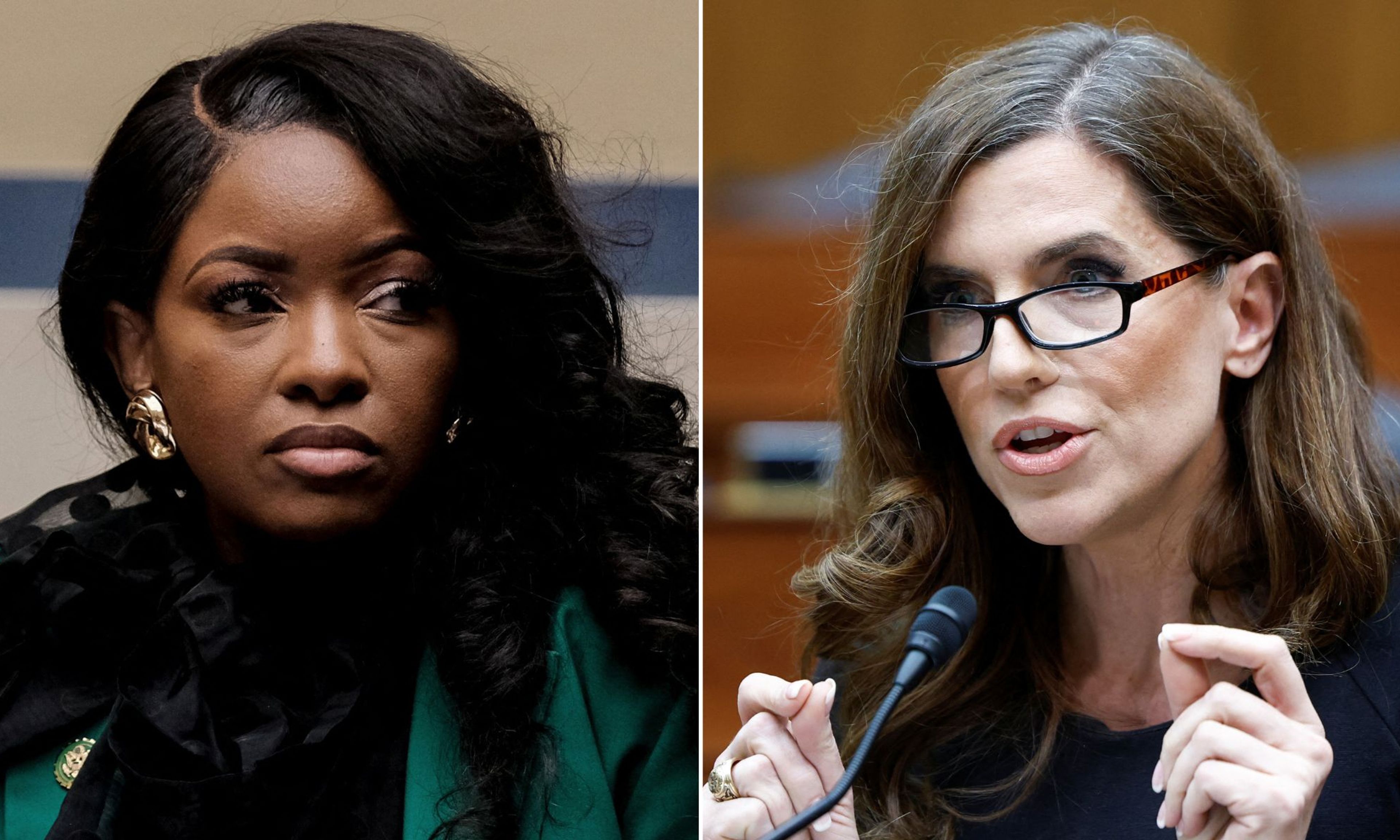
Left: Rep. Jasmine Crockett (D., Texas) attends a House Oversight Committee hearing on Capitol Hill in Washington, D.C., February 7, 2023. Right: Rep. Nancy Mace (R., S.C.) speaks during a hearing on Capitol Hill in Washington, D.C., February 29, 2024.
Dear Weekend Jolter,
It’s nice to see politicians admit how the game is really played.
In a profession (as this newsletter went to press, the author was still debating whether to scare-quote that word) brimming with ambitious people, two exemplars of the type recently gave interviews in which they, intentionally or not, leveled with voters about what matters in their pursuit of power.
Congresswoman Nancy Mace, in an interview with the Associated Press discussing her bid for South Carolina governor, simplified the stakes, reflecting a reality any observer of recent GOP primaries knows to be the case: at issue is President Trump’s endorsement.
“No one will work harder to get his attention and his endorsement,” she told the AP. “No one else in this race can say they’ve been there for the president like I have, as much as I have and worked as hard as I have to get the president his agenda delivered to him in the White House.”
Congresswoman Jasmine Crockett, in an interview with The Atlantic (in an article titled “A Democrat for the Trump Era”), vented her frustration about losing her bid to be the top Democrat on the House Oversight Committee, when what the party evidently needs is sharp-elbowed communicators like her: “It’s like, there’s one clear person in the race that has the largest social-media following,” Crockett told the magazine.
One Republican, one Democrat, one shared truth: they know, and never forget, their audience. The performance is for them. In the case of Mace, that’s just Trump; in the case of Crockett, the consumers of viral political content.
It is no coincidence that the gent who pens a weekly newsletter called Carnival of Fools noticed both of these interviews. “Crockett reveals a good deal about herself with her own words,” Jeff Blehar observes of the latter piece. And there's this:
In a detail that speaks inadvertent volumes, we discover that, while the “lock screen” on your smartphone might be a picture of your partner or your kid, the one on Crockett’s is a glamour shot of herself.
Caroline Downey, in a piece about our coarsening politics, also describes how Democrats have fallen into the “profanity trap,” with Crockett leading the way.
As for Mace, Jeff writes, “Mace is cynical, but she’s not stupid. She knows as well as anyone that in a state with a Republican primary electorate like South Carolina’s, a Trump endorsement is the golden ticket to primary victory.”
The Lowcountry candidate also told the AP that her platform calls for ending the state income tax, promoting school choice, protecting women and children, and other planks. Don’t expect such priorities to overshadow the Trump considerations, however.
The audience for conventional campaign promises is secondary these days.
NAME. RANK. LINK.
EDITORIALS
On the absurd ousting of the BLS commissioner: Trump Is Shooting the Messenger
Republicans may regret this, but Democrats have no ground to stand on: Texas Republicans Play Catch-Up in Gerrymandering
The vaccine skeptic makes his move: Don’t Abandon mRNA
There are many ways that Israel’s Gaza City takeover plan could go wrong: Israeli Takeover of Gaza Would Be a Big Risk
ARTICLES
Stanley Kurtz: The Conservative Cultural Comeback
Richard B. Frank: The Atomic Bombing of Japan Was Justified
Charles C. W. Cooke: Stockton Rush’s Name Deserves to Live in Infamy
Noah Rothman: Three Cheers for the Lunar Nuclear Reactor
Audrey Fahlberg: Republicans’ Summer Challenge: Selling the Big, Beautiful Spending Bill to Voters
Haley Strack & Audrey Fahlberg: DOJ Launches Grand Jury Probe into Obama Officials’ Russiagate Role
Dan McLaughlin: At the U.N., a Franco-Saudi-Led Step Toward Realism About Hamas
Jennifer Sey: The American Eagle Saga Only Shows the Woke Left Is Out of Touch
Becket Adams: The Media Love a Good Left-Wing Conspiracy
Jack Butler: Trump and Kennedy Can’t Have Their Coke and Drink It, Too
CAPITAL MATTERS
Amity Shlaes’s latest “Forgotten Book” column highlights a Trump precursor: The MAG Before MAGA
Dominic Pino would like to submit a nomination: Chart Crime Alert!
LIGHTS. CAMERA. REVIEW.
Armond White is not laughing: The Smoking Gun of The Naked Gun
ICYMI, Brian Allen’s been in the Land of Enchantment: The Albuquerque Museum: Curatorial Prowess and Easygoing Style
THESE EXCERPTS HAVE GREAT GENES
Eighty years after Hiroshima, military historian Richard B. Frank carefully, and comprehensively, makes the case for why the alternative to the bomb would have been worse:
The first basic point is that this war was not merely the “Pacific War.” That narrow lens treats events as though they were bound between December 1941 and August 1945. It foregrounds the conflict between the United States and Japan across the Pacific. It recognizes only a handful of additional participants: the Philippines, Australia, Pacific Islanders, and New Zealanders. The actual conflict properly identified is the Asia-Pacific War. It commenced with Japan’s assault on China in July 1937 and only ended officially 97 months later — although fighting continued “postwar” in Asia for years. Japan enormously expanded the war starting in December 1941 to reach India on the west and pierce far into the Pacific Ocean on the east.
The Asia-Pacific War killed 25 million human beings, by conservative count. Of these, about 6 million were military personnel, including about 3 million Chinese and 2 million Japanese. There were 19 million dead civilians — or three dead civilians for every combatant death. A reasonable range of European war casualties reaches the vicinity of 37–48 million, but the ratio of civilians to combatants does not rise above two to one.
Of the Asia-Pacific War civilian dead, 1–1.2 million were Japanese, including about 210,000 immediate and latent deaths at Hiroshima and Nagasaki. This leaves about 18 million dead civilians who were not Japanese. Extremely few of these were white. The 18 million comprises 12 million Chinese, 2.7 million Indonesians, 1 million Vietnamese, and about 2.3 million spread among other peoples of Asia and the Pacific. Framed another way, Japanese civilian deaths form about 6 percent of all civilian deaths, and atomic-bombing-related deaths make up less than 2 percent of all civilian deaths. . . . Getting the moral calculus correct on this anniversary is by far the most important task on the path to understand and judge how the Asia-Pacific War ended. But this also encompasses important factual issues. . . .
An invasion of the Japanese home islands was a highly contentious component of American strategy to achieve unconditional surrender. The U.S. Army believed that the critical issue was time. The American people would lose patience to sustain the war if the war became protracted. The Army saw the quickest path to Japanese surrender to be an invasion of the home islands. Ominously, after three years of the Japanese “no surrender” record, the Army further believed that it might not be possible to obtain an organized Japanese surrender. An invasion would position the U.S. to systematically subdue the holdouts.
The U.S. Navy believed that the critical issue was casualties. Huge casualties would prompt public demand for negotiated peace. The Navy looked to end the war by bombardment by air and sea and a blockade to starve to death Japanese civilians by the millions — based on the norm-breaking path set against Germany in World War I. This strategy would minimize U.S. casualties, but the timeline to a Japanese surrender by this strategy was unknowable.
The Army secured President Harry S. Truman’s reluctant authorization in June 1945 for an initial invasion of Kyūshū, the southernmost Japanese home island starting on November 1, 1945. Then, in July and into August, radio intelligence stunningly unmasked the Japanese preparation to turn southern Kyūshū into a huge strategic ambush. The Japanese exactly anticipated southern Kyūshū as a target, down to the specific landing areas. The radio intelligence showed that massive Japanese forces packed the landing areas, vastly outnumbering the American units that would actually engage the Japanese defenders, not perform support duties.
Admiral Ernest J. King, the senior American naval officer, fiercely opposed any invasion. But he had bided his time, waiting for a showdown. The radio-intelligence picture by early August demonstrated that the facts were on his side. King moved on August 9, the same day as the Nagasaki bomb, to trigger a showdown to cancel the Kyūshū landing (or any invasion). But Japan surrendered before this played out. This story remained unknown, because of secrecy, well into the 1990s. This rendered pointless the contentious debate on potential invasion casualties, since the belatedly revealed reality was far worse than the earlier projection contemplated. King’s action demonstrated just how dark the invasion strategy looked in August 1945. If the planned invasion then looked unthinkable, no plausible American president would have failed to authorize use of atomic weapons in August 1945.
NR’s editorial explains why the Bureau of Labor Statistics doesn’t deserve to be scapegoated:
The Bureau of Labor Statistics sends a survey to employers each month to figure out how many people they employ, as part of the jobs report. In the good old days before Covid, that survey had a response rate of about 60 percent. From respondents’ guesses about how many people they employ, the BLS had to guess about how many people are employed in this nation of 340 million souls.
That’s a really hard job. The BLS employs some of the best statisticians in the world, and they happen to be pretty good at it, often getting within a tenth of a percent of the final workforce numbers.
Then, Covid happened, and the establishment survey response rate dropped like a rock. It hasn’t recovered and currently sits at 43 percent. What was already hard at a 60 percent response rate is now even harder.
The problem of falling response rates has been well known for years, even before Covid. “The quality of data from household surveys is in decline,” said a paper published in the fall 2015 issue of the Journal of Economic Perspectives, because “households have become increasingly less likely to answer surveys at all” and “those that respond are less likely to answer certain questions.”
Within government, Donald Trump’s appointee as BLS commissioner, William Beach, has been a leader in calling for modernizing the surveys that statistical agencies rely on. . . .
Beach has called Trump’s firing of his successor, Erika McEntarfer, “totally groundless,” and he’s correct. The issues with jobs reporting are not about politics or McEntarfer’s competence. In fact, they are exactly the kind of thing that an administration committed to technological modernization and government efficiency should find to be in its wheelhouse. And there’s no reason to think this particular jobs report was any more flawed than any other.
McEntarfer was not standing in the way of this modernization. Trump was mad about the jobs report, so he fired her.
He made this abundantly clear in a Truth Social post less than an hour after the one announcing McEntarfer’s firing, where he called the jobs numbers “rigged” against Republicans. So biased, apparently, that Vice President Vance was referring to them approvingly on social media mere hours beforehand.
There’s no consistent partisan bias at work here, as was demonstrated last year when the same BLS that Trump said was pro-Democrat for issuing downward revisions of earlier jobs reports under Biden issued the weakest jobs report of the year right before the presidential election. The job is hard when done well, and it’s been getting harder to do well.
Okay, one last word on the American Eagle/Sweeney jeans ads, from ex–Levi’s exec Jennifer Sey:
The campaign uses a play on words to describe Sweeney’s jeans: “Genes are passed down from parents to offspring, often determining traits like hair color, personality, and even eye color. My jeans are blue,” she says in the ad.
Sometimes a pun is just a pun.
In my 30-year career as a marketer and maker of jeans — eight of them spent as the chief marketing officer for Levi’s — I’ve been pitched a similar campaign with the exact same pun more times than I can count on two hands. I never ran it. It just seemed too obvious.
But in an age of ads featuring morbidly obese and hairy-chested “nonbinary” people lounging around in jeans and underwear, this cliché feels fresh — if only because Sweeney is hot. After all, when old becomes new again, it’s always about context. Mom jeans and dad shoes became cool because of the irony, not because anyone actually wants to look like their mom.
And in the age of unwieldy wokeness, hot blondes are a breakthrough idea.
CODA
I’m feeling Steely Dan this week, what can I say? Thanks for reading, and catch you next weekend.

About the Author
Judson Berger is the managing editor of National Review Online.
Featured Tags
Advertisement
Advertisement

Comments