The Left’s Brand Is the GOP’s Most Powerful Midterm Weapon
Written by Judson Berger
Share this story
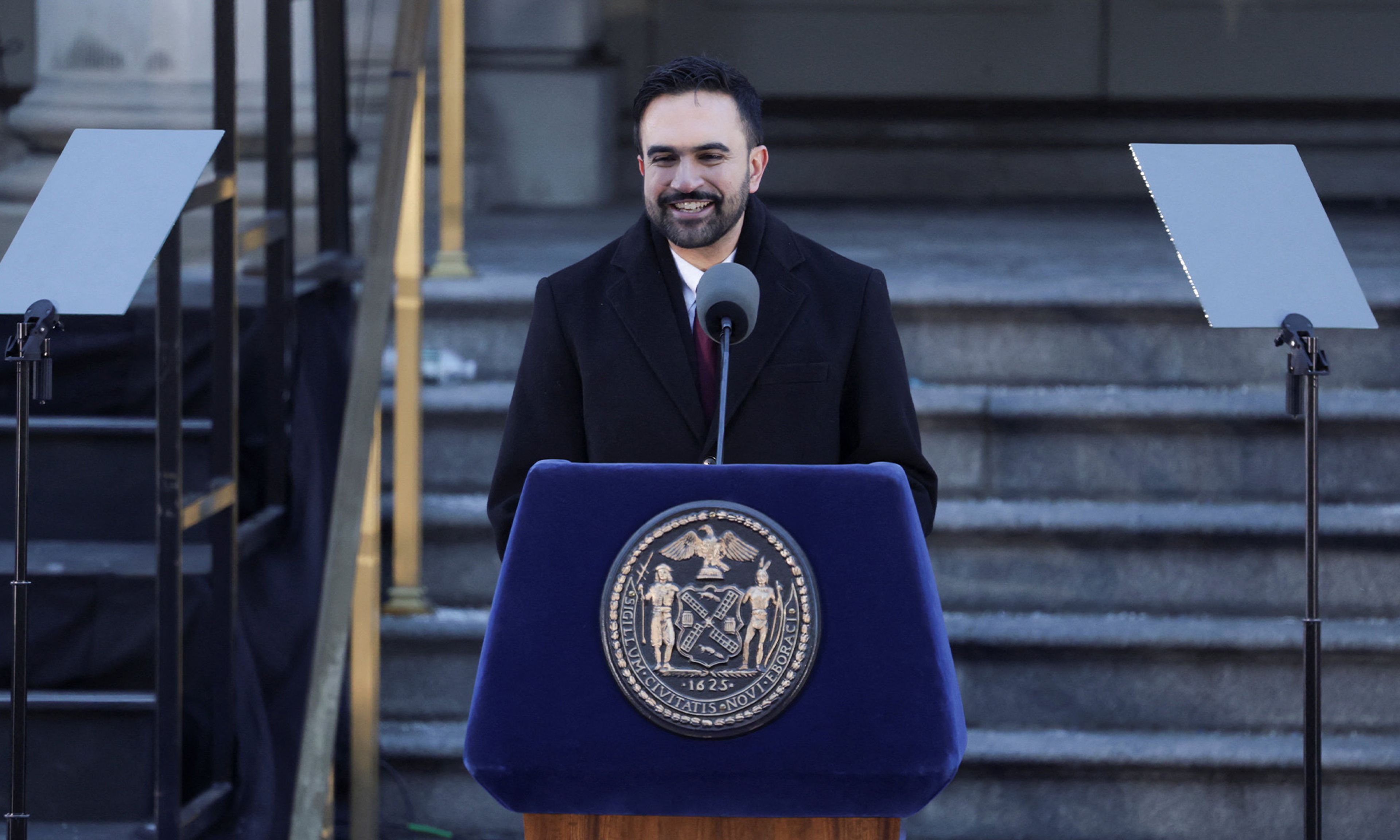
New York City Mayor Zohran Mamdani reacts during his inauguration ceremony in New York City, January 1, 2026.
Dear Weekend Jolter,
If anything saves the GOP from the fierce unpopularity of President Trump in the November midterms, it will be the left’s seemingly incurable image problem: its sustained attachment to unsustainable causes, its association with crummy local governance, and -- this just in -- its allergy to unqualified moments of national pride.
In a State of the Union address that overflowed with embellishments of his record and boasted a runtime longer than Dr. Strangelove’s, Trump was his most effective in (a) honoring a gallery full of heroes and tragedy-stricken families and (b) putting the spotlight on commonsense domestic policies and Democrats’ resistance to them. Jeff Blehar writes:
It was a turn that says so much about where the Democrats have placed themselves on the political spectrum; Trump roared to life when turning to domestic issues like the border and youth transgender medicine. It was by far the most powerful part of his speech, and he knew it — just look at how excited he was delivering those lines and turning the spotlight harshly upon the Democrats by leveraging their own public immaturity.
Democrats could give up their resistance to transgender-related regulations for minors. They could occupy a middle ground on immigration that opposes ICE dragnets and mass deportations but supports targeted enforcement -- even the very legitimacy of immigration enforcement as a function of government. But no matter how popular that would be, it would lead to a holy war with the base.
More conventional types see the problems with the Democratic brand, and their warnings burst into public view this past week. There was Fareed Zakaria, who teed off on blue-city governance using language and stats that could have come from your median NR essay.
“Blue cities are out of control. Promising more, spending more, delivering less, and pushing off the fiscal problems to some future day,” he pronounced on his CNN show, making an example of New York’s ballooning budget, which has nearly doubled since Michael Bloomberg’s day -- as well as Los Angeles’s massive homelessness spending, with little to show for it. “Stop governing as if the goal is to announce new entitlements and instead make government work.”
Jim Geraghty writes that centrist Democrats are getting fed up with progs “who insist they must be judged on good intentions and the amount of money spent instead of the actual results of their policies.” Citing Zakaria’s segment as well as a New York Times op-ed urging local Democrats to push back against public-sector unions, he describes a “crisis of faith in Democrats who can’t avert their eyes from the policies in place in America’s biggest cities”:
If the blue city and blue state “models” work so well, a whole bunch of blue states shouldn’t keep losing population while a whole bunch of red states keep adding population. If the tax-and-spend progressivism is supposed to be so good for working people, why is California the most unaffordable state in the country? Why is a black child in Mississippi two and a half times as likely to be proficient in reading by fourth grade as a black child in California? Why are low-income children more likely to test proficient in reading in Mississippi or Louisiana than in California, Massachusetts, or New York?
Noah Rothman, picking up on this theme, further explores the “pathology” that causes some on the left to dismiss urban crime and quality-of-life issues as topics unworthy of remedy or attention.
In this Semiquincentennial year, during which Americans will be served up so much red, white, and blue we’ll be seeing stars, one final peculiarity is the tendency -- especially among members of the media -- to sneer at national accomplishment (or even the notion of Western culture itself). Witness the bizarre news cycle over the win by the U.S. men’s hockey team over Canada on the Olympics’ final day, as the team faced media-amplified backlash for laughing at one of Trump’s off-color jokes and accepting a White House invitation. “It’s okay to be happy that the United States won something, without finding 100 other reasons to be sad, angry, indignant, or confused,” Charlie Cooke counsels. Lachlan Markay, on X, described the freakout tarnishing one of the greatest moments in American athletics as a “radicalizing moment.”
What is described above largely pertains to the local level or media ecosystem, not Congress. But as we saw in the 2024 election, the impressions created there all contribute to the Democrats’ image with voters.
Neither party is making a positive case for itself. There’s a reason the percentage of Americans who identify as independents keeps climbing and just hit a record high. If the Democrats’ brand is the GOP’s biggest weapon in the midterms, Trump remains Democrats’. “The Donald Trump of 2025 and 2026 is more erratic, impulsive, tempestuous, and self-absorbed than he was during his first term,” Jim writes. If that trajectory continues, and if the economy is politically neglected by the administration, the Democratic Party may be able to put off its cultural reckoning for yet another cycle.
NAME. RANK. LINK.
EDITORIALS
Our SOTU editorial: Trump’s Supersized State of the Union
This subject cannot be taboo: Yet Another Transgender Shooting Suspect
More on the men’s hockey non-controversy: Yes, Celebrate the U.S. Men’s Hockey Team
ARTICLES
Noah Rothman: Trump Hands Vance a Ticking Time Bomb
Audrey Fahlberg: Trump Pushes Congressional Stock-Trading Ban in State of the Union, Earning Applause from Dems
Audrey Fahlberg: ‘Vote No and Take the Dough’: House Dems Take Credit for Community Projects After Opposing Spending Bills
James Lynch: Chinese Official Accidentally Reveals Vast Influence Operation Through ChatGPT Use
Danielle Pletka: Delusion Keeps the Iranian Threat Alive
Christian Schneider: The Supreme Court Shows Its Work
Jim Geraghty: Mexico Kills a Drug Kingpin, and the Cartels Set the Country Ablaze
Dan McLaughlin: If the ‘Talking Filibuster’ Means Anything, It Would Irrevocably Change the Senate for the Worse
Rich Lowry: The Disgraceful Ravings of Candace Owens
Jeff Blehar: The Best of America, on Ice
Kamden Mulder: Newsom Pardon Allows Illegal Immigrant to Remain in U.S. Despite Attempted Murder Conviction
Joshua Treviño: An ‘Acceptable War’
Charles C. W. Cooke: We Need a Vote on Iran
Jianli Yang: Supreme Court Tariff Ruling May Not Be Good News for China
Andrew McCarthy: Why Trump’s Section 122 Tariffs Are Illegal
Brittany Bernstein: Compassionate Left-Wing Activists Outraged Mamdani Is Saving Homeless People from Freezing to Death
CAPITAL MATTERS
Sara Albrecht, on a well-timed anniversary: The Duty to Say What the Law Is
LIGHTS. CAMERA. REVIEW.
Giancarlo Sopo wrestles with one of the great questions: What Is a ‘Conservative Movie’?
Armond White isn’t buying the KPop hype: The Pop Fatigue of KPop Demon Hunters
Brian Allen is greeted with grievances in Berkshire County: Woke Addiction Makes For a Mixed Season at MASS MoCA
PODIUM-WORTHY EXCERPTS
James Lynch has the incredible story of a Chinese operative who tried to enlist ChatGPT:
A Chinese law enforcement official disclosed to ChatGPT a vast influence operation targeting foreign adversaries and dissidents worldwide that included the impersonation of U.S. officials to silence critics, according to a new report from Open AI, the company behind the chatbot.
The Chinese operative used Open AI’s ChatGPT to help plan an operation to undermine Japan’s pro-Taiwan prime minister as part of the broader operation against potential threats to the Chinese Communist Party. The individual used ChatGPT to edit and update reports on “cyber special operations,” accidentally revealing the sweeping cyber campaign against foreign enemies and domestic threats.
The periodic reports on “cyber special operations” laid out a “large-scale, resource-intensive and sustained” strategy featuring numerous operations and hundreds of staff. The operations deployed tactics such as the abuse of social media account reporting to target dissidents, mass online posting, forging documents, and impersonating U.S. officials. All of the campaigns were designed to suppress online and offline criticism inside China and abroad. Based on the Chinese user’s status reports, Open AI concluded that China ultimately conducted the Japan operation without using ChatGPT.
Open AI said it banned the account linked to the Chinese user and conducted open-source research to identify online activities that lined up with the user’s descriptions. The company revealed the Chinese influence campaign in a broader report laying out foreign operations and scams involving ChatGPT. When the Chinese user sought ChatGPT’s advice, the AI model refused to provide any and the user paused their inputs.
Audrey Fahlberg reports on a congressional role reversal:
In late January, Democratic Representative Kristen McDonald Rivet held a press conference celebrating $866,000 in federal funding she had lobbied Congress to include in a late 2025 appropriations bill.
“In an emergency, every second counts. Firefighters know that better than anyone else,” she wrote in a post–press conference social media post, which included photos of her standing beside firefighters. “We just announced new federal funding that will help the Bridgeport Fire Department respond faster and protect firefighters from dangerous toxins.”
Left unmentioned in McDonald Rivet’s remarks was the fact that she voted against the mammoth spending bill that secured the Bridgeport Fire Department funding for her own district.
Like many swing-seat House Democrats who had lobbied appropriators to include community funding projects in their districts last year, McDonald Rivet opposed the appropriations bill that included fire-station-facility improvement funding that she’d specifically earmarked over concerns that the appropriations bill in question didn’t extend the enhanced, pandemic-era Obamacare subsidies that were set to phase out on January 1.
McDonald Rivet is not alone in championing community-project funding she voted against. The Michigan congresswoman’s “no” vote is part of a larger trend in Congress in recent years, where many members oppose mammoth spending bills only to take credit for earmarked community funding projects on the campaign trail.
The trend demonstrates the increasingly partisan nature of the congressional appropriations process, with stopgap spending bills now routinely entangled in larger political battles over domestic policy issues. During the first year of Trump’s second term, for example, congressional Democrats have frequently opposed GOP-drafted appropriations bills to protest the administration’s policies related to Elon Musk’s cost-cutting efforts, expiring health-care subsidies, and immigration enforcement.
Describing this political phenomenon back in 2021, then–House Speaker Nancy Pelosi (D., Calif.) coined the term “vote no and take the dough” to preempt House Republican efforts to take credit for the Biden-era infrastructure and pandemic relief bills back home. And yet years later, vulnerable members of Pelosi’s own party have developed a track record for doing exactly that.
Giancarlo Sopo attempts to answer a timely and recurring question, on what makes a “conservative” film:
The better measure is not whether a film is conservative but whether it speaks to the preoccupations at the heart of the conservative imagination. Does it begin with a tragic view of human nature, understanding that darkness is interior as well as circumstantial? Does it treat inherited goods — family, order, faith, the transmission of civilization across generations — with the gravity they deserve, understanding that liberty depends on them? Does it stir gratitude for the Permanent Things? These are the questions worth asking.
We see them grappled with in A Man for All Seasons, when Thomas More (Paul Scofield) tells his accusers: “I am the King’s good servant, but God’s first.” Groundhog Day presents an Aristotelian argument through Phil Connors (Bill Murray): that virtue is discipline acquired through the unglamorous work of becoming someone worth being. In The Exorcist, Chris MacNeil (Ellen Burstyn) watches as doctors exhaust every materialist explanation for her daughter’s condition and is left with the truth that some things lie beyond the physical world. None of these were made by Republicans, yet all of them speak to what animates conservatism.
Films that engage these concerns most fully might fairly be called conservative. The label is best worn like Don Johnson’s white blazer, not a straitjacket. What I’m ultimately offering here is a lens, an invitation to engage with films across genres, decades, and political sensibilities — including ones being made right now — that have much more to say to us than we have allowed ourselves to believe.
The only admission ticket required: Ask whether a film makes you feel that truth, goodness, and beauty are worth defending — not just whether it would vote the way you do.
CODA
Let’s have some fun with the outro today.
From about two decades ago (though I vividly remember rocking out to this song like it was last week), “Through the Fire and Flames” is just an outrageous, completely over-the-top, almost-parodic and self-aware version of a metal song. I love it. A buddy and I listened to the album it’s on nonstop to keep us awake while driving at high speed across the Upper Midwest on a great American road trip one summer. The music video, linked above, also has a silly gag that wouldn’t be out of place in a Naked Gun movie, so wait for the picture-in-picture section.
DragonForce is the band, and rarely has a name been so apt. Having seen them in concert, I can confirm that these guys do, in fact, shred at this tempo. (That’s 200 BPM, the internet tells me.)
Enjoy, and thanks for reading.

About the Author
Judson Berger is the managing editor of National Review Online.
Featured Tags
Advertisement
Advertisement

Comments