Share this story
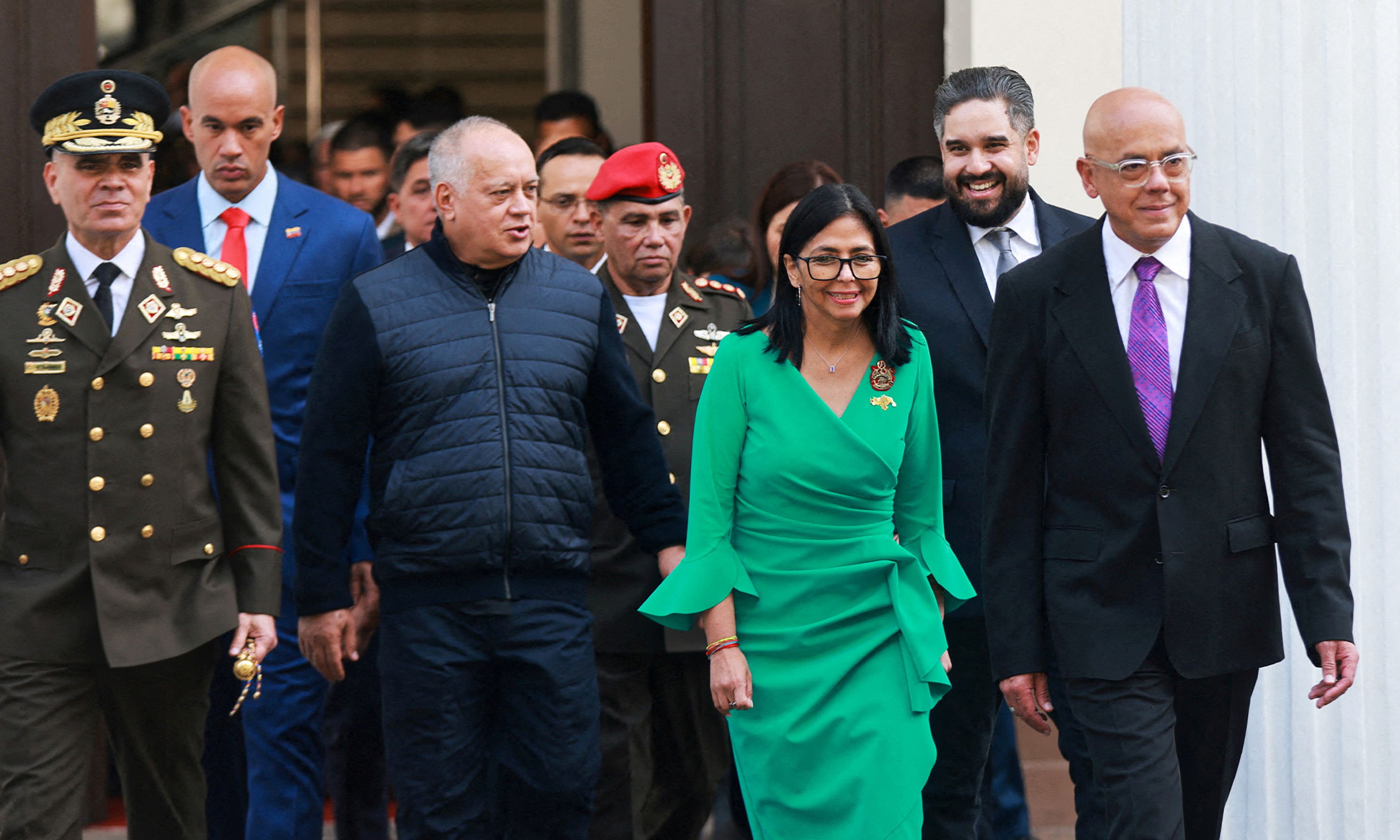
Venezuela’s Acting President Delcy Rodríguez walks with senior government officials at the National Assembly in Caracas, Venezuela, January 5, 2026.
Dear Weekend Jolter,
President Trump vowed, after ordering the most audacious act yet of his second term, that America will “run” Venezuela until a “safe, proper, and judicious transition” can occur. The question of who would run it was most immediate for reporters at Mar-a-Lago.
“Transition to what?” may be more consequential.
I’m going to let Elliott Abrams cast my horoscope from now on, because he wrote in detail for NRO last Friday morning about the prospect of regime change in Venezuela. So the former special representative for Venezuela’s analysis carries added weight here, and his first take after the extraction raid was that if the U.S. backs 2024 election winner Edmundo González, he can “lead a transition to democracy”; but if the U.S. deals with “regime remnants,” it invites the resumption of drug-trafficking, mass migration, and Cuba/Iran interference.
So far, the Trump administration looks to be dealing with regime remnants. That includes Vice President turned acting President Delcy Rodríguez, whose dark record Jim Geraghty details here and who, as Jim puts it, is “responsible for a list of crimes longer than a CVS receipt.” A taste of her dossier:
She is a Maduro loyalist, a “hardline socialist,” and has close ties to Cuba’s intelligence agency. The New York Times described her “impeccable leftist credentials” as the “daughter of a Marxist guerrilla who won fame for kidnapping an American businessman.” From 2018 to 2022, Rodríguez headed SEBIN, the Venezuelan intelligence service, which the United Nations determined “repressed dissent through crimes against humanity” “including acts of torture and sexual violence. . . . The report details how orders were given by individuals at the highest political levels to lower-ranking officials. Both SEBIN and DGCIM made extensive use of sexual and gender-based violence to torture and humiliate its detainees.”
In December, imprisoned retired Venezuelan major general Cliver Antonio Alcalá Cordones sent a letter accusing “Rodriguez and her brother, National Assembly President Jorge Rodriguez of being the real leaders of the criminal network long known as the Cartel de los Soles.”
Noah Rothman and Michael Brendan Dougherty -- who don’t always agree -- concur that the regime remains largely intact, for now. Andy McCarthy questions if the plan is to simply “squeeze reform and concessions” out of Rodríguez; he notes that Trump has not tried to install González (and the president played down the prospects for opposition leader María Corina Machado).
But Secretary of State Marco Rubio appealed for patience, describing a “threefold process” that includes stabilizing the country, ensuring American and other firms “have access to the Venezuelan market” while starting a political reconciliation process, and finally, pursuing a transition. According to Politico, the administration has specific demands for the acting presidente: crack down on drug-trafficking, kick out operatives from nations hostile to the U.S., and stop selling oil to American adversaries. Importantly, they want her “to eventually facilitate free elections and step aside” -- though the timeline is unclear.
Rubio voiced confidence in America’s leverage over Caracas in the form of an oil blockade (not to mention the threat of a second attack). But absent a full-blown military occupation, which the public and presumably the administration have little appetite for, Trump’s options may be limited, shaped by fluid and unpredictable circumstances. The neighborhood is not friendly. Pro-Maduro, armed gangs reportedly roam the streets, hunting for supporters of the U.S. intervention. As Jianli Yang writes, “Any U.S.-backed transitional authority will face immediate legitimacy crises, fragmented opposition forces, and the possibility of asymmetric resistance,” while administering a society “in near systemic collapse.” Meanwhile, Trump’s attention is already shifting across the Atlantic, with saber-rattling toward Greenland and NATO ally Denmark not only threatening the integrity of the alliance and alienating partners he’d need for a deal, but also diluting the case that the Maduro raid was an extraordinary measure for an extraordinary threat.
It is obviously a good thing, for America and for Venezuela, that Nicolás Maduro is in handcuffs. The dancing dictator offered no hope for reform. As NR’s editorial recaps, “He wrecked his country, stole elections, facilitated the drug trade, flooded the hemisphere with millions of refugees, and aligned his regime with enemies of the United States.” Noah calls the raid itself a strategic victory and tactical success, sending a sobering signal to “anti-American great powers and rogue states alike.” Joshua Treviño adds, “America, in the Americas, is back.”
But the impact of that message will depend in part on whether Maduro’s capture leads to chaos, a mere continuation of the regime under new management (this time friendlier to American oil interests) -- or something better.
If Washington succeeds in stabilizing Venezuela while neutralizing China’s embedded influence, it will be a decisive assertion of American hemispheric dominance. If it fails — if Venezuela becomes a prolonged contest of sabotage, debt disputes, and geopolitical signaling — it will confirm that even in its own backyard, U.S. power now faces determined, capable resistance.
Either way, Venezuela has become a proving ground for the emerging world order.
NAME. RANK. LINK.
EDITORIALS
Meet Cea Weaver: Mamdani’s Commie Housing Official Is a Lunatic
Good riddance: Tim Walz Departs on a Deluge of Fraud
Venezuela isn’t the only scene of turmoil: The Unrest in Iran
ARTICLES
Rich Lowry: Don’t Annex Greenland
Rich Lowry: Teddy Roosevelt Would Be Proud
Audrey Fahlberg: Heading into the Midterms, Trump Is Sure the GOP Is Winning. He Can’t Figure Out Why Voters Disagree
Noah Rothman: The Trump Administration Goes Full Tinfoil Hat in Its Revisionist History of January 6
Charles C. W. Cooke: How Not to Think About the ICE Shooting in Minnesota
Andrew McCarthy: The Legal Fallout from the Minnesota ICE Shooting
Pradheep J. Shanker: Vaccine Policy Should Be Based on Science, Not Partisanship
Gregory Slayton and Sergei Ivashenko: The West Must Start Preparing for Ukrainian Reconstruction
John H. Hinderaker: Tim Walz’s Unsurprising Two-Step from the Political Stage
Dan McLaughlin: Hack Walz Down
Will Swaim: Newsom Has His Own Massive State Fraud Problem
Guy Denton: The Devil’s Favorite Libertarian
Deborah J. La Fetra: Seize, Sell, Profit: Is the Government Allowed to Snatch a Family’s Home over a Disputed Tax Bill?
CAPITAL MATTERS
More on that ill-advised California tax proposal, from Marc Joffe: What to Do with California’s Billionaire Tax Proceeds
And more from John Puri, on what comes next in Venezuela: Don’t Replace One Nationalized Oil Industry with Another
LIGHTS. CAMERA. REVIEW.
Giancarlo Sopo serves up a moviegoer's guide for the New Year: Twenty Films Worth Leaving the House for in 2026
Armond White rolls out his patented “better-than” list: The Better-Than List for 2025, the Year of Sedition
Christian Schneider, on the anti-collectivist message of Pluribus: Hollywood Comes for Mamdani
ICYMI, Brian Allen lays out his “accolades and quibbles” concerning an Ivy League museum: Highs and Lows at Princeton’s New Art Museum
EXCERPTS OF THE CARIBBEAN (AND BEYOND)
Rich Lowry examines the historical backdrop to last weekend’s Caribbean raid:
It’s not difficult to find analogues for Donald Trump’s incursion into Venezuela — because they are littered throughout 20th-century American history.
Trump’s operation was as American as Henry Cabot Lodge saying that, however unformed it might be in other respects, U.S. foreign policy was “very definite” in our hemisphere, namely to be “supreme.”
It was anticipated by, to pick one year, the U.S. interventions in Nicaragua in 1912, in the Dominican Republic in 1912, or in Cuba in 1912.
It would feel familiar to such disparate figures as Teddy Roosevelt, William Howard Taft, and Woodrow Wilson. Granted they were all early 20th-century figures, but there’s also Ronald Reagan in Grenada, George H. W. Bush in Panama, and Bill Clinton in Haiti.
If Trump is particularly unadorned and openly bullying in how he’s handling Venezuela, the U.S. approach to Latin America has often had a large element of coercion and selfishness, especially in Teddy Roosevelt’s grabby maneuvering to secure the territory for the Panama Canal, which created an enormous strategic boon for the United States.
As has been widely noted, the Trump Corollary to the Monroe Doctrine bears resemblance to the Roosevelt Corollary setting out a U.S. obligation to intervene when Latin American countries were failing (Trump’s version also draws on the Lodge Corollary). In 1904, TR told Congress that countries that exhibited “chronic wrongdoing,” or misgovernance that produced a “general loosening of the ties of civilized society,” could require intervention “by some civilized nation,” i.e., the United States.
TR sent troops into Latin America only twice, but Presidents Taft and especially Wilson followed up with many interventions of their own.
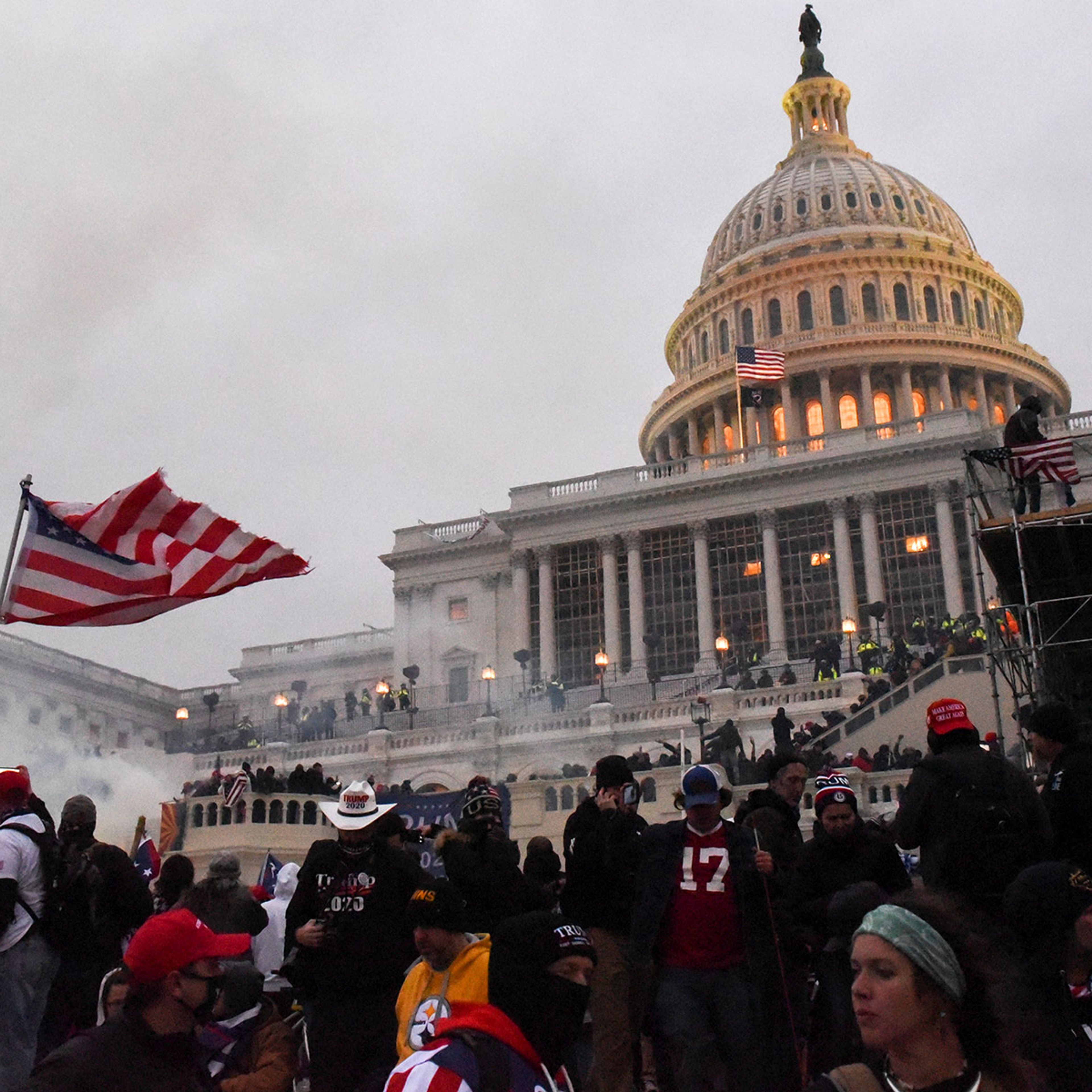
Noah Rothman bemoans the taxpayer-funded revisionism over January 6:
The story the president is promoting on the White House’s official website is comprehensive. The rebuttal to it must, therefore, be similarly extensive.
The document goes off the rails at the outset — in the introduction, to be exact. In it, Trump’s aides hail the president’s “blanket pardons” of the January 6 convicts. Trump “ordered immediate release of those still imprisoned, ending years of harsh solitary confinement,” the White House’s account reads, “denied due process, and family separation for exercising their First Amendment rights.”
In fact, the majority of the January 6 convicts were found guilty of misdemeanors and sentenced only to probation. The only people that Trump could spring from prison were those who had been convicted of more serious, even violent, offenses. And there were a lot of them. As I wrote at the time:
Devlyn Thompson attacked a police officer with a metal baton. Robert Palmer bludgeoned another officer with a fire extinguisher, among other items of debris he could find strewn about the ransacked Capitol steps. Julian Khater shot pepper spray into the faces of three Capitol Hill police officers. David Dempsey used all these weapons and more in his frenzied attack on law enforcement. They are free today, along with those who were convicted of seditious conspiracy for the preparation and planning that culminated in that premeditated act of mass violence.
In addition, federal courts have rejected the claim that some of the criminal charges brought against the rioters represented a violation of their First Amendment rights. As U.S. District Judge Timothy Kelly wrote in the case of the Proud Boys defendants, “There were many avenues for defendants to express their opinions about the 2020 presidential election.” Whatever the “expressive aspect” of protests might have been, “it lost whatever First Amendment protection it may have had” at the outset of the violence.
The introduction proceeds to blame former House Speaker Nancy Pelosi for the extent of the violence that this document simultaneously argues was no big deal.
Pelosi is supposedly undone by her own daughter’s documentary footage, which allegedly features her “repeatedly acknowledging responsibility for the catastrophic security failures,” the White House claimed. “‘We have totally failed’ and ‘I take full responsibility’ for not having the National Guard pre-deployed,” reads the speaker’s imagined confession.
The authors must assume that you won’t watch the video of the exchange they are describing. In it, Pelosi laments her own failure to impress upon the White House the need for more proactive measures to defend the Capitol, and she explicitly concedes that she lacks the authority to deploy the National Guard. That makes sense because no member of Congress has such authority over the U.S. armed forces. That is the province of the executive branch.
The timeline as established via congressional testimony is instructive. Just after 1 p.m., as the melee on the Capitol’s steps intensified, Capitol Hill Police Chief Steven Sund approached House Sergeant at Arms Paul Irving, asking him to request an emergency Guard deployment. “During a tense phone call that began 18 minutes later, a top general said that he did not like the ‘visual’ of the military guarding the Capitol and that he would recommend the Army secretary deny the request,” the New York Times reported. “Pentagon approval finally came at 3:04 p.m.” At 3:36 p.m., Press Secretary Kayleigh McEnany announced that the “National Guard is on the way,” but the first troops did not arrive at the scene until about 4:17 p.m.
“In truth,” the introduction concluded, “it was the Democrats who staged the real insurrection by certifying a fraud-ridden election, ignoring widespread irregularities, and weaponizing federal agencies to hunt down dissenters, all while Pelosi’s own security lapses invited the chaos they later exploited to seize and consolidate power.”
That delusional narrative is rendered more incomprehensible by the president’s own statements on January 6 — reluctant though they almost certainly were — that his administration had pursued all legal avenues to challenge the election results.
The official newly named to “protect tenants” in NYC is a terrifying zealot. From NR’s editorial:
Venture aloud that the new mayor of New York City, Zohran Mamdani, might just have a touch of the communist about him, and you will run immediately into a wall of indignant pedantry. “He’s not a communist,” his apologists will insist. He’s a “communitarian.” Other preferred substitutions include “collectivist,” “Fabian,” “democratic socialist,” and, in the less intellectually inclined depths of the well, “just, like, someone who cares about other people.”
Whatever. A commie by any other name still smells as foul. Besides, far more important than whether Mamdani wishes to be more closely associated with the Judean People’s Front or the People’s Front of Judea is what he is actually doing with his power — and, alas, what Mamdani is actually doing with his power is appointing lunatics such as Cea Weaver to run the Mayor’s Office to Protect Tenants. Given that New York City has more people living in rented housing than any other American city has residents, this is a position from which a great deal of mischief can be made.
If Cea Weaver did not exist, one would be hard-pressed to invent her. Weaver seems to have been designed in a laboratory to work in the Ideological Compliance Department of the East German Kommunale Wohnungsverwaltung, but, as the result of an unfortunate accident with a time machine, ended up overseeing housing policy in the most important city in the United States. She believes that “rent control is a perfect solution to everything” — not least because it is an “effective way to shrink the value of real estate.” She considers that “private property is a weapon of white supremacy,” she believes that “homeownership is racist,” and she holds that the highest aim of government ought to be to “impoverish the *white* middle class.” And they say that ambition is dead in America!
In Weaver’s estimation, the United States “built wealth for white people through genocide, slavery, stolen land & labor,” “white supremacy built the north and the south,” and the most reasonable response to these presuppositions is to “endorse a no more white men in office platform.” Unwilling to limit her racism to the temporal realm, she also enjoys fantasizing about her enemies roasting in the afterlife. “I wish I believed in god,” she declared in 2019, “so I could believe that all men who take credit for women’s work and all white men who take credit for the work of women of color would one day burn.” Perhaps this was what Mayor Mamdani was referring to when, in his inaugural address, he promised “the warmth of collectivism”?
Naturally, Cea Weaver’s approach to housing will not work. But, then, Cea Weaver’s approach to housing is not supposed to work so much as it is supposed to collapse the system completely.
Dan McLaughlin explains what really did in Tim Walz:
As Walz rose to the national scene in the summer of 2024, there were three lines of criticism from the right. My own view was that Walz’s problem was far-left extremism. First elected to Congress in the 2006 blue wave as an anti-war candidate with an otherwise apparently moderate profile, he spent twelve years representing Minnesota’s first congressional district, a red-leaning territory along the Iowa border that voted twice for George W. Bush and twice for Donald Trump. But Walz bled support from those voters after becoming governor, especially over his overzealous Covid policies, his response to the George Floyd riots, and the eye-popping, far-left agenda signed into law by Walz in 2023 after his party took sole control of the state legislature. That included repealing Minnesota’s law against coercing women into abortions, pushing radical education and transgender policies, turning the state’s big budget surplus into a debt hole, and strangling business growth with new mandates and taxes.
The second line of criticism against Walz was less about his governing record than that there just seemed something off about the guy. Sure, this argument went, Walz is a stocky, gravel-voiced Midwesterner with thinning hair who looks and sounds nothing like your stereotypical urban coastal Democrat. He’s not, in other words, Gavin Newsom. But the guy who talked his way onto the Democratic ticket by coining the “Trump and Vance are weird” talking point, and who was touted by the pro-Democrat national political press as “America’s Dad,” struck many people as pretty weird himself, and specifically as inauthentically and performatively masculine. Walz came off as the try-hard assistant coach who wants everybody to call him “Coach,” the awkward-gesturing schoolteacher who is not actually the gun-toting, truck-driving handyman he wants to seem. In our image-conscious politics, that matters.
The third line of criticism was that Walz was a terrible administrator sitting atop a scandalous tower of fraud on the taxpayers. Our own Jim Geraghty was way out in front of this from the moment Walz’s name surfaced as a potential veep pick, and even the national press couldn’t entirely ignore it — nor could the blue-leaning Saint Paul press corps, which despite a lot of hesitancy was ultimately important in shedding light on a series of frauds plaguing Covid and welfare programs and various other boondoggles.
Well, my hat’s off to Jim. It wasn’t the extremism that did in Walz, although that played a role in Republicans retaking a share of control of the Minnesota House in 2024. At the presidential level, Walz’s record and personality didn’t matter all that much compared with the top of the ticket, although his personal inadequacy was exposed on the debate stage when he got bulldozed by JD Vance. . . .
But what sealed Walz’s political fate was the scandals. Was Walz a completely inept leader who — as Jim noted — couldn’t even properly account for his own office’s routine expenditures? Was he fundamentally uninterested in fraud because, as Dominic Pino argued, giving the taxpayers’ money to Democratic constituencies is blue-state progressivism, and preventing them from defrauding the state would interfere with the efficiency of just letting the treasury get looted? Or was Walz unable to see and respond to fraud within the Somali community for reasons of woke political correctness, too afraid of charges of racism that were wielded as a defensive shield?
Maybe the simplest answer all along was yes, yes, and yes.
CODA
There’s something immensely satisfying still -- even in the age of Amazon and with the world of commerce at our fingertips -- about rummaging through a bin in the cramped corner of a store and finding a classic, used record at a good price. I’m still riding the high from finding Joan Baez’s debut for ten bucks at a coffee shop in Southern California over the winter break. Even the clerk was surprised nobody had claimed it yet (that, or she was slyly sealing the deal with an East Coast rube -- I don’t care!). Here are a couple from that record.
Thanks for reading, and buckle up for 2026.

About the Author
Judson Berger is the managing editor of National Review Online.
Featured Tags
Advertisement
Advertisement

Comments