Share this story
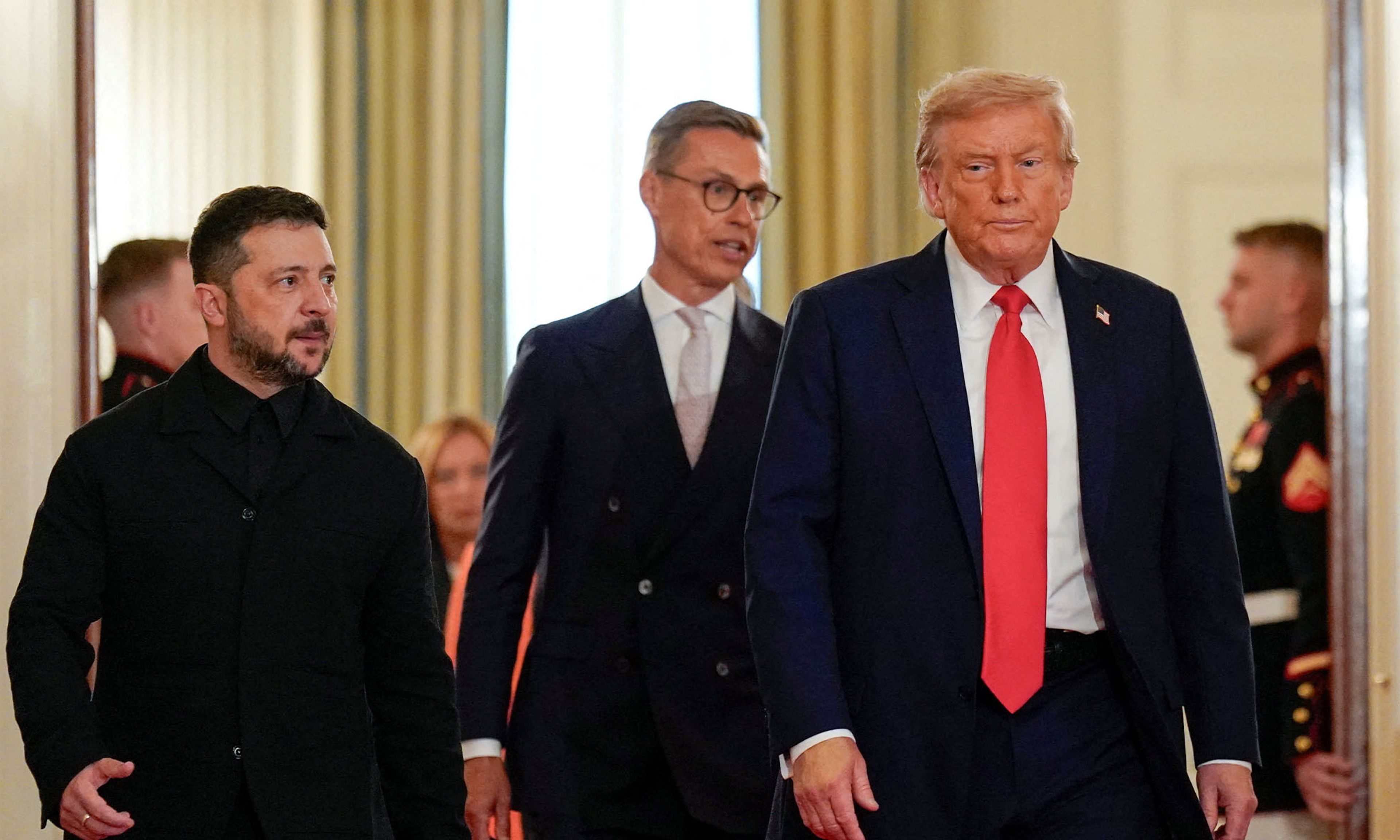
President Donald Trump and Ukrainian President Volodymyr Zelensky walk during a meeting at the White House in Washington, D.C., August 18, 2025.
Dear Weekend Jolter,
You know who was notably quiet during this week’s White House gaggle with Volodymyr Zelensky? Vice President JD Vance.
The veep’s subdued presence before the cameras as compared with his active role escalating a diplomatic blow-up back in February was one sign that, just maybe, the Trump administration is indeed committed to seeking a peace deal that doesn’t leave Ukraine to the wolves (or bear).
Among the many big questions is what kind of security guarantees President Trump is entertaining, realistically.
“Would Trump really now dangle such a significant change in his position — the change that is most coveted by the Ukrainians — in order to get them to agree to land swaps with Russia and a cease-fire?” Mark Wright asks. “The devil will be in the details of course.”
Special envoy Steve Witkoff has described what's now being discussed as including “Article 5-like language” covering a security guarantee, which would be . . . significant. At the same time, by the morning after the Zelensky meeting, Trump was insisting to Fox News that there won’t be boots on the ground in Ukraine: “You have my assurance.”
NR’s editorial calls talk of a NATO-like guarantee a “pipe dream” (Noah Rothman voices other concerns), describing any plan as likely to involve an offer of some sort of air support, short of Americans on the ground. Trump nevertheless appears serious about a deal, judging by the presence in Washington on Monday of top European leaders -- and the push for future meetings with Zelensky and Vladimir Putin, and eventually Trump.
Jim Geraghty puts the developments of the past week in perspective; on the security guarantees, he writes:
If this comes to pass, it will be one of the biggest game-changers to the region imaginable, an outcome that is not just good enough for the remaining 80 percent of Ukraine that is independent, but one that would effectively shut off the possibility of further Russian aggression in the long term. In fact, because this is such a huge win for Ukraine, it’s fair to wonder if it will come to pass, or what the catch is.
There was, in fact, a catch. It now turns out that Russia says it wants veto power over any such support ("a bit like the criminal saying he will abide by the law if he can be his own judge,” Gregory W. Slayton writes). Still, Jim challenges the received wisdom that Russia can endure endless casualties, and wonders “if Putin is looking for a way to end the war and spin it as a glorious victory.”
Much (more) can yet go wrong. The Russian leader did appear to emerge from the initial Anchorage summit with more spring in his step than Trump, as Mark observed at the time. And, of course, it is far from clear whether all parties can agree to terms, or want to. NR’s editorial, with the last words:
There is now talk of three-way talks between Trump, Zelensky, and Putin, but would they, by themselves, be enough to persuade Putin to push the pause button on a war of attrition he believes he can win? It seems unlikely.
In the end, while the closer understanding between the U.S. on the one side and Ukraine and Europe on the other is a relief, we have yet to see how it will hold up when the extent of the chasm between Russia and Ukraine again becomes apparent to an American president still chasing the will-o’-the-wisp of a quick peace.
Trump’s efforts to come to a deal are welcome, and should be pursued, but the best hope of bringing a halt to the fighting on an even remotely acceptable basis is for Putin to be convinced that victory, or even significant additional territorial gains, are beyond his grasp for now — at least at a cost that he is prepared to pay. For that to happen, sanctions will have to be tightened further, and Europe and the U.S. will have to keep supplying Ukraine with the support it needs.
NAME. RANK. LINK.
EDITORIALS
A reality check for Trump’s mail-in voting rant: Presidents Don’t Run Our Elections
The federal government should mind its own business: The Government Shouldn’t Get into the Chip Business
Enough already: The Persecution of the Little Sisters of the Poor
ARTICLES
Audrey Fahlberg: ‘Blackmail’ Accusations and Awkward Phone Calls: A Summer of Tension on the Virginia GOP Ticket
Audrey Fahlberg: Inside California Republicans’ Strategy to Fight Gavin Newsom’s Redistricting Effort
Andrew McCarthy: The Trump DOJ’s Embarrassing Letter in the Tariff Case
Andrew McCarthy: Trump DOJ Has FBI Search John Bolton’s Home
John Noonan: How the U.S. Can Make the Most of a Defense-Spending Boom
Christian Schneider: Mark Twain Is Still Mocking His Critics
Philip Klein: Israel Isn’t a Danger to Jews — Jew Haters Are
John R. Puri: How American Students Were Lured to China to Put on a Propaganda Concert for the CCP
Jeffrey Blehar: The Disappearing Democratic Party Voter
Michael Brendan Dougherty: Irish Too Good to Serve Each Other
Becket Adams: The Left Can’t Stop Self-Destructing
Brittany Bernstein: Five Years On, Ex-Washington Post Fact-Checker Finally Apologizes for Covid-Origins Failure
Charles C. W. Cooke: Why They Want You to Think Feudalism Is Bad
CAPITAL MATTERS
The winds are shifting in South America. Dominic Pino, on Bolivia’s election: Bolivia Is Fed Up with Socialism
LIGHTS. CAMERA. REVIEW.
Brian Allen goes (mid)West, and hits up the Kohler Arts Center. Whatever you do, don’t miss the restrooms: Who Knew Sheboygan Is an Art Mecca?
Armond White, on lockdown soft-pedaling: Suspended Time: A Privileged History of Covid
FROM THE NEW, OCTOBER 2025 ISSUE OF NR
Noah Rothman: The New Generation of Urban Radicals
Abigail Anthony: What Young Hungarians Really Think About Viktor Orbán
Frederick M. Hess: The Southern Surge in Education
Kayla Bartsch: The Tulsa Honors College: A Cautionary Tale
Charles C. W. Cooke: Southern Comfort: Finding the Flip Side of Tacky in Tennessee
SWIPE UP FOR EXCERPTS
The new issue of NR is out, and it’s a special edition on education. Thumb through it here. But to start, let’s turn things over to Noah Rothman, for an update on the march of the radicals:
Zohran Mamdani, New York City’s Democratic nominee for mayor, claims that he confessed his sympathies for “democratic socialism” only after Senator Bernie Sanders’s unsuccessful presidential bid in 2016 gave him the confidence to do so. If he is being honest about this, he has taken to his philosophy with the convert’s zeal.
On paper, Mamdani’s economic plans are about as sound as the business model for the blood-testing start-up Theranos. Since his first election to New York’s State Assembly, Mamdani sponsored legislation that would make New York City buses “free” — by which he means funded by extracting even more wealth from the city’s already fleeing tax base. He has backed reforms that would expand rent freezes, which would increase the commercial pressure that has already made construction an unprofitable pursuit and truncated the city’s housing supply. He has backed the creation of state-run grocery stores as an alternative to market-based grocers. The municipalities that have tried them found they only absorb great sums of taxpayer funds while providing consumers with substandard products and shortages. He sees wealth creation as a zero-sum game. Hence, Mamdani’s recent profession that “I don’t think we should have billionaires” (in New York or elsewhere). Mamdani seems earnest in his desire to push wealthy city residents out by boosting punitive taxes on individuals and corporations, which would “increase quality of life for everyone.” Somehow.
“We need to abolish private insurance, institute single-payer, [and] nationalize the medical supply chain immediately,” the candidate stressed at the outset of the Covid pandemic. Paraphrasing Marx, Mamdani summarized his philosophy as “each according to their need, each according to their ability.” At the tender age of 29, the wide-eyed mayoral candidate endorsed unreconstructed Leninism, calling for the exacerbation of “class consciousness” with the “end goal” of fomenting a putsch aimed at “seizing the means of production.”
These are all sources of grave concern given Mamdani’s likely imminent accession to Gracie Mansion. Or, at least, they should be. But the mayoral candidate’s outlook on crime and justice may be the most disquieting. Mamdani’s defenders are quick to note that the candidate has evolved from 2020, when he found himself swept up in the progressive enthusiasm for a social contract in which police were written out of the equation. Yet neither Mamdani nor his allies retail a convincing conversion narrative. One could be forgiven for thinking the candidate’s change of heart was little more than pragmatic compromise with political reality. After all, his rhetorical record speaks for itself.
“Violence is an artificial construction,” Mamdani told supporters at a rally outside a New York City courthouse. “What is happening here with these district attorneys,” he continued, “that is violence.” New Yorkers “don’t need an investigation to know that the NYPD is racist, anti-queer, [and] a major threat to public safety,” he wrote. “There is no negotiating with an institution this wicked [and] corrupt. Defund it. Dismantle it. End the cycle of violence.”
In April, the New York Times soft-pedaled Mamdani’s stance on police reform, as elaborated in his campaign’s 17-page white paper on public safety. Mamdani still sees “a critical role” for police, but he would also “eliminate the Police Department’s huge overtime budget” and disband “a unit known as the Strategic Response Group that responds to protests.” In addition, Mamdani would establish a “Department of Community Safety,” which would deploy “mental health teams” to “respond to 911 calls.”
Mamdani’s rise to the forefront of Democratic politics in America’s largest city might be written off as a historical accident — the culmination of a series of unfortunate events that pitted him against a corrupt and unloved Democrat-turned-independent incumbent mayor and a disgraced former governor. But the candidate’s success also represents a repudiation of the accumulated wisdom Democrats gleaned from their failures over the course of this decade. That repudiation isn’t limited to New York City.
All is not well on the Virginia GOP ticket this year. Audrey Fahlberg reports:
On June 18, Virginia Republicans’ 2025 lieutenant gubernatorial nominee John Reid dialed up his party’s gubernatorial nominee, Lieutenant Governor Winsome Earle-Sears, to try and smooth things over.
The pair hadn’t spoken since April, when Virginia Governor Glenn Youngkin phoned Reid — a Richmond talk radio host and the state’s first openly gay statewide nominee — and asked him to suspend his campaign following allegations that he reposted nude photos of men on a Tumblr account years ago that shares his Instagram handle. Reid denies the allegations and has declined to withdraw from the race.
Hence the lieutenant governor nominee’s decision to call Earle-Sears in mid-June to assess how they could “get over the hump, and have everything be good, or as good as it can be,” to unite the ticket. “So, tell me,” Reid said at one point in the private phone call, “what, what — how you see things, certainly for the two of us, at the moment?”
Things went south from there, according to a recording of the call obtained by National Review. Throughout the conversation, whose details were also confirmed by two sources familiar with the matter, Earle-Sears repeatedly dodged Reid’s questions as she expressed her own distrust in Reid, as well as her concern that their conversation was being recorded. Her reluctance to acknowledge their communication problem prompted further pushback from Reid.
“I’ve tried very diligently to be positive about you and the ticket and both in public and private,” Reid said at one point on the call. “But I’m not going to lie and act like everything’s been hunky-dory. It’s been eight weeks since we’ve spoken. I’m puzzled about that. I don’t know why that is.”
The tense private conversation comes as no surprise to Virginia Republicans, who secured their three statewide candidates in April but whose ticket did not appear on the same stage together until July 1. Earle-Sears backers point to a joint local radio appearance between her and Reid last week as proof that the ticket is now rowing in the same direction following a mid-July staff shake-up on the gubernatorial nominee’s campaign team, which has seen high consultant and staff turnover in recent years. And following an inquiry from National Review for this story, both Reid and Earle-Sears made a show of sharing a joint social media video on Saturday with both candidates holding a campaign sign bearing all three statewide GOP candidates’ names. The three statewide GOP candidates also now share a joint field program.
But for months, the ticket has been rocked by bad headline after bad headline focused on the explicit photo allegations and the intra-party drama that followed.
And the mid-summer tensions between Reid — who became the default nominee in late April after his primary opponent, Fairfax County Supervisor Pat Herrity, withdrew for health reasons — and Earle-Sears is just one of many issues worrying Old Dominion Republicans ahead of this fall’s elections. . . .
Three months out from Election Day, many Republican operatives are feeling bearish about the party’s chances of keeping all three statewide offices in November, let alone flipping Democrats’ 51–49 majority in the House of Delegates.
John Puri tells the incredible story of a Midwestern school choir that was brought to China to perform for the CCP. Read the whole thing:
In May, a Des Moines, Iowa, businessman named Luca Berrone reached out to a local high school gospel choir with a once-in-a-lifetime opportunity. Berrone told the director that his choir, called Bridges 2 Harmony, had been invited to perform with “a symposium of choirs from around the world” in Shijiazhuang, a city in southern China, in mid-July.
The invitation seemed plausible, as Shijiazhuang had been linked to Des Moines for decades as one of its “Sister Cities.” Members of the choir, most of whom were under 18 and had never traveled internationally, were thrilled to hear they were headed to China.
In a meeting with the students’ families less than a month later, Berrone told parents that the nature of the trip had transformed, an attendee told NR. The choir would now be skipping the first part of the symposium in Shijiazhuang. Instead, they would fly into Beijing and stay in China’s capital. The choir was to give three performances for high-level representatives of the Chinese government, including President Xi Jinping and his wife. (In the end, Xi himself did not attend the concert, though his wife did.)
Berrone told parents that the Des Moines choir would be the “highlight of the entire symposium.” Their children’s presence in Beijing was to be widely publicized in Chinese media. Nowhere on the itinerary he provided did it mention an “international choir symposium,” which was initially presented as the purpose of the trip.
All in-country trip expenses — meals, hotels, transportation, tourist site visits — were being paid for by a Chinese foreign affairs organization, the Chinese People’s Association for Friendship with Foreign Countries, or CPAFFC. Airfare would be covered by the Chinese government. CPAFFC staff, as well as Berrone, would escort the choir throughout their stay.
CODA
How about a deep track from Deep Purple? Their debut album is a strange, strange trip, but aside from the radio hit “Hush” it does contain other highlights -- “Mandrake Root” among them. Enjoy. And catch you soon.

About the Author
Judson Berger is the managing editor of National Review Online.
Featured Tags
Advertisement
Advertisement
Comments