Share this story
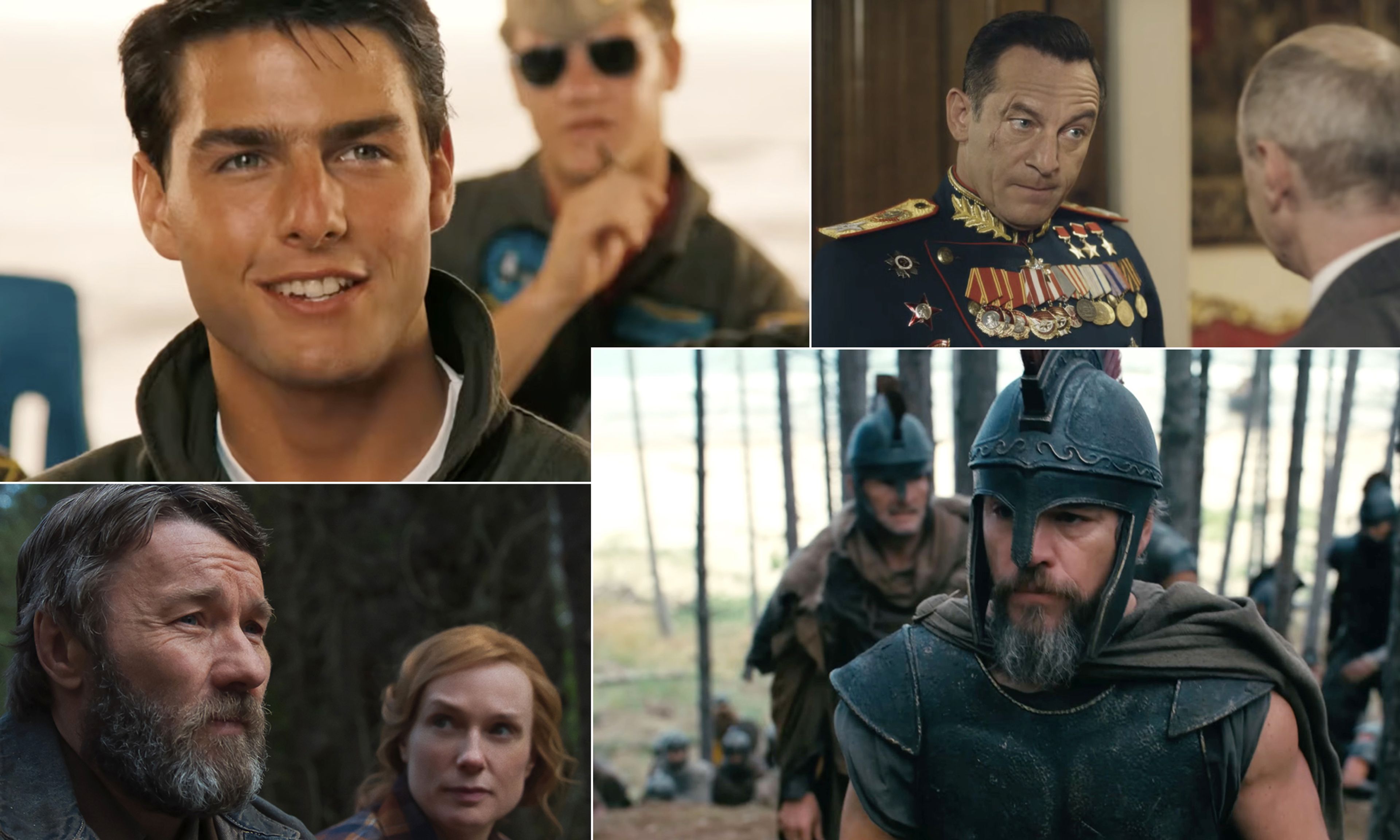
Clockwise from top left: <i>Top Gun</i>, <i>The Death of Stalin</i>, <i>The Odyssey</i>, and <i>Train Dreams</i>
The right side of Twitter spent the morning after Super Bowl LX trying very hard not to say something obvious. Bad Bunny had just headlined the halftime show. Turning Point USA, to its genuine credit and after the year it has endured — including the assassination of its founder followed by the torment of conspiracy theories by she-who-shall-not-be-beetlejuiced — organized an alternative.
In a since-deleted Instagram post, country singer Zach Bryan called the All-American Halftime Show “embarrassing as hell and the most cringe s*** on the planet.” He was dragged for it, but the critique struck a nerve. The contrast of Kid Rock’s performance with the NFL’s choreographed spectacle ignited a broader argument about conservative art, or rather its conspicuous absence, which drifted, as these debates always do, toward Hollywood. The argument presumed its own conclusion: that such a thing as a conservative movie exists, that Tinseltown refuses to make them, and that we’d recognize one if they did. None of those things are as obvious as they sound.
The "conservative movie" label arrives preloaded with the wrong questions, demanding both too much and too little of the world's most popular art form. Too much, because it asks cinema to do the work of a campaign ad: to win an argument and move a vote. Too little, because it flattens the hundreds of technical and expressive decisions that make a film into a single ideological verdict. It also sells conservatism short, reducing a tradition that gave the West much of its aesthetic vocabulary to a cable news chyron.
William F. Buckley Jr. once faced a similar challenge. In an essay titled, with perfect self-awareness, “Notes Towards an Empirical Definition of Conservatism: Reluctantly and Apologetically Given,” he resisted reducing centuries of wisdom to a sound bite. “I could not give you a definition of Christianity in one sentence,” he wrote, “but that does not mean that Christianity is undefinable.” He then defined it largely through subtraction — not the Randians, not the Birchers, not the anarcho-libertarians. Let us take a similar approach.
A distinction Whittaker Chambers would have appreciated makes a fine starting point. There is a difference between a conservative and a reactionary. The former asks what is worth preserving and handing down to the next generation, what goods the present age has inherited and must steward against an era that mistakes novelty for progress. The latter defines himself by opposition; he is whoever the other side is not. Conservatism, as Roger Scruton explained, is an expression of oikophilia, love of home, gratitude for the familiar, for the particular place and people one has inherited. Reaction begins with a grievance. Confusing them has cost the right more than it knows.
Asking whether a film is "woke" — a term whose definition shifts so reliably with the news cycle that it has become useless as criticism — is the wrong test entirely. We don't know if Lupita Nyong'o has even been cast as Helen of Troy in Christopher Nolan's The Odyssey, but the mere possibility launched a thousand memes. Suppose Nolan honors the poem's moral architecture: the homecoming, the cost of long absence, what a man owes his family. Would any of that be undone by his choosing an award-winning black actress to play a fictional character? A reactionary frets over such pettiness. A conservative asks what the film believes about Odysseus's journey.
Applied consistently, the same test would impoverish both conservatism and cinema. Are we to write off Boyz n the Hood — one of cinema's most searching portraits of fatherhood — because John Singleton took the legacy of racial injustice seriously? A conservatism worth defending is confident enough to grapple with ideas that challenge it.
The politics behind the camera settle little, with examples in both directions. Luchino Visconti was an Italian Marxist who gave us The Leopard, one of cinema's greatest films and most Burkean laments. Angel Studios, a faith-and-family outfit, produced a Mother Cabrini biopic that was so spiritually neutered you would never understand why the first American canonized by the Vatican was more than just a do-gooder.
Culture-war theatrics are no more reliable. Contrast the God's Not Dead franchise with The Death of Stalin. The former offers a kind of Manichean view of human nature: The faithful are blameless while the secularists are irredeemable. Armando Iannucci, hardly a man of the right, knows better: Every character in his savage satire of Soviet communism is self-serving, compromised, and capable of evil. Ironically, a lapsed Catholic has a more orthodox view of human nature than a production company built on Christian apologetics.
A right-coded milieu offers no firmer ground. Tony Scott’s Top Gun straps you into a cockpit for a two-hour celebration of boomer liberalism: the lone maverick who defies institutional authority and wins through charisma rather than discipline, hierarchy, or the habits of a well-ordered soul. It’s great fun, of course. Just don’t mistake it for an expression of our sensibility.
Behind all these shortcuts is a conflation. One that, judging by the left-wing outrage at Wim Wenders's refusal to chime in on Gaza, is not unique to the right. Nearly every film touches on society and human relations, which makes cinema political in the broadest sense. But that is very different from taking sides in particular political divisions. American partisan politics is a tableau of platforms, interests, coalitions, votes. The best art operates upstream from that, shaping the heart before reason governs the mind. A River Runs Through It never proffers an EPA regulation — Robert Redford makes you fall in love with Montana. The rest is up to you.
This confusion has left the right culturally impotent at the very moment of its greatest political power in a generation. The ongoing regulatory battle over whether Netflix or the more Trump-friendly Paramount acquires Warner Bros. is the purest expression of the problem. The Heritage Foundation distributed a report branding the streaming giant as “the biggest political and ideological messaging machine in human history.”
An overview of the rival studios' 2025 slates complicates this narrative. Both operate at roughly the same center-left metabolic resting rate that defines much of Hollywood, but if we're being honest, Netflix had more to offer conservatives. Its best picture nominee, Train Dreams, is a portrait of the stoic, anonymous men who built this country and what it cost them. Nonnas is a celebration of a son keeping his mother’s memory alive through her recipes. Blue-collar guys find brotherhood through communal song at a neighborhood dive bar in the Oscar-nominated short The Singers. Together they engaged the conservative imagination more fully than anything Paramount released last year. It turns out that a studio executive’s place in the Mar-a-Lago buffet line is about as useful as a horoscope in predicting his films’ philosophical disposition.
Whom a film alienates is another poor proxy. Ari Aster’s Eddington was last year’s most politically interesting American movie, and it would have been an awards season contender had it not committed the unpardonable sin of finding progressive pieties as absurd as right-wing conspiracy theories. Set in a small New Mexico town at the height of the pandemic, it lingered long enough on white teenagers mouthing BLM talking points they learned that morning to impress girls that the New York Times’ chief film critic yelled “f*** you Ari Aster!” on a podcast.
But that's an anecdote, not a credential. Where a film rooted in conservative thought would mourn the collapse of something worth preserving — mourning requires first believing the lost thing had genuine worth — Eddington is nihilistic. Everything is rotten in its view. It is a damn good movie. It is not a conservative one.
After considerable clearing of underbrush, we can answer the question in the title of this essay. The better measure is not whether a film is conservative but whether it speaks to the preoccupations at the heart of the conservative imagination. Does it begin with a tragic view of human nature, understanding that darkness is interior as well as circumstantial? Does it treat inherited goods — family, order, faith, the transmission of civilization across generations — with the gravity they deserve, understanding that liberty depends on them? Does it stir gratitude for the Permanent Things? These are the questions worth asking.
We see them grappled with in A Man for All Seasons, when Thomas More (Paul Scofield) tells his accusers: “I am the King’s good servant, but God’s first.” Groundhog Day presents an Aristotelian argument through Phil Connors (Bill Murray): that virtue is discipline acquired through the unglamorous work of becoming someone worth being. In The Exorcist, Chris MacNeil (Ellen Burstyn) watches as doctors exhaust every materialist explanation for her daughter’s condition and is left with the truth that some things lie beyond the physical world. None of these were made by Republicans, yet all of them speak to what animates conservatism.
Films that engage these concerns most fully might fairly be called conservative. The label is best worn like Don Johnson's white blazer, not a straitjacket. What I'm ultimately offering here is a lens, an invitation to engage with films across genres, decades, and political sensibilities — including ones being made right now — that have much more to say to us than we have allowed ourselves to believe.
The only admission ticket required: Ask whether a film makes you feel that truth, goodness, and beauty are worth defending — not just whether it would vote the way you do. Better questions make for better criticism. They make for better conservatism. And if enough people on the right start asking them, we might just make better art.

About the Author
A veteran of political campaigns, Giancarlo Sopo is a cultural writer exploring the intersection of cinema, politics, and the conservative imagination. In addition to National Review, his commentary on culture, aesthetics, and public life has been featured in IndieWire, the New York Times, and CNN. Follow him on X (@giancarlosopo) and Letterboxd.
Featured Tags
Advertisement
Advertisement
Comments