Share this story
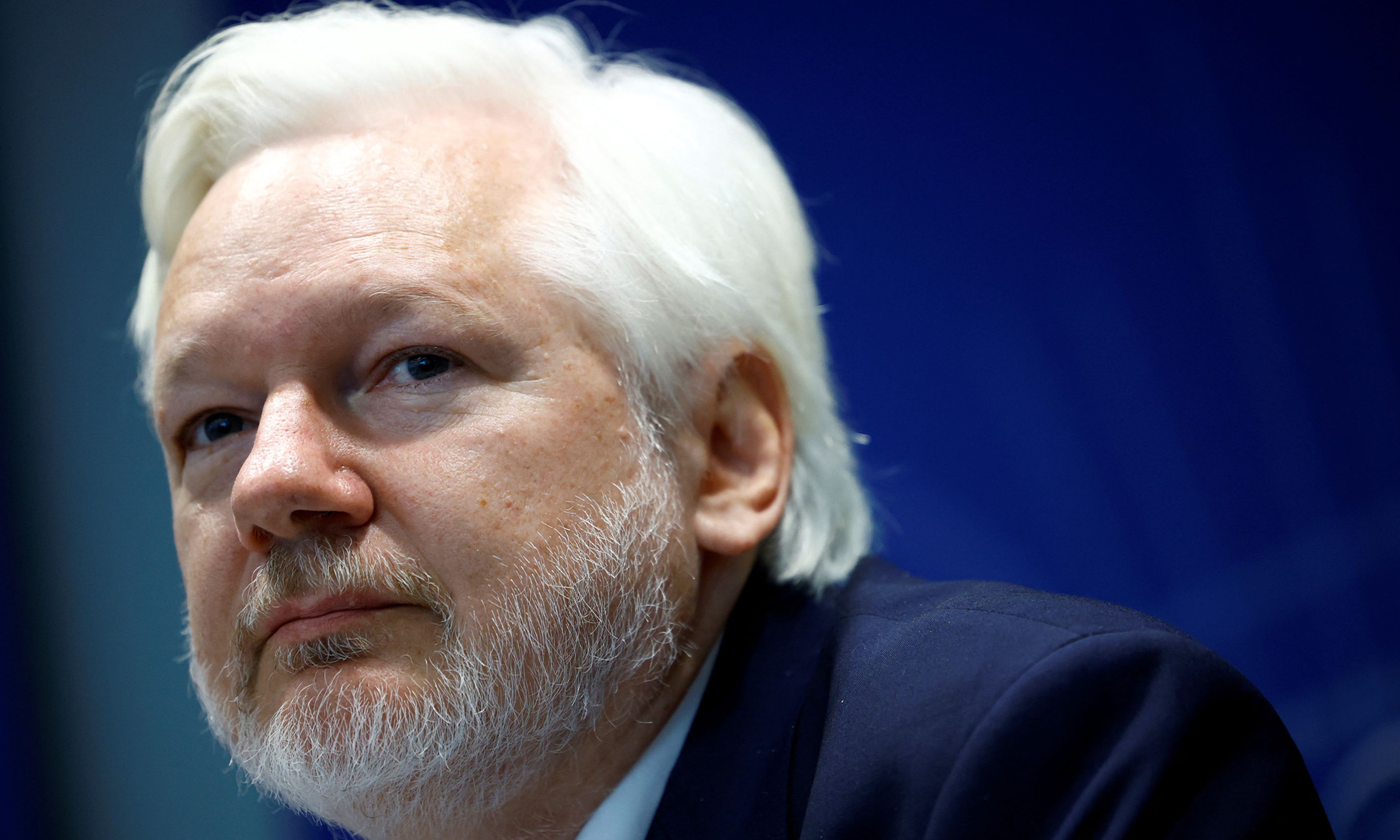
WikiLeaks founder Julian Assange attends a hearing before the Parliamentary Assembly of the Council of Europe in Strasbourg, France, October 1, 2024.
I am very grateful for the public support I received from a number of people in connection with the Saturday night contretemps to which I responded at length on Monday. I especially appreciate the backing of my friend Eli Lake, not just because he was among the most perspicacious journalists in reporting on Russiagate and the Mueller probe but because defending me got him into a couple of tussles of his own -- nothing he couldn’t handle but I’m sorry he had to make the effort.
In that connection, one subject that arose was the case of Julian Assange. I wanted to discuss Assange in recounting my deconstruction of the Mueller probe, but the piece was already too long. The Bulwark’s Cathy Young, in continuing the effort to prop up the discredited Trump-Russia collusion tale, pointed out that, in the run-up to the 2016 election, Trump’s wacky adviser Roger Stone solicited potential derogatory information about Trump’s opponent, Hillary Clinton, from Assange’s WikiLeaks. As Eli point out in response, Assange had publicly (albeit dubiously) suggested he had such information, so there was no proof of any cyberespionage conspiracy -- just of an unscrupulous political operative doing what unscrupulous political operatives do. I’d add that, in essence, Stone was doing what the Clinton campaign did in commissioning faux intelligence reports from former British spy Christopher Steele: turning to a foreign source for dirt of questionable provenance on a political rival.
But that’s not the half of it. I think the collusion claims are conclusively bogus, no small thanks to Robert Mueller’s probe, which tried very hard but finally acknowledged the case could not be proved. But if I were trying to revive the collusion allegations, the last places I’d turn would be the Stone and Assange prosecutions.
As I did observe in the piece, the Mueller probe's staff’s most insidious tactic was the conjuring of fever dreams: narrative indictments and complaints with pages and pages of heavy breathing that insinuated Trump-Russia collaboration; but if you waded through it and got to the end, you found no collusion-based charges -- usually just process crimes (false statements, obstruction, and the like). I wrote at the time that Stone was Exhibit A of this genre.
But the dog that didn’t bark in the Mueller probe was Assange.
The Justice Department made energetic efforts to extradite Assange from England to face prosecution in the United States. As I explained at the time, British extradition is an arduous process. It requires a foreign government to make a compelling case that there is proof that the defendant committed serious criminal offenses. What could be more serious than what we were told for years in connection with Russiagate? To wit, the Kremlin orchestrated a cyberespionage conspiracy to swing the outcome of the 2016 election to Trump, and its main partner in the endeavor was Assange. Plus, if the Justice Department fails to include charges when it extradites a defendant, various legal rules can bar it from adding such charges once the defendant arrives in the United States.
But Assange was never charged with an offense related to Russian cyberespionage, in connection with the 2016 election or anything else. Instead, the DOJ charged an entirely unrelated crime: Assange’s conspiracy with Bradley Manning (now known as “Chelsea”), a former intelligence analyst for the U.S. Army who embezzled classified defense secrets. And finally, after being released from custody in London in 2024, Assange was permitted by the Biden DOJ to settle the case by pleading guilty (in the Northern Mariana Islands) to one count of conspiring to obtain and disclose the information from Manning. He was sentenced to time served and the case is closed -- no collusion prosecution . . . ever.
How could the central figure in the collusion caper not be charged with what we were told was the most serious crime in modern history -- a traitorous conspiracy on Donald Trump’s part if it had happened and if prosecutors could connect him to it?
Because, as I illustrated in sundry ways over several years, Mueller couldn’t prove the case.
If Assange had been charged with Russian cyberespionage, he’d have denied that Russia was WikiLeaks’ source for the Democratic National Committee emails. (And to repeat, Hillary Clinton was not implicated in any wrongdoing in the DNC emails, in which she barely appeared, so it was always inane to suggest that the DNC hack could swing the election -- regardless of whether the Kremlin was responsible.) Consequently, Mueller’s prosecutors would have to have proved beyond a reasonable doubt that Russia carried out the DNC hack. But the DNC had declined to voluntarily surrender its servers, and the Obama DOJ and FBI made no effort to compel their production for forensic examination. Federal investigators relied instead on testing done by a DNC contractor, CrowdStrike. Of course a DNC contractor would be powerfully motivated to render findings implicating Russia, knowing that would hurt Trump; but more importantly, CrowdStrike ultimately admitted that it could not prove that Russia was the culprit.
Moreover, to repeat what I began saying in 2017 and reiterated on Monday:
When Mueller announced his two ballyhooed indictments of Russian actors, I scoffed that these were mere press releases that his staff hoped would end any questions about Russia’s conduct. Knowing they couldn’t prove their allegations, prosecutors made them anyway, in the expectation that they’d never have to prove their case in court because Putin would never extradite the defendants. I was proved right when Mueller made the mistake of indicting a Russian company — unlike the Russian people he’d charged, the Russian company didn’t have to worry about being thrown in jail or financially crippled. When the company demanded discovery and its day in court, Team Mueller reeled, first claiming they couldn’t make discovery because of national security concerns (something prosecutors who indict a case they expect to try know they can’t get away with), and finally dismissing the indictment in order to avoid the humiliation of a certain acquittal.
To be clear, it’s entirely possible that U.S. intelligence agencies were correct in assessing that Russia meddled in the 2016 election. (As I’ve said repeatedly, Russia has been meddling in American politics for decades, just as our spy agencies have meddled in Russian politics.) And there is circumstantial evidence going back to the Obama era that Russia regarded WikiLeaks as a useful anti-American operation -- though the proof that Assange was a willful agent of Russia (as opposed to an operative whose agenda aligned with Russia’s) is sketchier.
Nevertheless, though it alleged that Russia conducted cyberespionage in connection with the 2016 election, Team Mueller never established that proposition and shied away from cases in which prosecutors would have had to prove their allegations. And those prosecutors never came close to establishing that Trump was complicit in what (they didn’t prove) Russia was up to.

About the Author
Andrew C. McCarthy is a senior fellow at National Review Institute, an NR contributing editor, and author of Ball of Collusion: The Plot to Rig an Election and Destroy a Presidency.
Featured Tags
Advertisement
Advertisement
Comments