Share this story
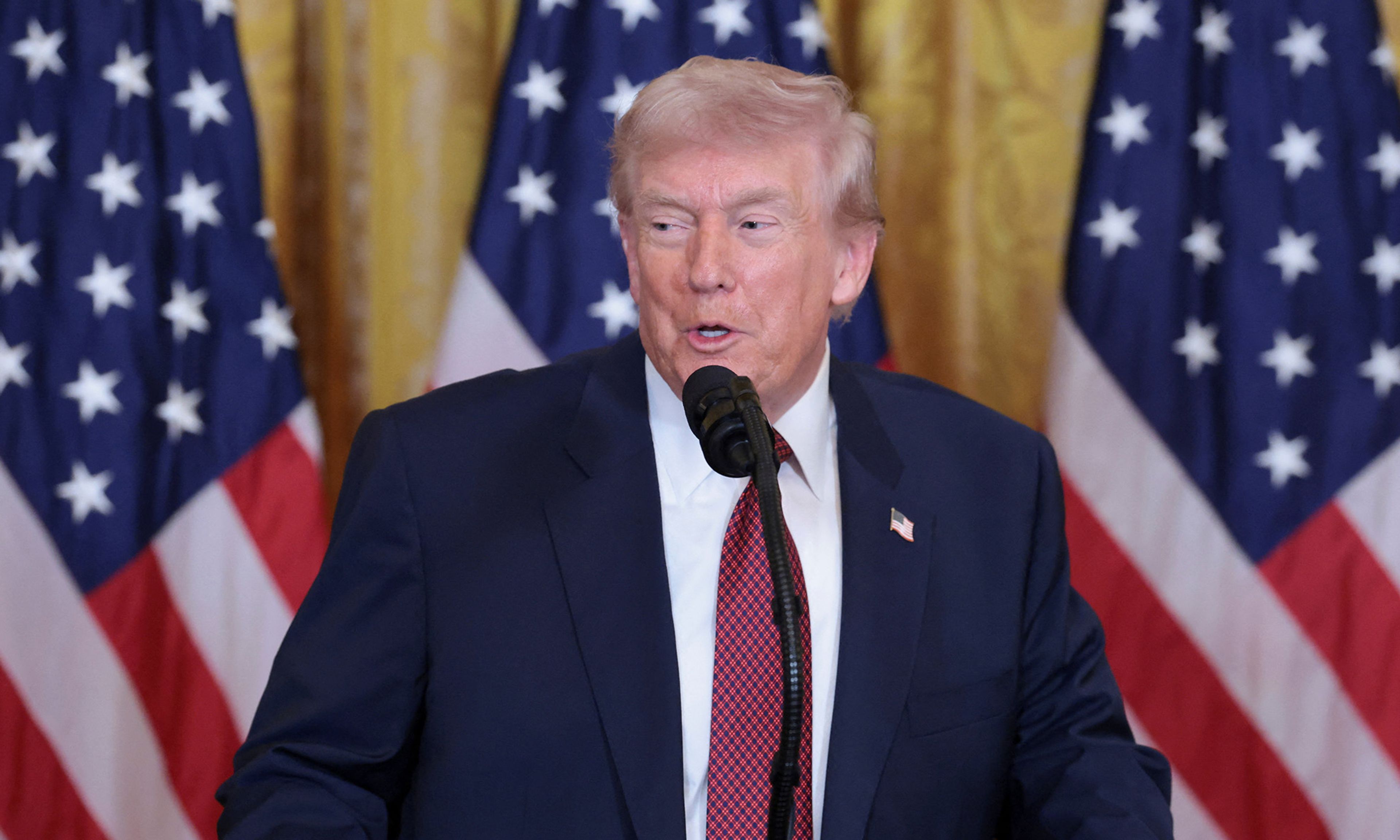
President Donald Trump speaks as he hosts an event promoting coal-powered energy sources in the East Room at the White House in Washington, D.C., February 11, 2026.
At the conclusion of my five-part series on the crypto saga entangling President Donald Trump, the United Arab Emirates, and the Binance cryptocurrency exchange (whose founder, Changpeng Zhao, Trump pardoned for money laundering crimes), I addressed the president’s net worth, which Forbes reported in September 2025, had increased by $3 billion during the first year of his presidency. And note: That was before the Wall Street Journal’s recent revelation that the UAE had secretly invested $500 million in the Trump-Witkoff crypto enterprise, close to 80 percent of which was slated to go to the Trump family.
A few more observations about the president’s wealth.
In reporting by Forbes, Bloomberg, and others who watch such things closely, the net worth of the president, who has been a celebrity for decades, has rarely been stable. Surges and plunges have been a feature of the past three years, and we’ve covered the reasons why.
The Trump organization began (with the president’s father) as a real estate development business; but has long since evolved into a branding business. The Trump organization still holds significant real estate, but it has also been convicted of New York State felony tax and fraud charges. Moreover, although the outrageous disgorgement fine of nearly $500 million (when interest is factored in) was thrown out on the appeal of the civil fraud judgment in the case brought against Trump by State Attorney General Letitia James, the appellate division left in place the liability finding (that Trump had committed fraud by inflating asset values). The court-ordered monitoring of the Trump organization is also still in effect. It makes doing business more complicated. Trump is continuing to appeal.
The branding business is mainly tied to the splashy real estate projects of other developers; hence, the misimpression that Trump is still a major developer himself. Besides that business, the main sources of Trump’s revenue nowadays are his media company and crypto.
I’ve discussed the latter over the past week (though there are still important things to say about, for example, the patent conflict between Trump’s roles as investor and regulator -- especially on legislative proposals now being debated . . . more on that soon). As for the Trump Media and Technology Group, which holds Truth Social (a minor social media platform in the grand scheme of things) and not much else, it makes very little money and posts big losses (nearly $55 million in the third quarter of 2025). The stock hit a high of about $79 per share when Trump fans bid it up after the spring 2024 rollout; but gravity has more than set in: Today, the company (DJT on the Nasdaq ticker) trades at around $11 a share.
Obviously, these three businesses -- the marketing of Trump’s name, a media company whose main value is posts by the president of the United States (i.e., another instance of leveraging of his government power), and sundry ventures in the shady crypto industry -- are volatile. But they lend a logic to what we’re seeing day after day.
Why does the president want his name on everything from the Kennedy Center, weapons systems, and health-care accounts to Grand Central Station, Dulles Airport, and the coming East Wing Ballroom? Because the value of his name for marketing purpose is his signature business. The more prominent American edifices are named in his honor, the more developers around the world will be willing to pay to slap “TRUMP” on luxury hotels, resorts, golf courses, etc., in the years to come.
Why does the president post outlandish, often appalling announcements, cultural commentary, and streams of consciousness on Truth Social? Because the Trump media company’s business is his posts. To the extent the company has value, it is because he draws people to it. He is president of the United States, so even people who don’t want to look have to pay attention. But to entice the willing audience, he has to give them a show . . . and that’s what he does. It’s not very presidential, but it’s the entertainment biz.
And now the president is deeply involved in crypto promotion, development, and regulation because, at least on paper, much of his estimated $6.4 billion fortune is crypto-derived. As I detailed in the series, crypto’s value has crashed several times in the past 15 years (see David Bahnsen’s superb analysis). It recently had another drought in which major cryptocurrencies, such as Bitcoin, dropped 40 to 50 percent in value. If crypto is the basket in which you’ve stored most of your eggs, good luck with that.
Hence, the moving target that is the president’s net worth.
Trump hit a low point in early 2024. He’d been found liable in major civil cases brought by E. Jean Carroll and the aforementioned James, and his organization had been criminally convicted of tax fraud and business records offenses. He was looking at an imminent criminal trial in Manhattan, was under two major federal indictments, and yet another criminal case in Fulton County, Ga. As it happened, the federal cases got derailed, the Georgia case imploded, and the Manhattan case was such a sham it didn’t hurt him politically or financially. And, again, the civil disgorgement penalty was eventually tossed out. But none of that could be known at the time. His financial and political prospects were intertwined with his legal prospects.
In early 2024, Forbes had his net worth at about $2.3 billion. He regained his footing when (a) an appeals court dramatically reduced the bond he’d need to post for the appeal of the civil fraud case, and (b) the merger of his media company -- which had looked for a time like it was going collapse -- was finally consummated. On paper and a surge of enthusiasm, he rose to about $6.5 billion in late March 2024 and topped out at $8 billion seven months later, when his election as president appeared likely.
By the end of 2024, after he’d won the November election, the rally in his media company and crypto holdings crested and ebbed. It is estimated that he was back in the $4 billion range of net worth.
Nine months later, in September 2025, Forbes said that he had raked in $3 billion year in the past year (including his first eight months as a second-term president) and was by then worth $7.3B. The increase was attributed to (a) $2 billion from cryptocurrency ventures (mainly stablecoin, which was rolled out in March and shot up in May with the UAE’s $2 billion purchase -- one of the main subjects of my series of posts); (b) $500 million because the New York appeals court threw out the fine in the civil fraud case; and (c) about $400 million because, after he won the presidency, foreign developers suddenly wanted to do business with his organization. (Naturally, that branding business was dormant while he was being prosecuted and before he won the presidency in 2024.)
Importantly, when the president’s wealth was pegged at $7.3 billion around six months ago, it was not known that the UAE had poured $500 million into the Trump-Witkoff crypto enterprise, of which nearly 80 percent (about $400 million) would go to the Trump family. We just learned that two weeks ago. Presumably, Trump’s net worth back in September was closer to $8 billion.
After the crypto slump and the continued lethargic performance of the Trump media venture, Forbes now estimates that the president is worth $6.3 billion (that’s today . . . so it’s down $100 million since I wrote the last post in the series three days ago). I would note, though (as detailed in the timeline I posted in part 5 of the series), the Trump stablecoin venture (USD1) had a striking increase in value in December and January thanks to promotions by Binance (after Trump pardoned Changpeng Zhao, its founder). And the president is also currently putting his thumb on the scale in favor of the crypto industry in discussions about how thoroughly it will be regulated by the government.
We will have to watch how these initiatives affect the president’s personal bottom line. No doubt, that’s what he’s doing.

About the Author
Andrew C. McCarthy is a senior fellow at National Review Institute, an NR contributing editor, and author of Ball of Collusion: The Plot to Rig an Election and Destroy a Presidency.
Featured Tags
Advertisement
Advertisement

Comments